 echolabs
Medir el azar antes de buscar la mejora
Reproduje la base pública Duck + M2 (24,15 en la clasificación), probé dos piezas de ECHO que no mejoraron y repetí la base para medir el ruido: una mejora tiene que superar unos diez puntos para distinguirse.

Hasta el 18 de octubre mi mejor envío a ARC-AGI-3 en Kaggle tenía 0,11 puntos. Mi propio arnés jugaba en mi PC y solo usaba Kaggle para la inferencia, así que no podía enviarse como solución oficial. Cambié de estrategia: partir del mejor programa abierto y añadirle piezas de ECHO de una en una, midiendo cada pieza contra la base con el mismo modelo, la misma configuración y el mismo presupuesto.
La base es el arnés Duck de Tufa Labs con el parche Milestone 2 de Daniel Franzen (Apache-2.0, 27,89 puntos públicos declarados). El modelo es Qwen3.8-Flash-Next cuantizado a W4A16, con un drafter para decodificación especulativa, servido con SGLang en una RTX PRO 6000 de Kaggle. El notebook corre sin internet. Las piezas de ECHO solo pueden usar observaciones públicas del juego: nada de colores, coordenadas o soluciones de un juego concreto.
Primero, los resultados en gráficas
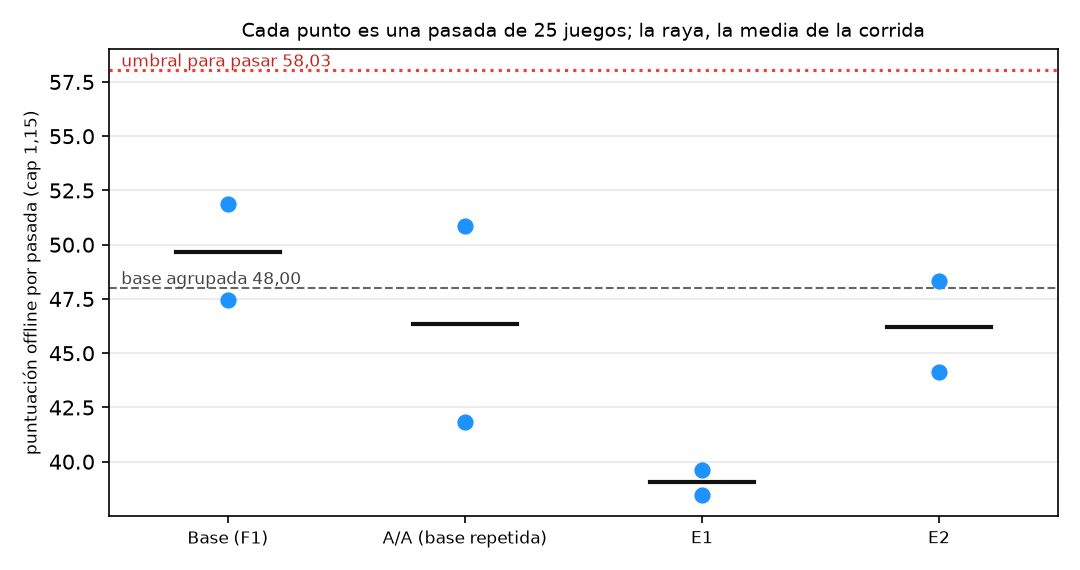
| Corrida (25 juegos × 2 pasadas) | Media (cap 1,15) | Pasadas | Niveles por pasada |
|---|---|---|---|
| Base (F1) | 49,66 | 47,45 / 51,88 | 104 / 108 de 183 |
| A/A (base repetida) | 46,34 | 41,85 / 50,84 | 99 / 109 de 183 |
| E1 | 39,06 | 38,48 / 39,64 | 91 / 96 de 183 |
| E2 | 46,23 | 44,14 / 48,31 | 100 / 104 de 183 |
La puntuación de cada nivel es min(1,15, (acciones humanas / acciones del agente)²), ponderada por nivel; un juego vale como mucho 100. Son los 25 juegos públicos de desarrollo jugados dentro del mismo notebook, no los 110 juegos ocultos de la clasificación.
Cómo mido una mejora
Cada brazo cambia una sola cosa respecto a la base, y lo declaro antes de correrlo. Un brazo pasa si supera la media de la base por más que la banda de ruido y además gana en al menos tantos juegos como pierde. Los resultados negativos se publican igual que los positivos.
Al principio usé como banda la diferencia entre las dos pasadas de la base: 4,42 puntos. Me quedaba corta. El planificador de M2 reparte un solo presupuesto de tokens entre las 50 partidas de una corrida, así que las dos pasadas no son independientes. Por eso repetí la base completa sin tocar nada.
Lo que mostró la repetición
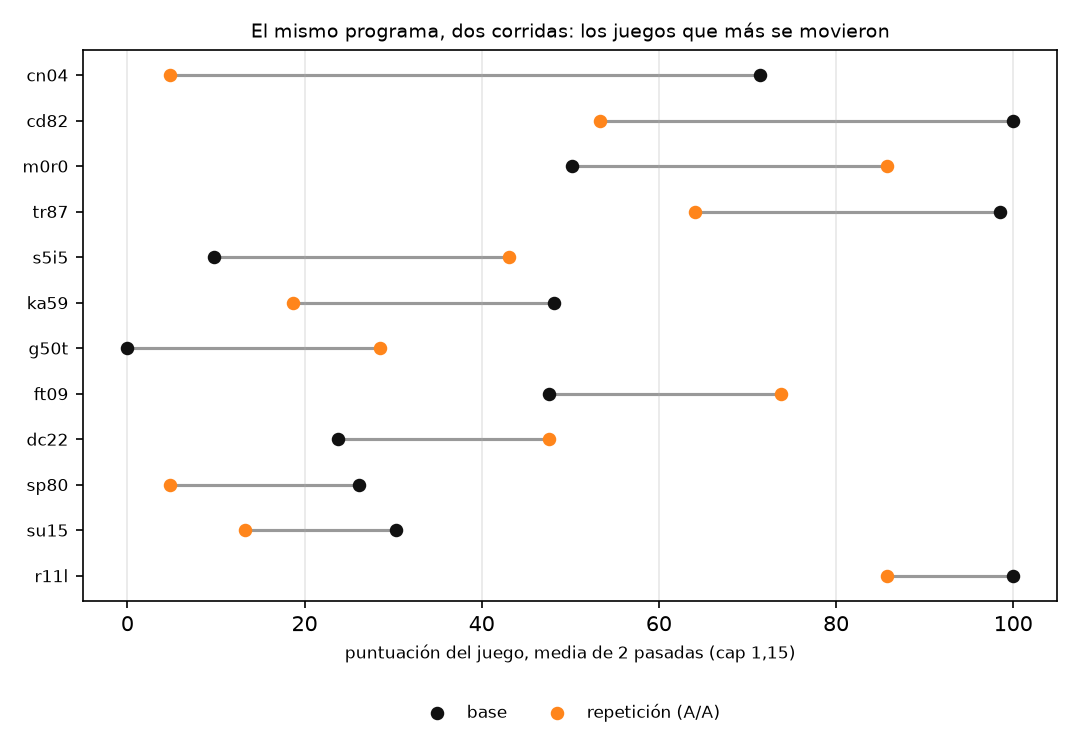
El mismo programa sacó 49,66 la primera vez y 46,34 la segunda. Hubo juegos enteros que se movieron entre 30 y 67 puntos: cn04, cd82, m0r0, s5i5 y tr87. Con las dos corridas juntas, la base vale 48,00 y la banda es 10,03. Para que una pieza cuente como mejora tiene que pasar de 58,03. Con este ruido, una mejora real de tres o cinco puntos no se puede demostrar con cuatro pasadas.
La clasificación pública también tiene azar. Mi primer envío, que en la competición es el mismo programa que el M2 público, sacó 24,15 (puesto 1.557 de 4.495 el 19 de octubre). Franzen declaró 27,89 con el mismo código. Unos 600 equipos están entre 27 y 30 puntos, en buena parte con variantes de ese mismo notebook.
Las dos primeras piezas de ECHO
E1, libro de efectos. Una función effects() en el sandbox del modelo resume qué ha cambiado tras cada acción ya ejecutada. Resultado: 39,06 frente a 48,00. No pasa. El modelo la llamó 16 veces en 3.108 pasos. Sus dos pasadas son las dos más bajas de las ocho de programas tipo base; por azar, eso ocurre con una probabilidad de 1 entre 28. Probablemente perjudicó. No pudieron ser las 16 llamadas, que son muy pocas; sospecho del cambio en el prompt, pero no lo he aislado.
E2, planificador condicionado. Una función echo_plan() que propone secuencias de acciones a partir de los efectos observados. Resultado: 46,23. No pasa. El modelo no la llamó ni una vez en 3.225 pasos, ni la mencionó al razonar. En la práctica, E2 fue la base con un párrafo más en el prompt, y por eso puntuó como su repetición (46,34).
La lección es concreta: este modelo no usa funciones nuevas solo porque el prompt las describa. Si una pieza de ECHO tiene que ayudar, el arnés debe entregarle la información sin que la pida.
E1b: decirle al modelo las consecuencias
E1b no espera a que el modelo pregunte. Después de cada acción, el arnés añade a la salida de la herramienta una línea con lo que hizo esa misma acción las veces anteriores en el mismo nivel. Por ejemplo:
[effects] UP (level 1): n=1 changed=1 | moved N s12 dr-4 dc+0 1/1
[effects] MOUSE@b (level 1): n=1 changed=0 | no interior effect
Como mucho van tres líneas por llamada y 2.000 caracteres por bloque de código. Antes de gastar GPU lo ensayé en seco con las 50 partidas grabadas de la base: habría añadido unas 5.200 líneas (unos 145.000 tokens en toda la corrida), 2.071 caracteres en el peor bloque y ninguna excepción. Ese ensayo mide el coste, no el efecto en el juego. La corrida real está en marcha en Kaggle. Si saca 53 o menos, la doy por no aprobada; si saca más, la repito antes de decidir con cuatro pasadas.
Otras cosas que medí sin GPU
- De los 50,34 puntos que la base deja por el camino en la primera corrida, 49,15 se pierden en niveles que no alcanza y solo 1,19 por usar más acciones que un humano. El margen está en pasar más niveles, no en hacerlo más rápido.
- Un explorador de ECHO en CPU que juega cuando el modelo termina habría añadido entre 0,06 y 0,42 puntos. No compensa la GPU.
- Borrar del historial los intentos de código fallidos antiguos: son el 2,5 % del contexto. M2 ya expulsa historial viejo.
- Filtrar clics fuera de la rejilla: 0 de 3.008 clics caían fuera. M2 ya bloquea repetir acciones sin efecto o mortales en el mismo estado.
Evolución
| Fecha | Paso | Resultado |
|---|---|---|
| 25 sep | Primer envío con mi agente anterior | 0,11 públicos |
| 18 oct | F0: notebook propio a partir de M2, herramientas de lectura y comparación, prueba en CPU con un modelo simulado | listo para GPU |
| 18 oct | F1: base Duck + M2 en Kaggle | 49,66 offline · 24,15 públicos |
| 18–19 oct | E1: libro de efectos | 39,06 · no pasa |
| 19 oct | E2: planificador condicionado | 46,23 · no pasa |
| 19 oct | Repetición de la base (A/A) | 46,34 · banda 10,03 |
| 19 oct | E1b: consecuencias entregadas por el arnés | en curso |
Roadmap
- Hecho. Reproducir la base pública y enviarla: 24,15.
- Hecho. Probar E1 y E2 con comparación pareada: no pasan.
- Hecho. Medir el ruido entre corridas con una repetición de la base: banda 10,03.
- Hecho. Preparar E1b en CPU: pruebas, contrato con un modelo simulado y ensayo en seco con partidas grabadas.
- En curso. E1b en Kaggle: primera corrida de 25 juegos × 2 pasadas.
- En curso. Puntuación pública del envío de E2, para medir el azar de la clasificación.
- Pendiente. Si E1b supera 53: segunda corrida y veredicto con cuatro pasadas.
- Pendiente. Si queda cuota de GPU: otra pieza empujada por el arnés, como la identidad persistente de objetos.
- Pendiente. Del 29 al 31 de octubre: congelar dos candidatas, copiar las entradas de terceros a versiones fijas, verificarlas con una corrida corta y elegir los dos envíos finales antes del 1 de noviembre.
- Pendiente. 9 de noviembre: informe para el premio de artículos, con resultados positivos y negativos.
Repeticiones y log de pensamiento
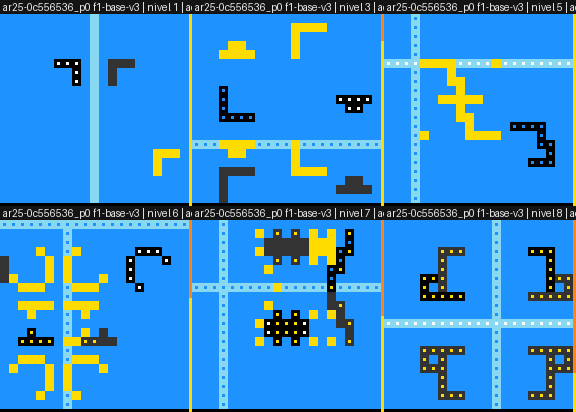
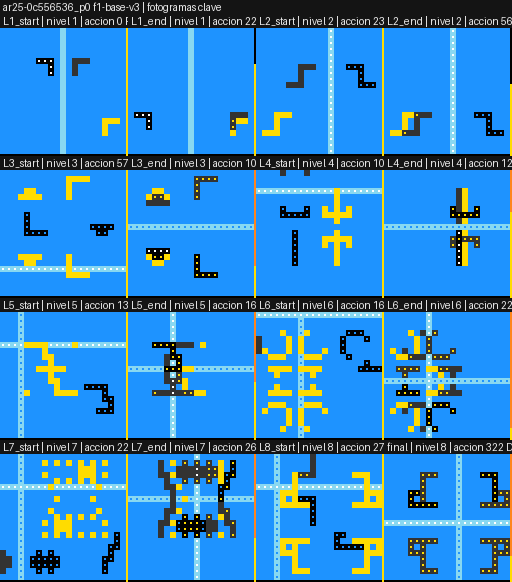
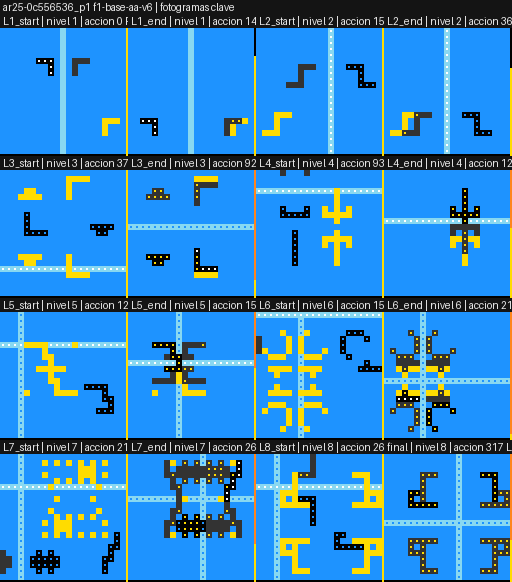
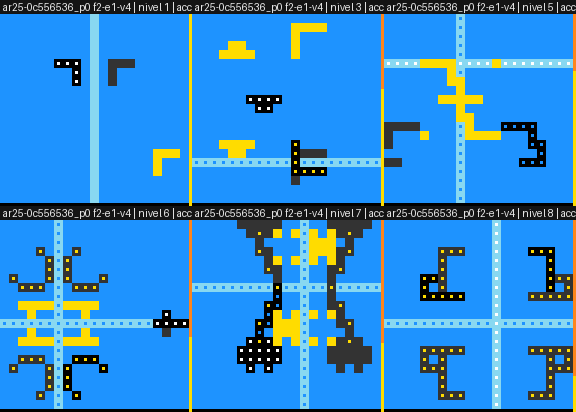
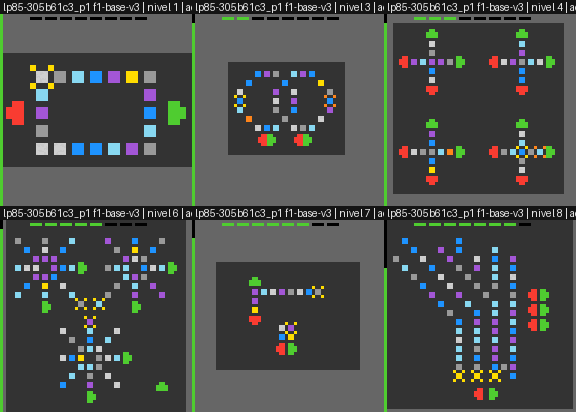
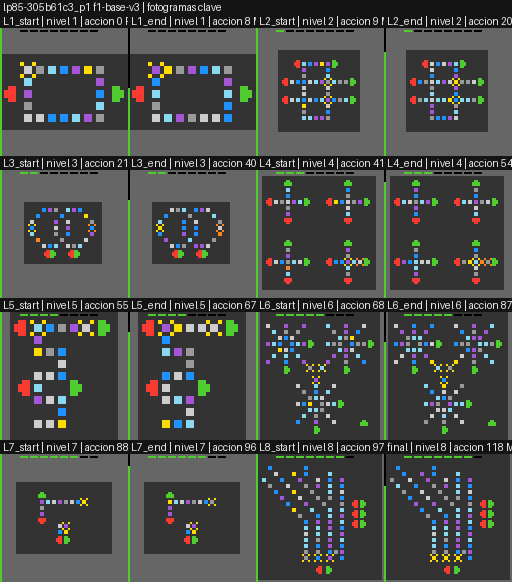
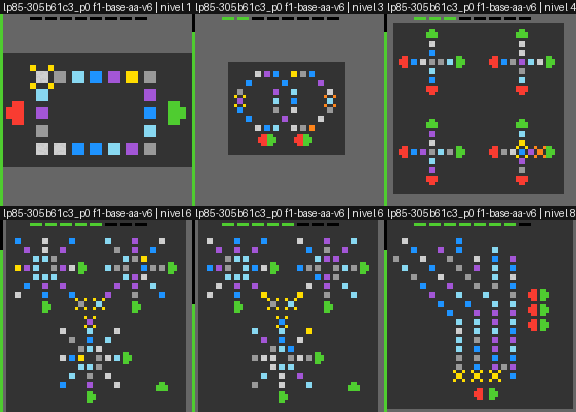
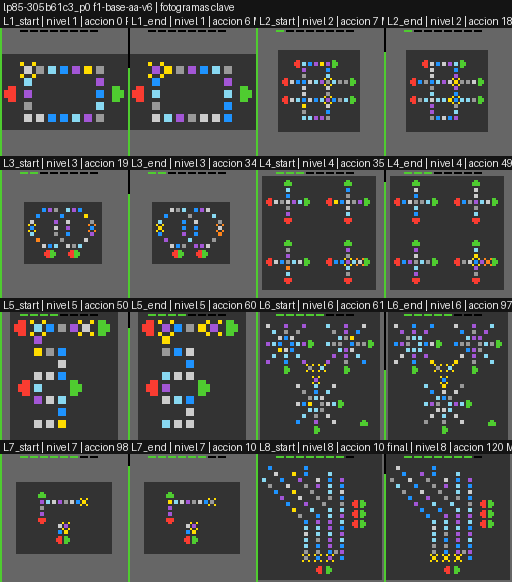
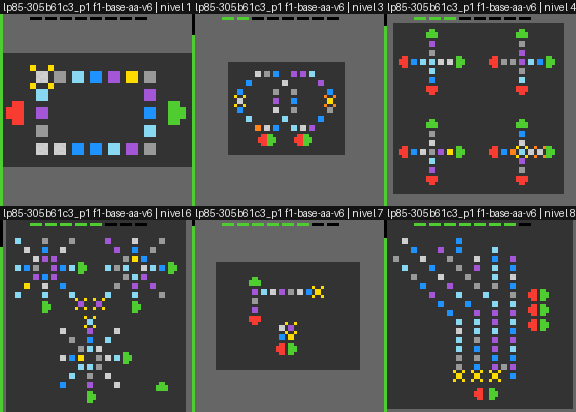
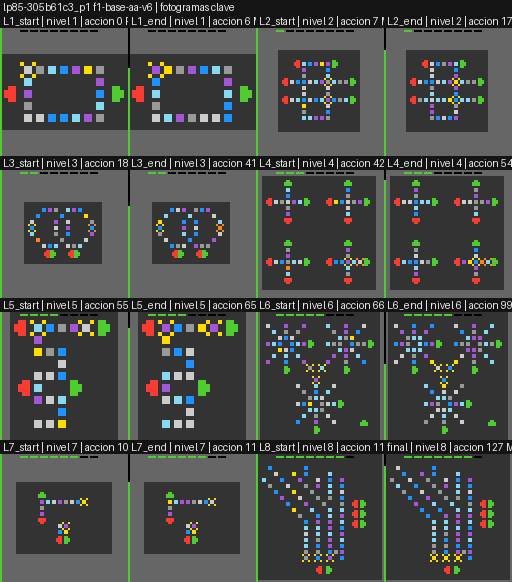
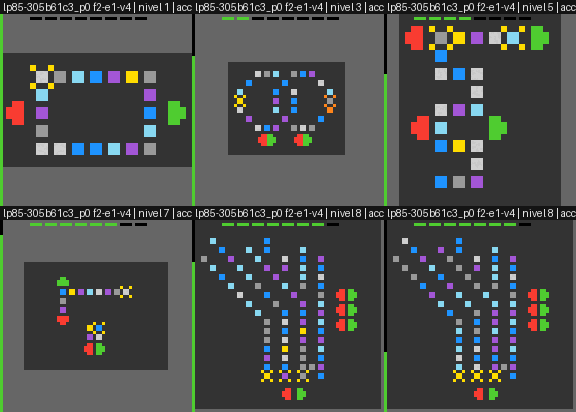
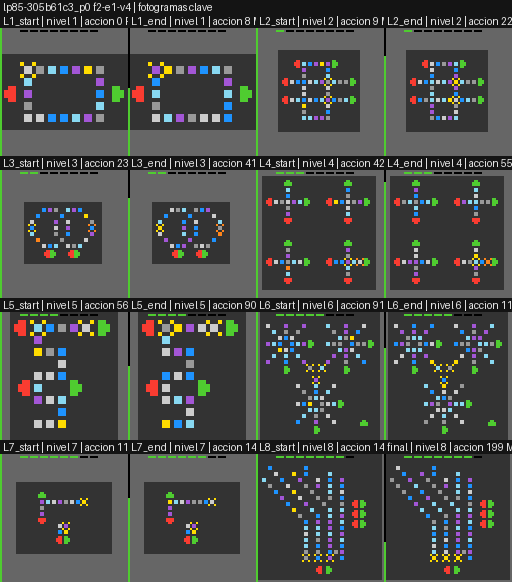
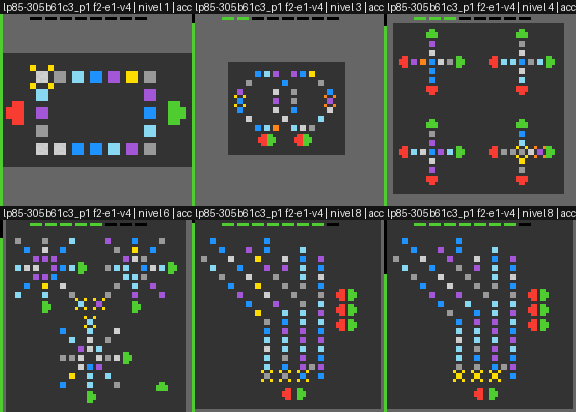
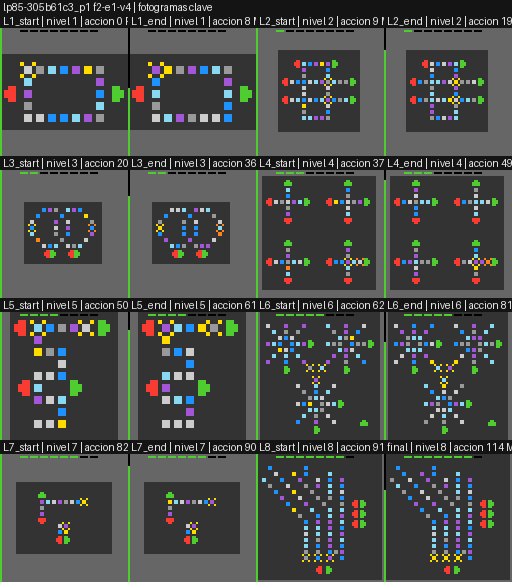
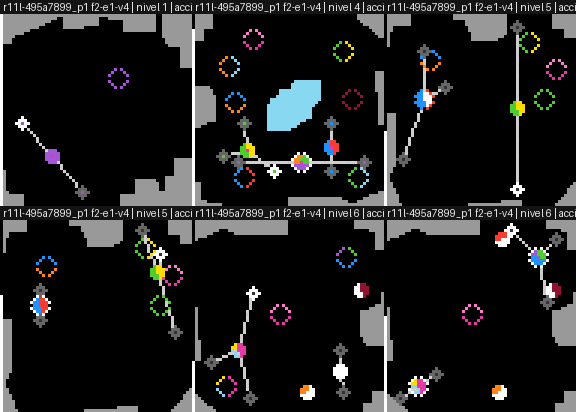
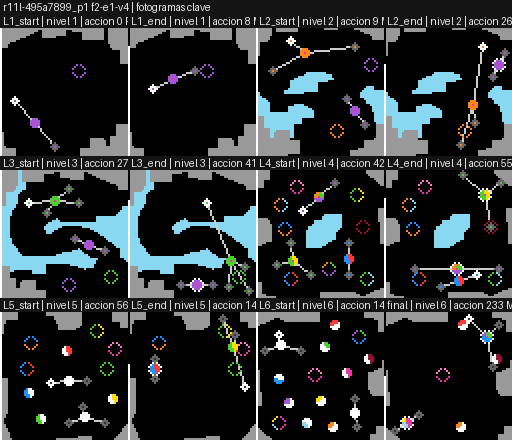
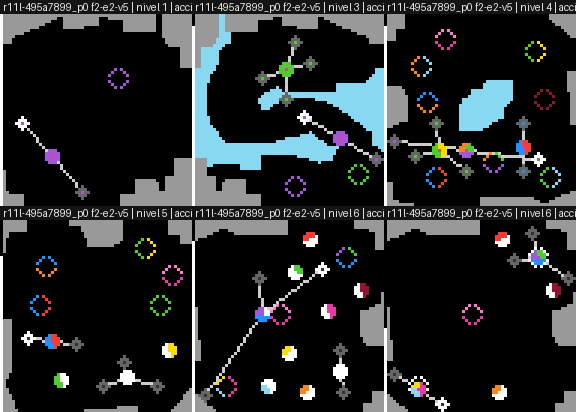
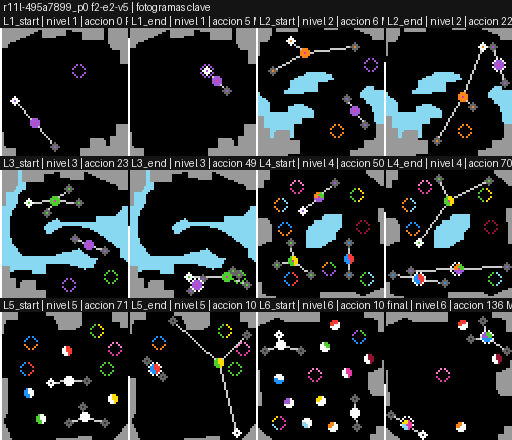
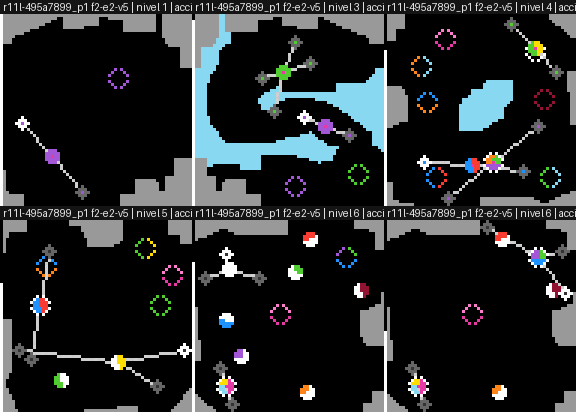
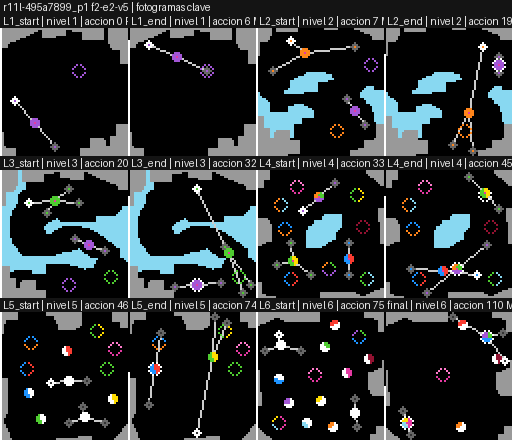
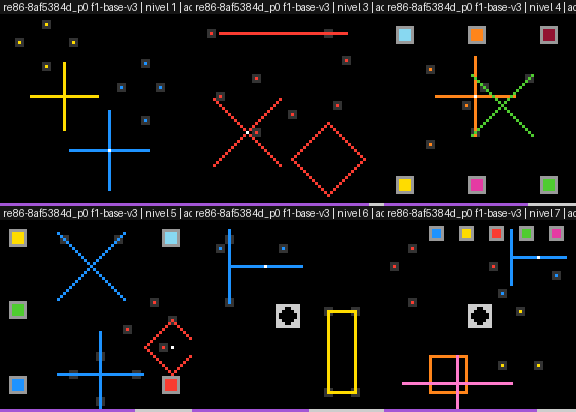
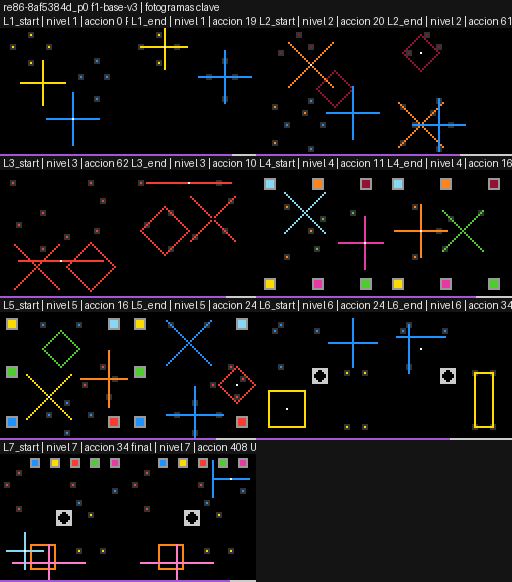
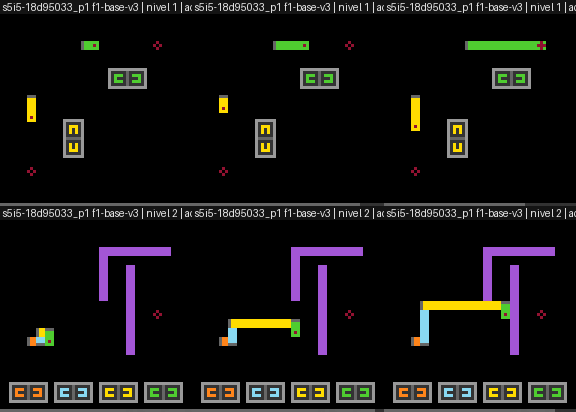
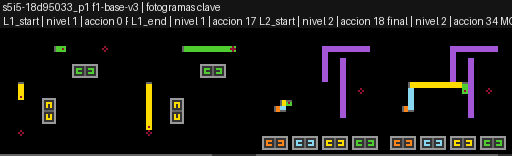
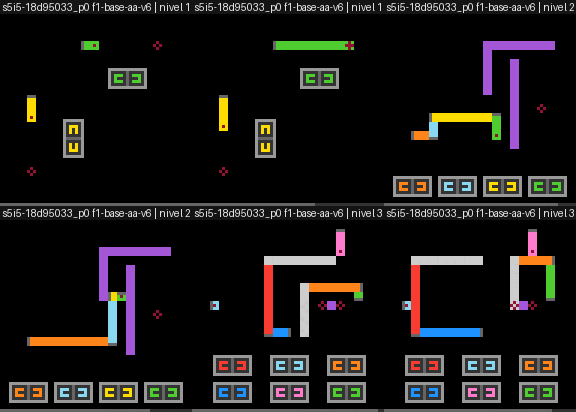
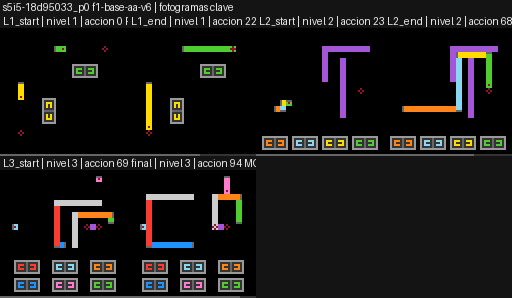
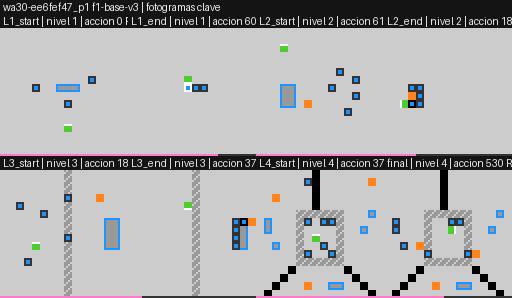
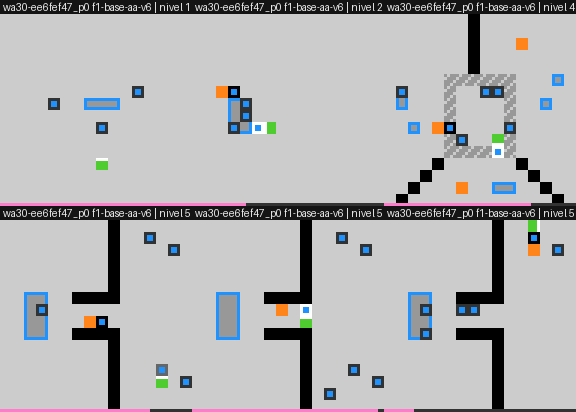
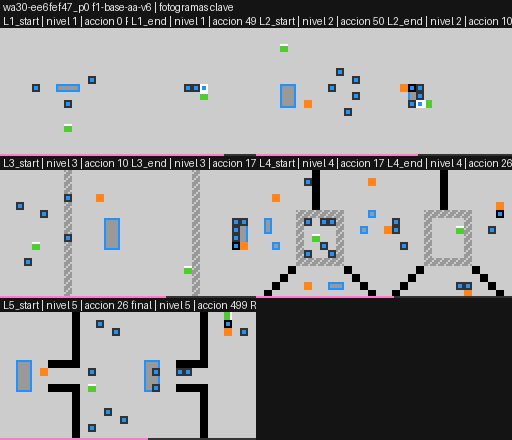
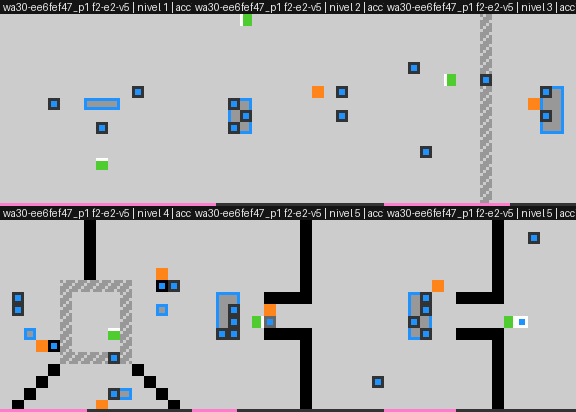
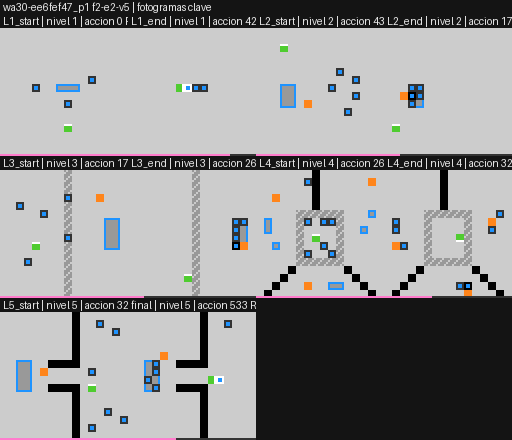
Hay una entrada por juego: qué pasó en cada pasada, frases del propio modelo (su último plan antes de pasar el primer nivel y donde se quedó) y los GIFs de la base, la repetición, E1 y E2. Los GIFs usan los fotogramas registrados con la paleta del toolkit oficial; la cadencia es de presentación y las partidas largas se muestrean alrededor de los fotogramas clave. El log de pensamiento completo de la base, recortado por paso, está enlazado bajo cada GIF de la base.
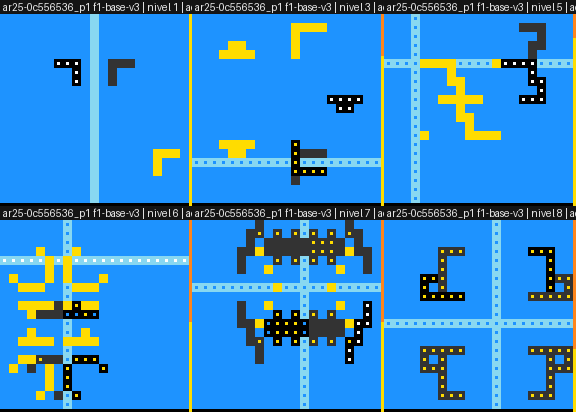
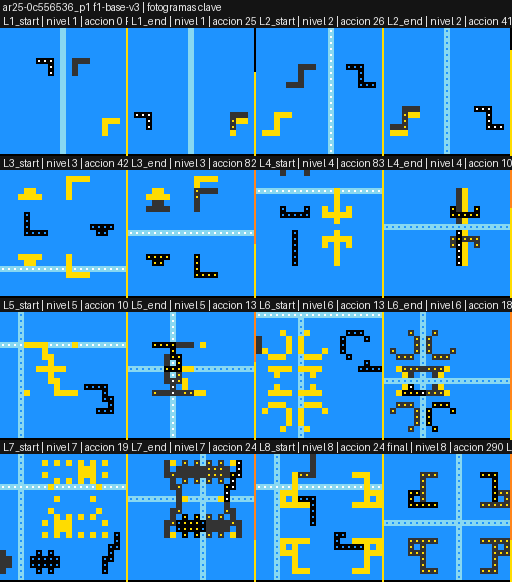
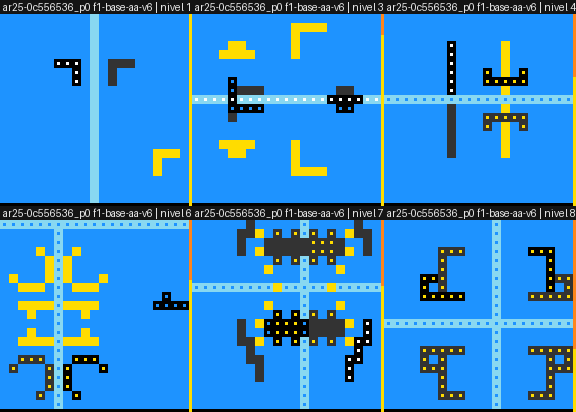
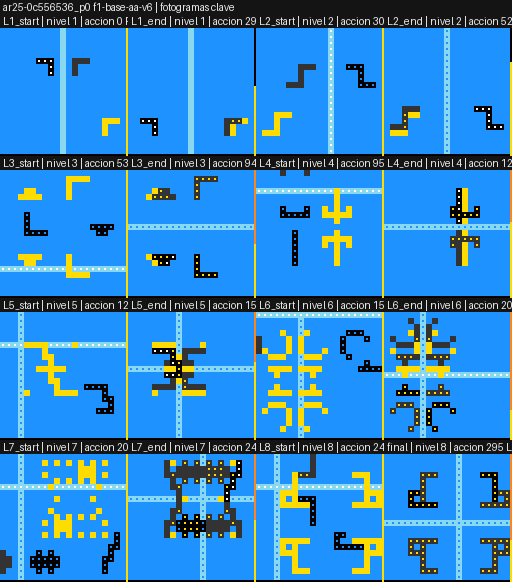
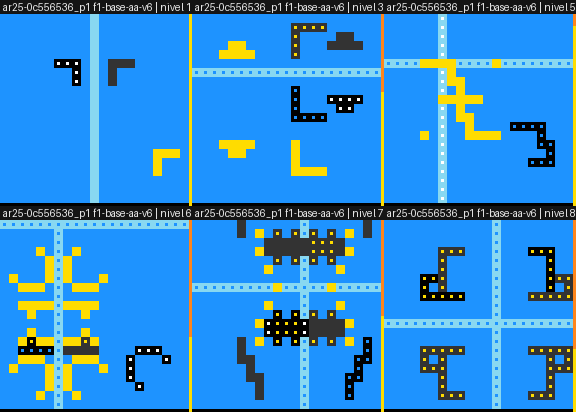
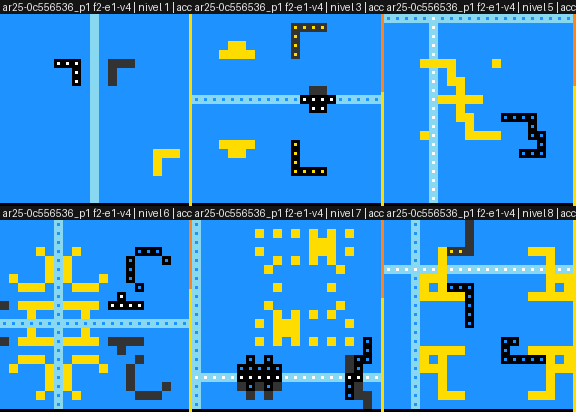
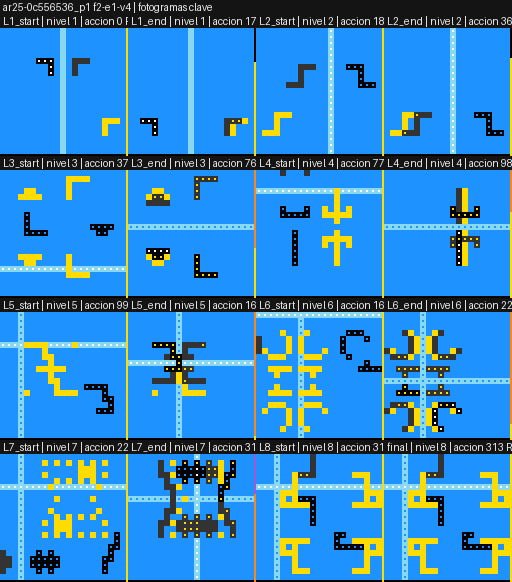
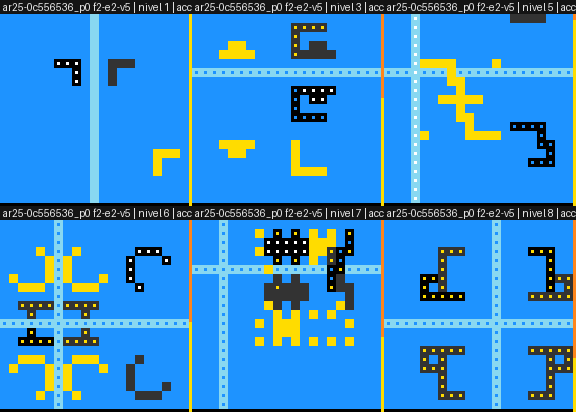
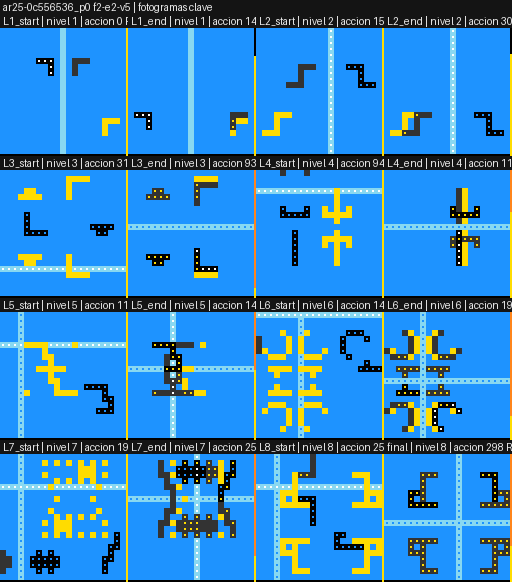
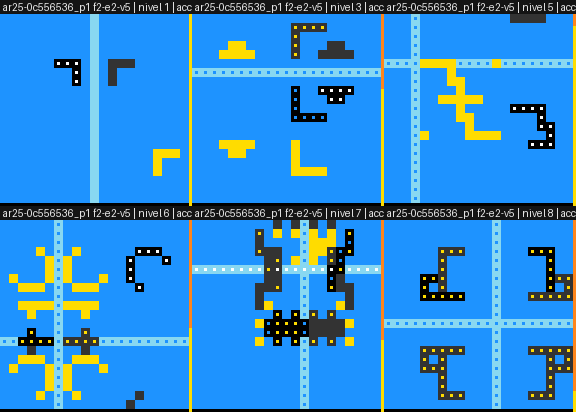
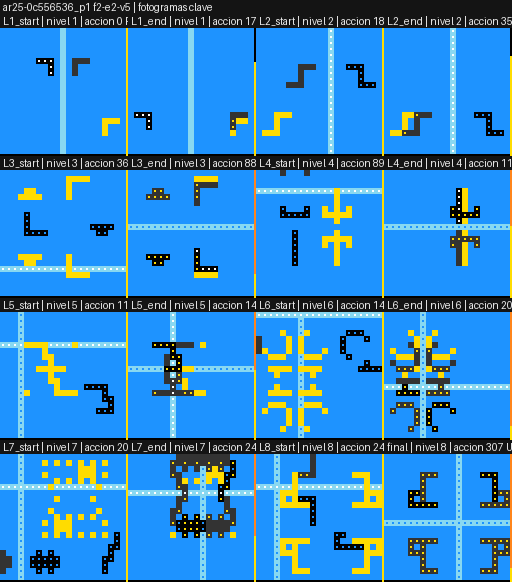
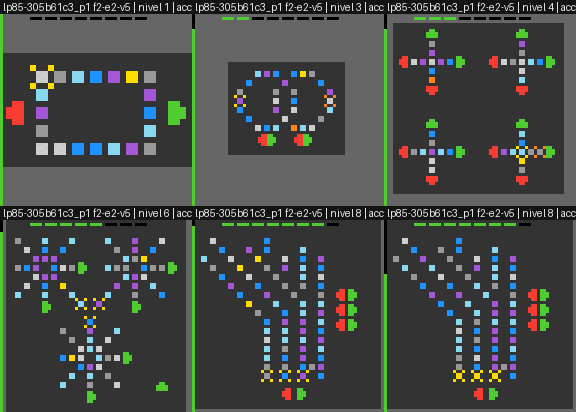
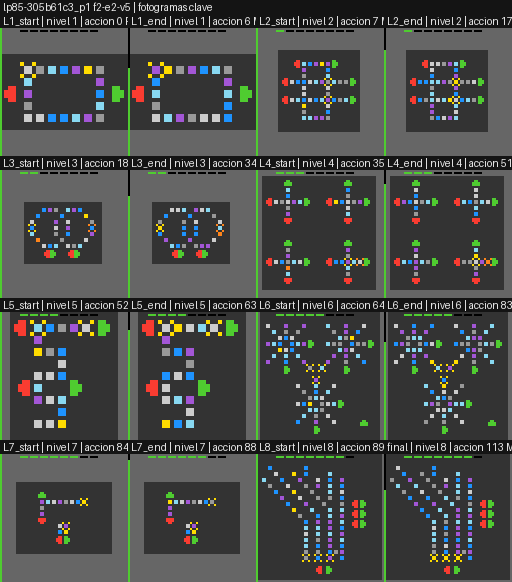
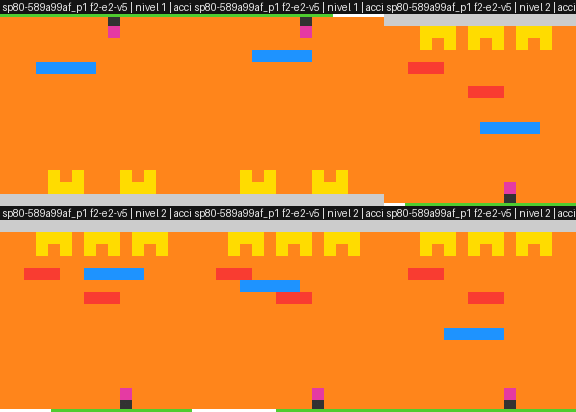
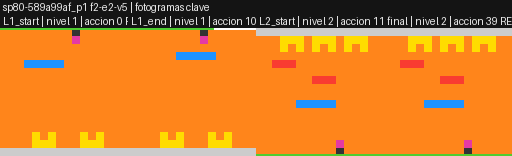
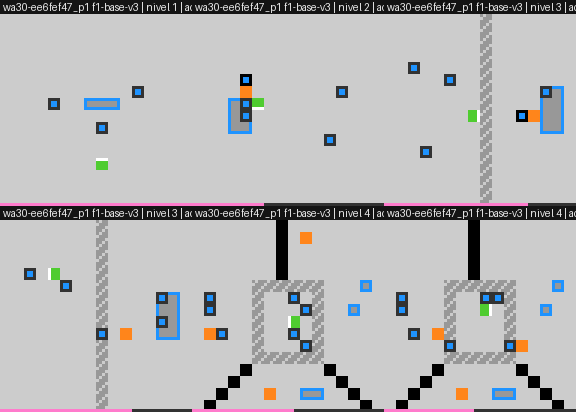
ar25 · 8 niveles · Base (F1): 100,00 / 100,00 · A/A (base repetida): 100,00 / 100,00 · E1: 100,00 / 77,78 · E2: 100,00 / 100,00
Pasada 0: completó los 8 niveles en 322 acciones (un humano usa 748). Pasada 1: completó los 8 niveles en 290 acciones (un humano usa 748). Puntuación (cap 1,15): 100,00 y 100,00.
…e action (e.g., MOUSE clicks). Let's first test the hypothesis with LEFT x5 and see if charcoal moves right by 3 each time and black moves left.
Also, potential alternative: maybe the goal is to move shapes so they overlap/touch the divider? Or maybe the dots indicate a "path" to trace and the shapes must go through... Let's just try moving toward the yellow and observe.
Let me do: 5x LEFT, print positions each step.
…be the "reflection" of nothing... Actually, another thought: maybe the yellow shape is a third object that is also controllable but only by SPACE (a "selected" piece). Let's test SPACE and MOUSE cheaply to see if anything changes.
Let me do: UNDO x3 to restore, then SPACE, then check diff.
Actually, order: I want to test SPACE (1 action) and see. Then decide. Let's do UNDO, UNDO, UNDO, then SPACE, printing summaries.
Base (F1)
A/A (base repetida)
E1
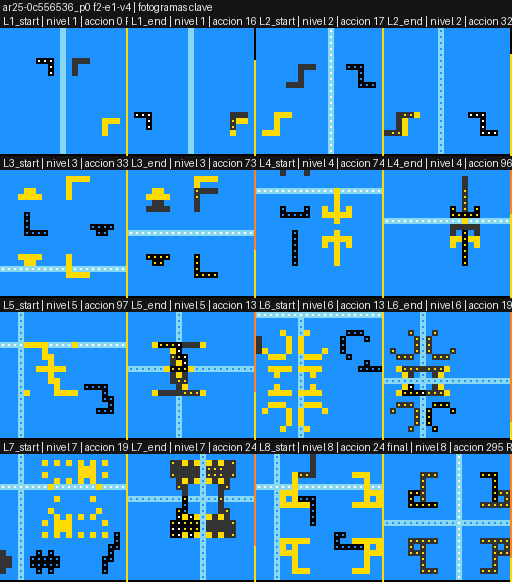
E2
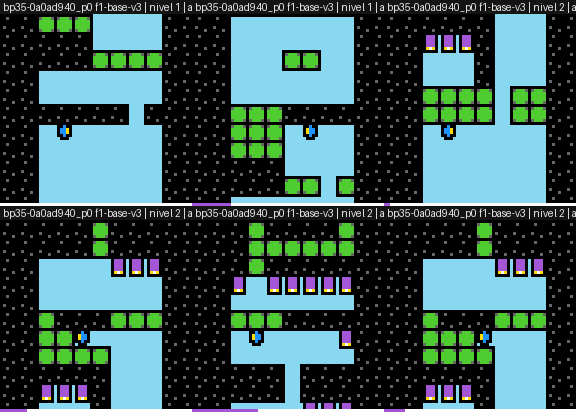
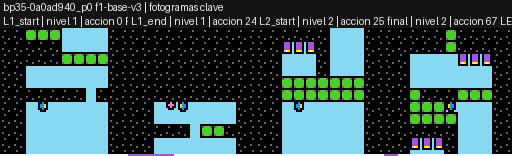
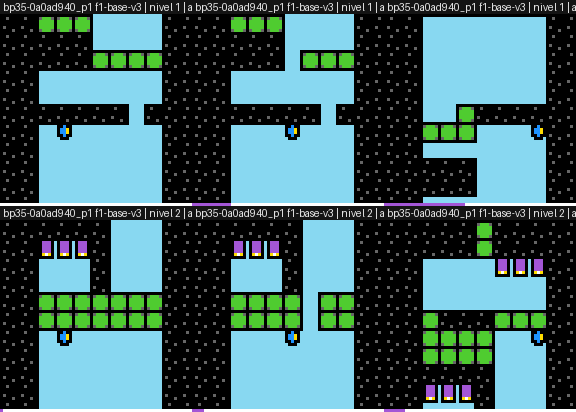
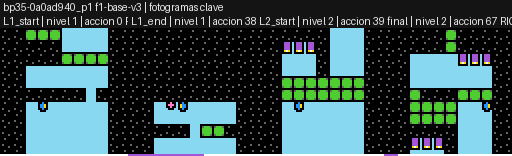
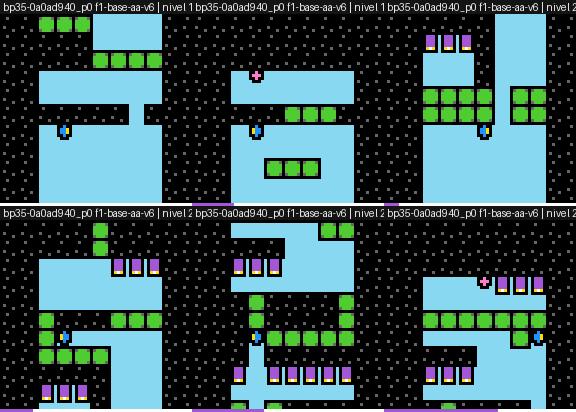
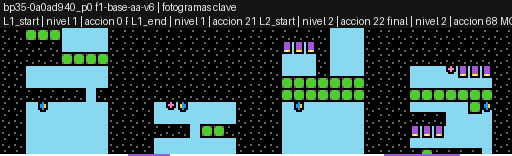
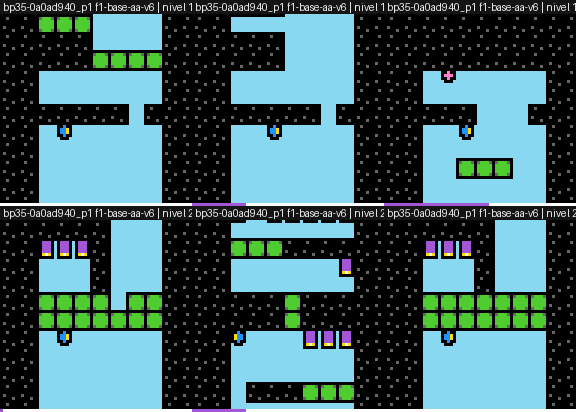
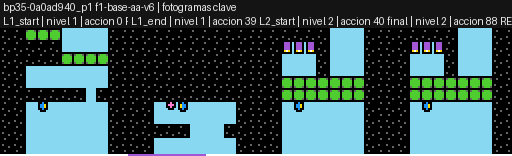
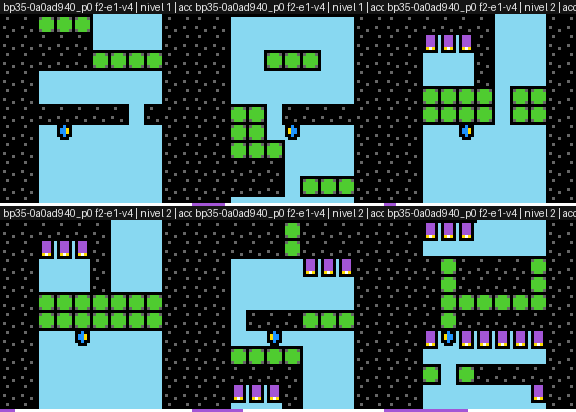
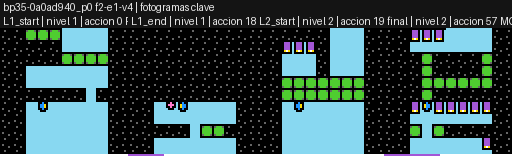
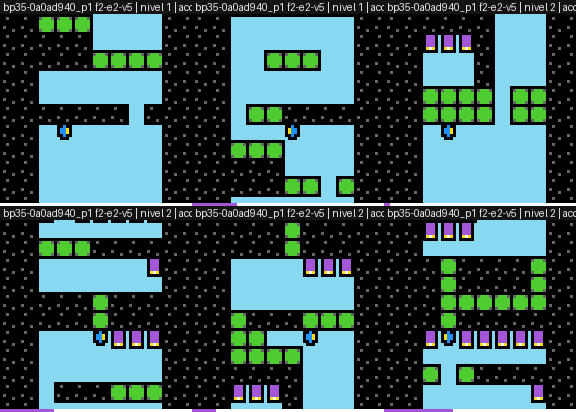
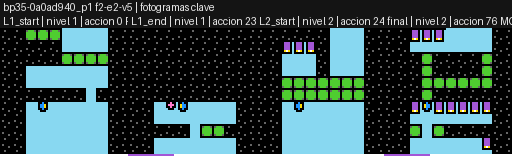
bp35 · 9 niveles · Base (F1): 1,57 / 0,64 · A/A (base repetida): 2,02 / 0,61 · E1: 2,22 / 2,22 · E2: 6,65 / 1,70
Pasada 0: 1 de 9 niveles, con 25 acciones (un humano usa 21); se quedó en el nivel 2 con 67 acciones en total. Pasada 1: 1 de 9 niveles, con 39 acciones (un humano usa 21); se quedó en el nivel 2 con 67 acciones en total. Puntuación (cap 1,15): 1,57 y 0,64.
…cked (no move), I'll know the cross is solid.
Note the player is at the ceiling; the ceiling of this pool is row 37 (the camera scrolled). Actually the current frame shows the player at rows 37-41 and the pool at rows 37-48ish. Let me look: comps shows S rows 37-62 (773) — the pool the player is in is rows 37-48 and then the shaft down at cols 43-47? Let me not worry.
Let me press LEFT and check for level completion.
…So boxl found a yellow or blue pixel at col 13 → likely in the HUD bar (row 63) or elsewhere. Let me restrict the search to rows 0-62 and require the pixel to be adjacent to the blue (part of the sprite).
Better: find the blue cluster (it's unique), then find the yellow pixels within 2 cols of the blue cluster → box_left = min(blue_min, yellow_min) - 1.
Let me fix boxl and re-run the tunnel loop for B in (25,19,13).
…e sprite would land exactly on the pink (pink at cols 19-23, sprite at 31-35 → 31-6=25, not 19). Hmm, one LEFT would put the sprite at cols 25-29, which is adjacent to the pink (pink 19-23). Two LEFTs → 19-23 = exactly the pink's position!
Let me press LEFT once and see: does the sprite stop at 25-29 (adjacent), or does it get blocked by the pink, or does the pink disappear (collected)?
Let me press LEFT and observe.
…all, rows 13-29 = the big room's sky. No purple directly above (the purple is at cols 38-40, 44-46, 50-52) ✓ SAFE under both models.
OK so the plan: D5 → LEFT (L=43) → D4 → LEFT (L=37? or 31?) hmm.
Let me redo this carefully with the actual current maze. Let me first get the exact brick list from the current frame's segmentation, then write a simulator of the sprite's movement+rise to plan safely. Let me do that now.
Base (F1)
A/A (base repetida)
E1
E2
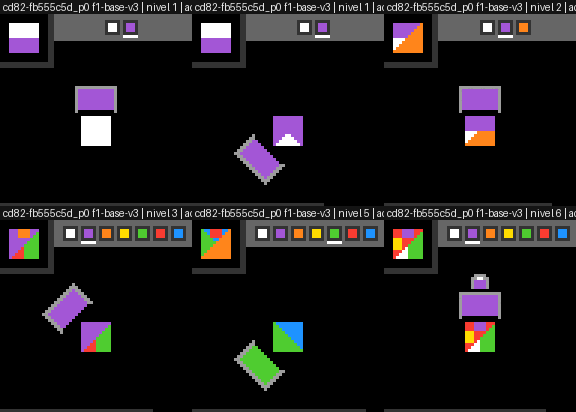
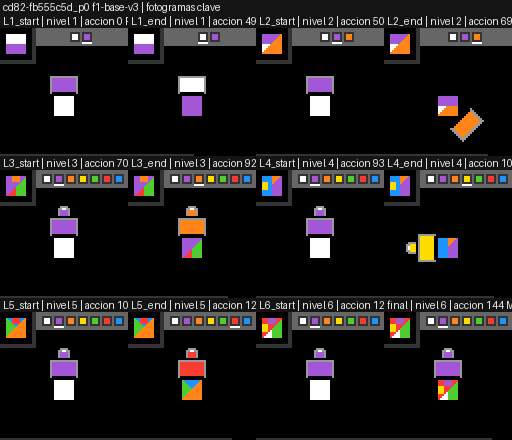
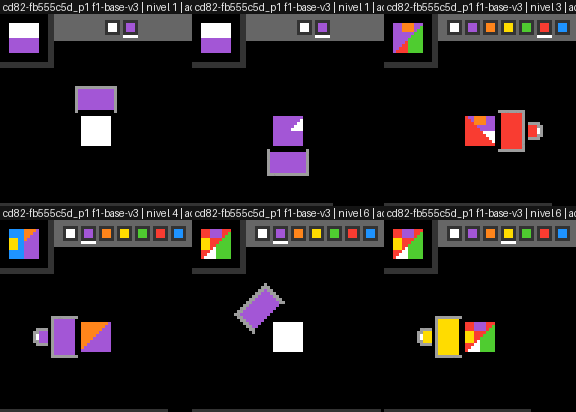
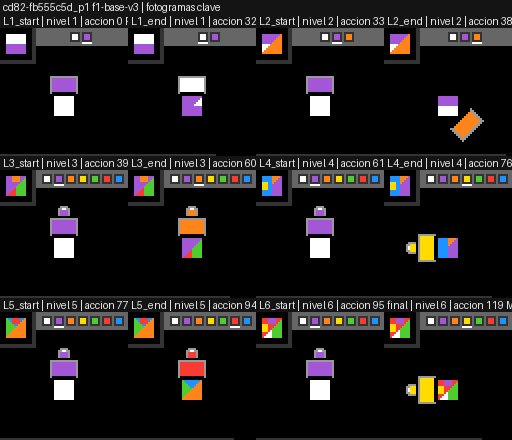
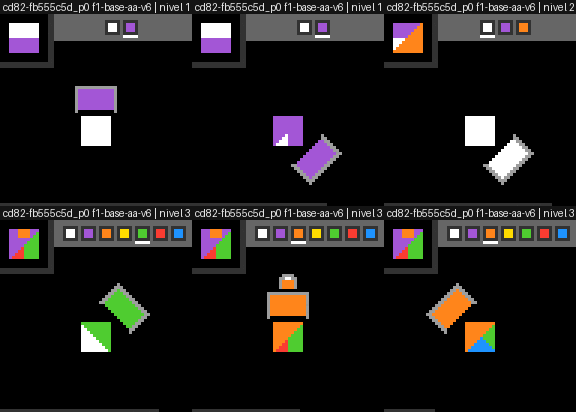
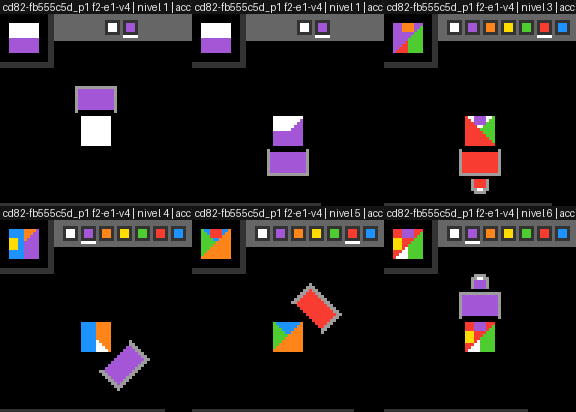
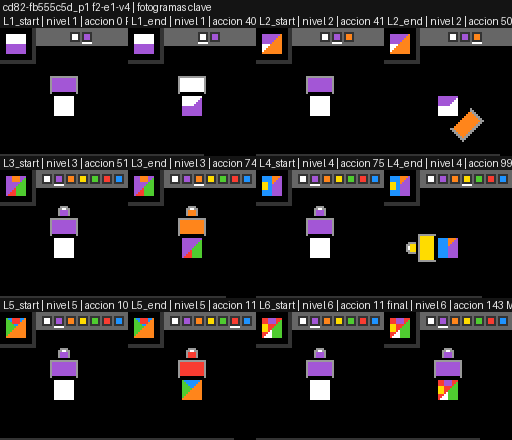
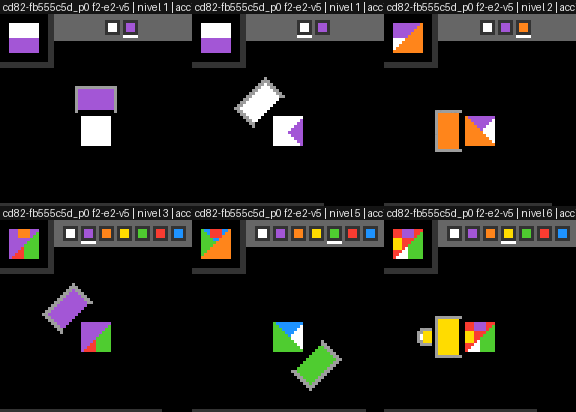
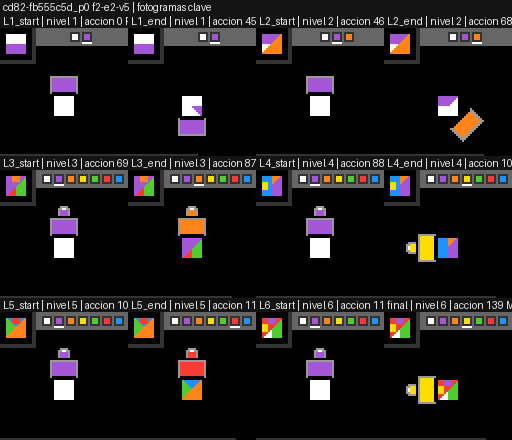
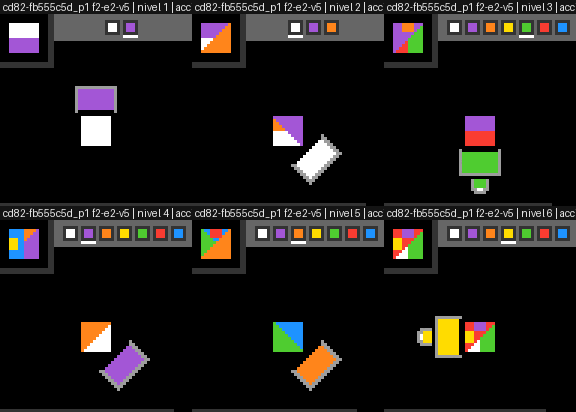
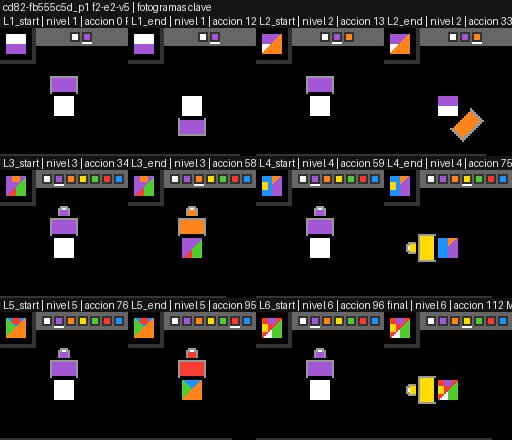
cd82 · 6 niveles · Base (F1): 100,00 / 100,00 · A/A (base repetida): 6,63 / 100,00 · E1: 99,91 / 93,00 · E2: 100,00 / 100,00
Pasada 0: completó los 6 niveles en 144 acciones (un humano usa 171). Pasada 1: completó los 6 niveles en 119 acciones (un humano usa 171). Puntuación (cap 1,15): 100,00 y 100,00.
…. Then select white, then SPACE.
Actually, let me build a robust navigator: I'll implement a BFS over the known transition graph, using probes as needed. But simpler: from E: UP → SE, RIGHT → S. 2 steps. Then MOUSE white (1 step), SPACE (1 step) = 4 steps. Budget: the bar shows ~64-47 = 17ish remaining. Fine.
Let me do UP, check, RIGHT, check, then verify the cup is at home (24,25,32,38), then select white and SPACE.
…Alternatively the other way: LEFT, DOWN, DOWN, RIGHT → also 4.
Let me do: RIGHT, UP, UP, LEFT, then verify the bucket is at N (bbox rows 24-32, cols 25-38), then MOUSE white, then SPACE. I'll batch with verification and conditional execution.
Careful: the pour from N with white paints rows 34-38 white ✓ → final state: top white, bottom purple = target. Then hopefully level_completed.
Let me batch it all with checks.
Base (F1)
A/A (base repetida)
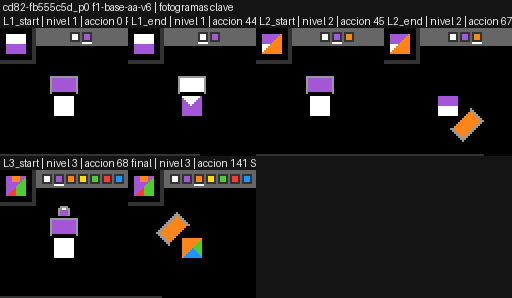
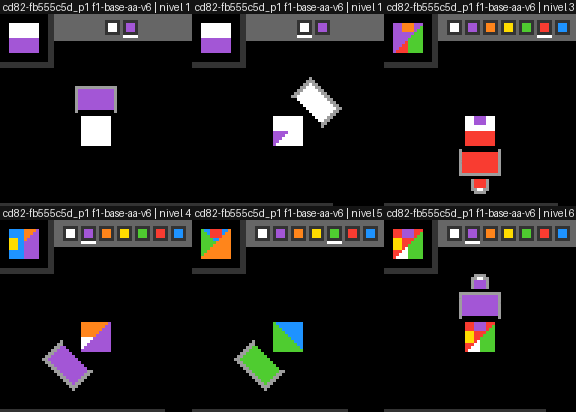
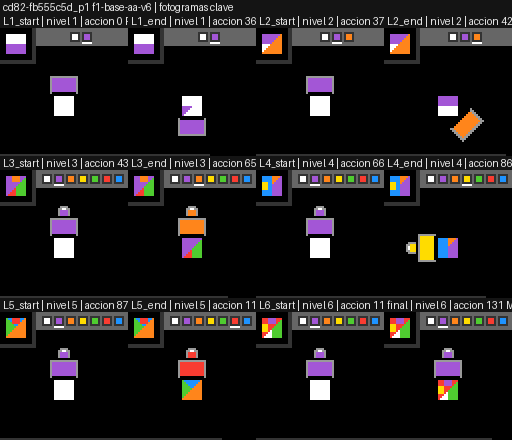
E1
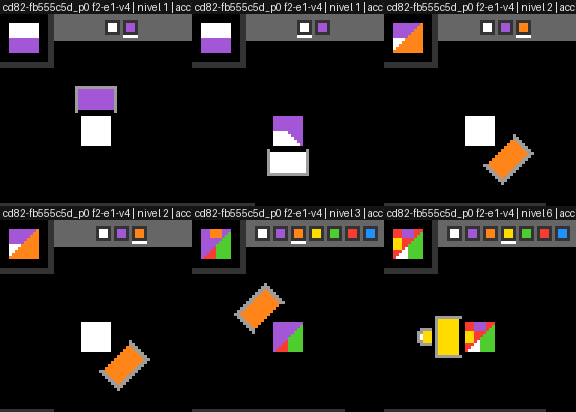
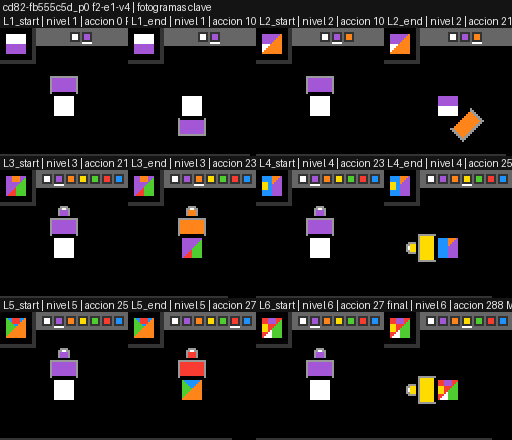
E2
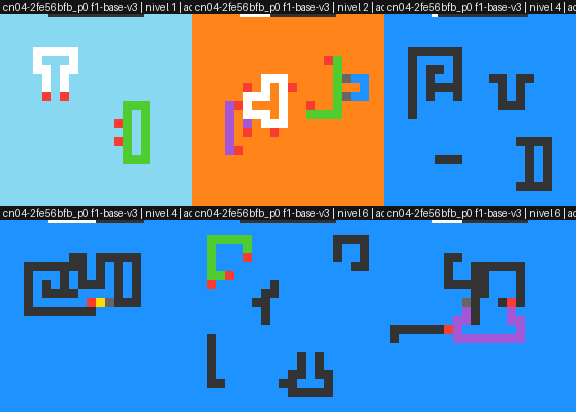
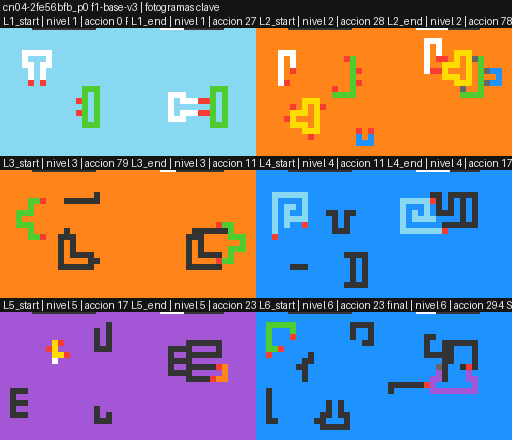
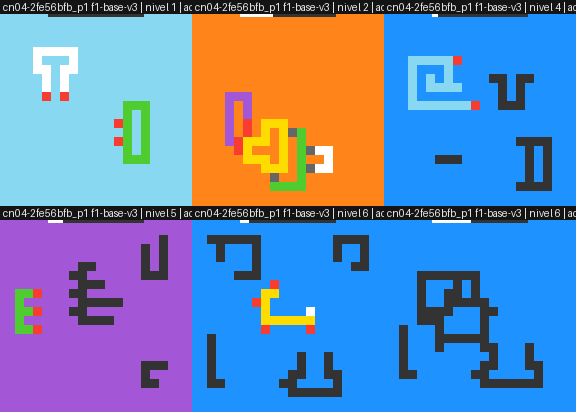
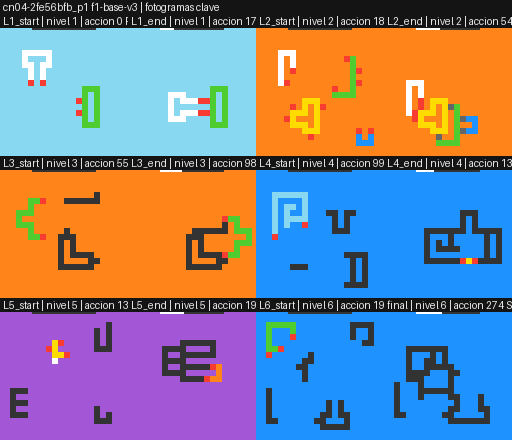
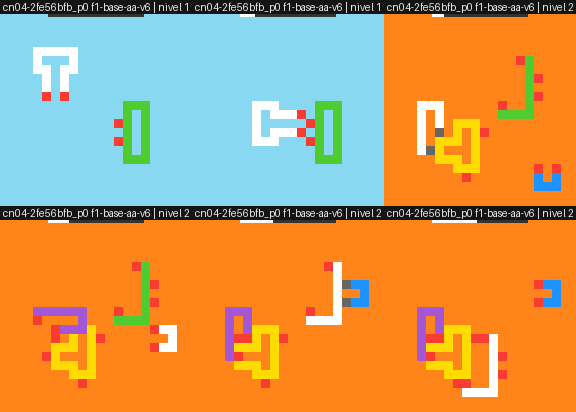
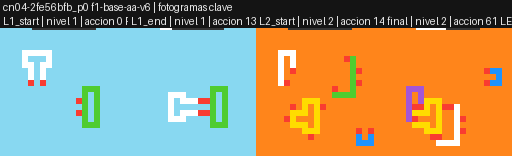
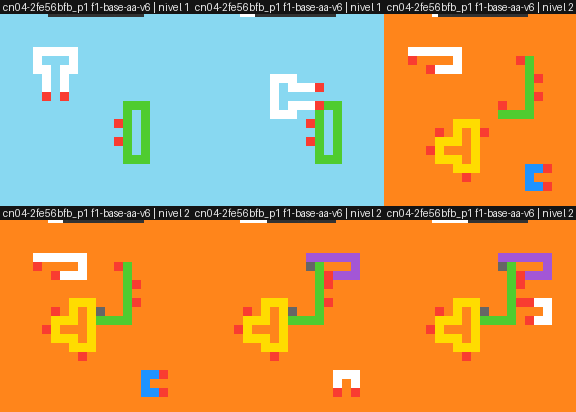
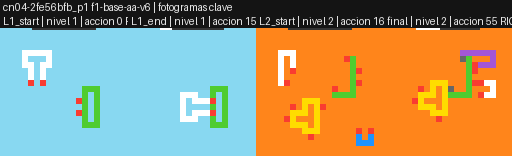
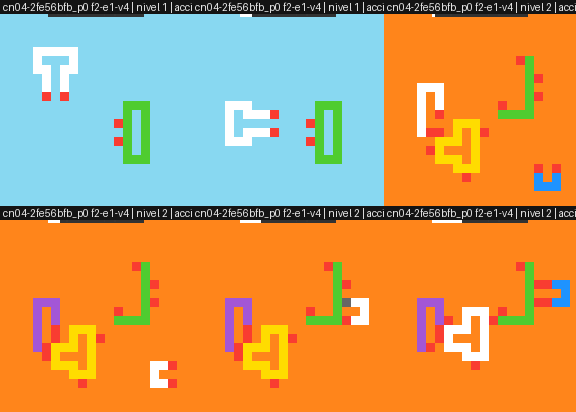
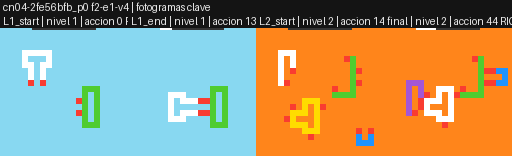
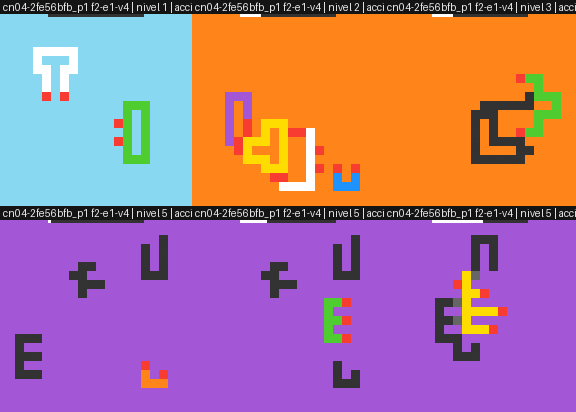
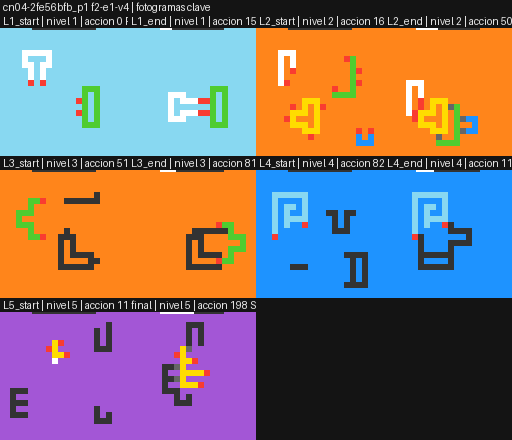
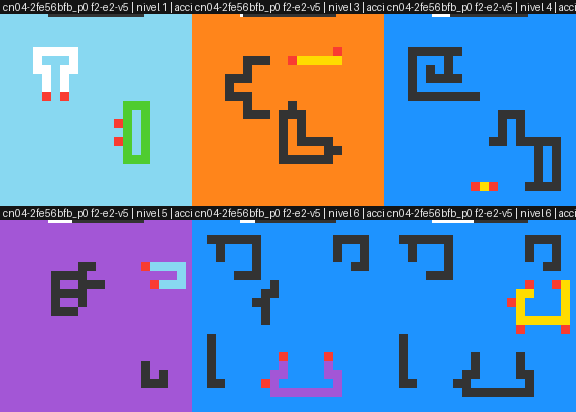
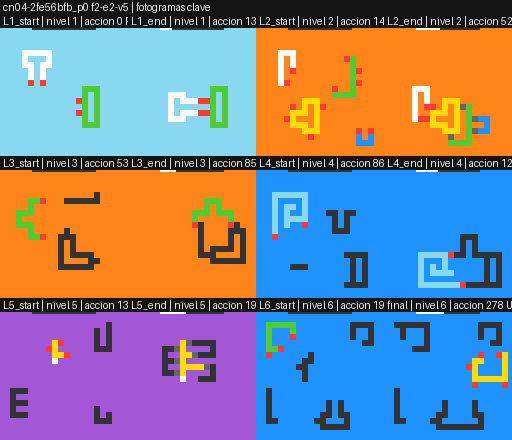
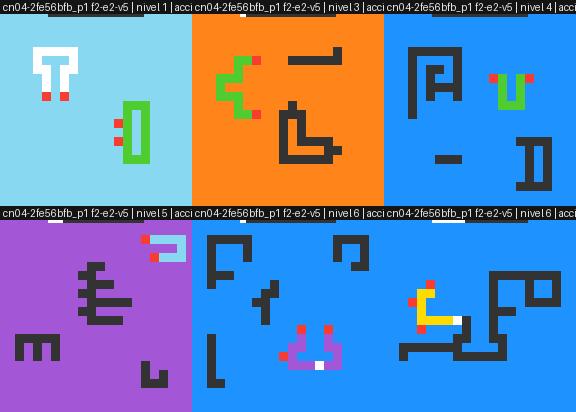
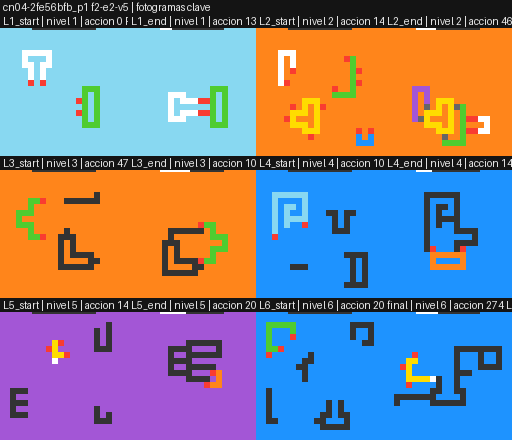
cn04 · 6 niveles · Base (F1): 71,43 / 71,43 · A/A (base repetida): 4,76 / 4,76 · E1: 4,76 / 47,62 · E2: 71,43 / 71,43
Pasada 0: 5 de 6 niveles, con 28, 51, 32, 66 y 57 acciones (un humano usa 29, 54, 85, 300 y 208); se quedó en el nivel 6 con 294 acciones en total. Pasada 1: 5 de 6 niveles, con 18, 37, 44, 36 y 58 acciones (un humano usa 29, 54, 85, 300 y 208); se quedó en el nivel 6 con 274 acciones en total. Puntuación (cap 1,15): 71,43 y 71,43.
…12. OK.
Actually, one more consideration: maybe the win needs the plug to be inserted AND then SPACE (activate). Hmm, SPACE rotates. In the connected state, maybe SPACE would do something different (e.g., "lock in")? We tried SPACE when connected... no wait! We tried SPACE when the plug was connected to the socket, and it rotated (breaking the connection). So SPACE = rotate always.
Let's go. First: 3 SPACE + measure.
…g action was something else, like a rotation or a click), that would tell me the check is not automatic on connection.
Let me examine L4: find the transition with level_completed and level==4 (transition 110, action 'RIGHT'). Let me print the before-frame's component count and the tip status, and the diff of that action.
Let me do L4 before-frame analysis: components (union of non-background) and the action's effect.
…here since contacts at rows 35-43, cols 38-40; plug max col 37 anyway). Then DOWN 21: plug rows 32-46, cols 20-37. Green contacts at cols 38-40 — plug max col 37 ✓.
Total 12 actions. Budget: the bar showed 30 remaining. Fine.
Let me do it step by step but batched: I'll execute the batch and check level_completed after each. I'll write a loop that executes actions one at a time and stops if level_completed/game_over.
…the config search from the CURRENT state to find the cheapest connected config (allowing D at any state, B at any state, etc.). That's what search_conn + eval_cfg do. Let me do that now with the corrected current state.
Also, I must FIX the executor bug: always click the piece before its first arrow, and use the correct (pre-move) position for retries.
Let me first verify the fit combination and then run the search.
Base (F1)
A/A (base repetida)
E1
E2
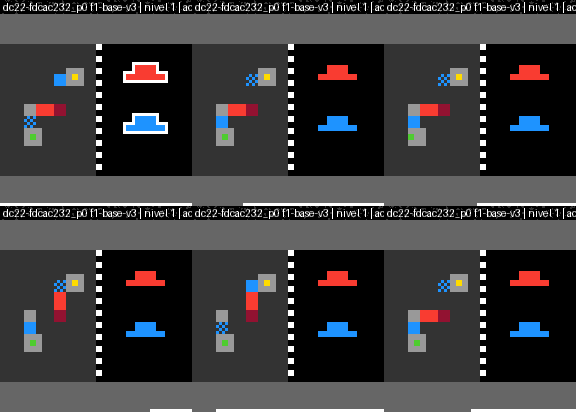
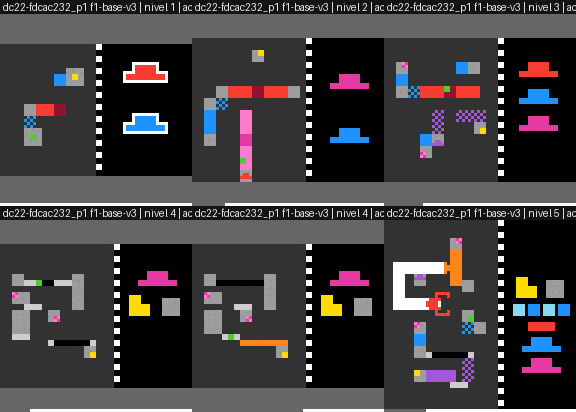
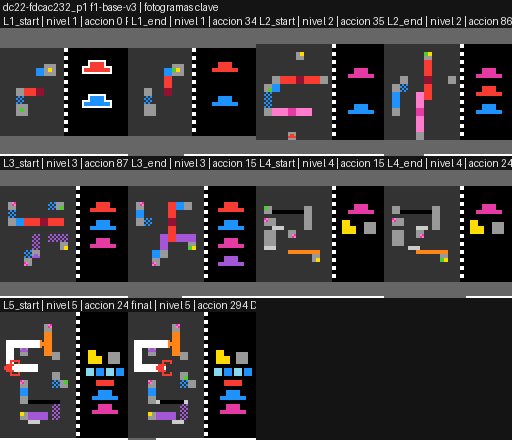
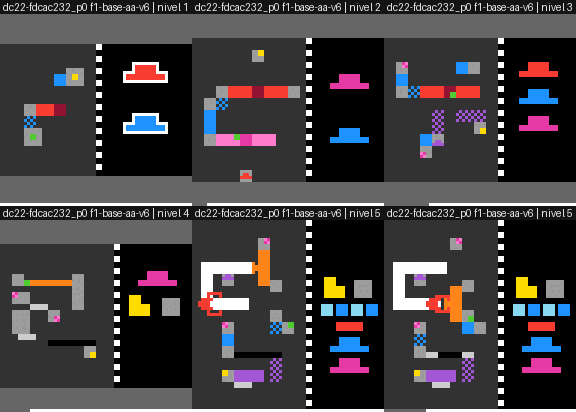
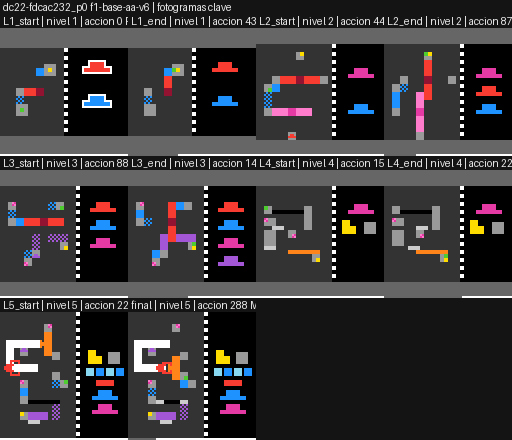
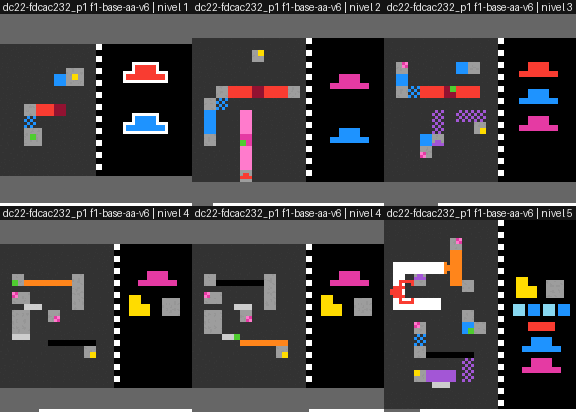
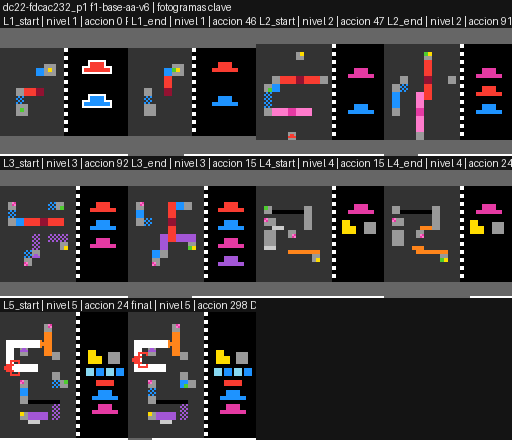
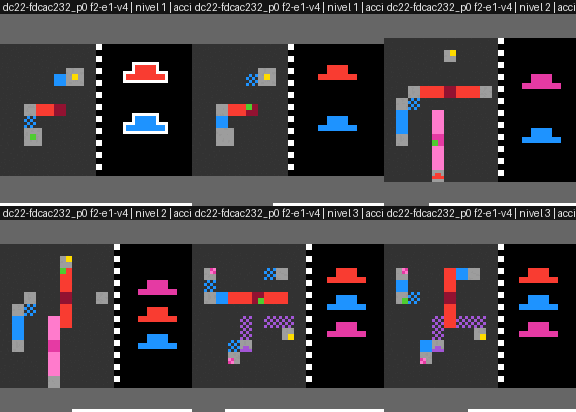
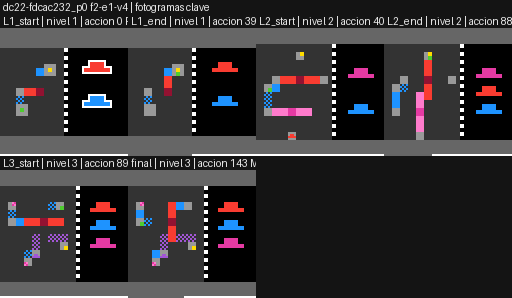
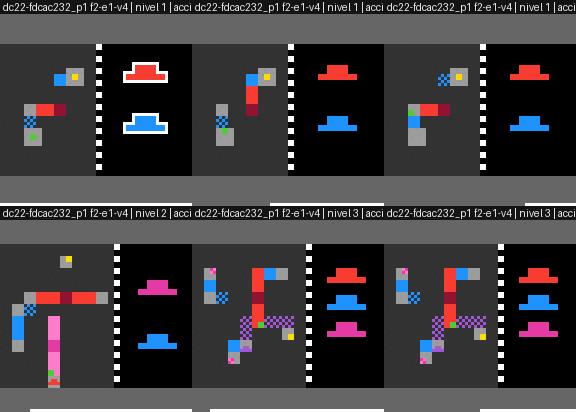
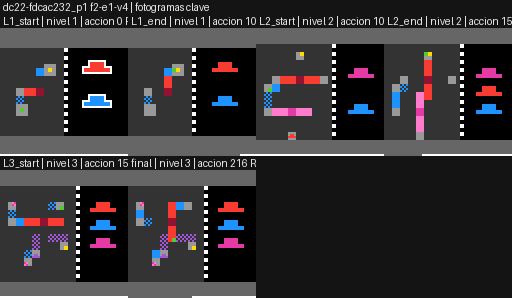
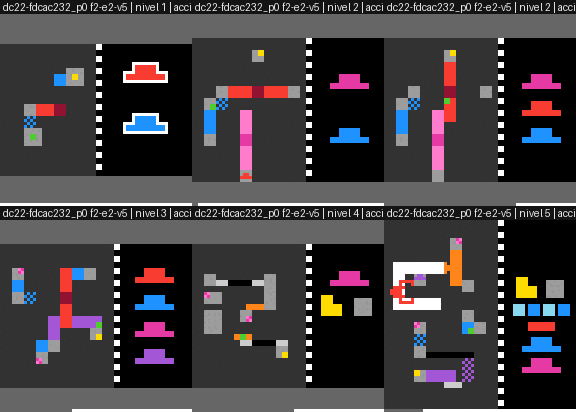
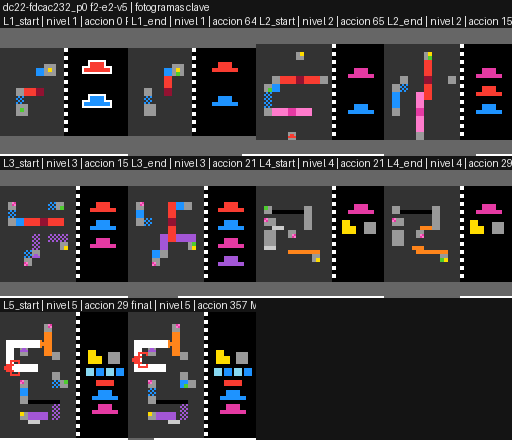
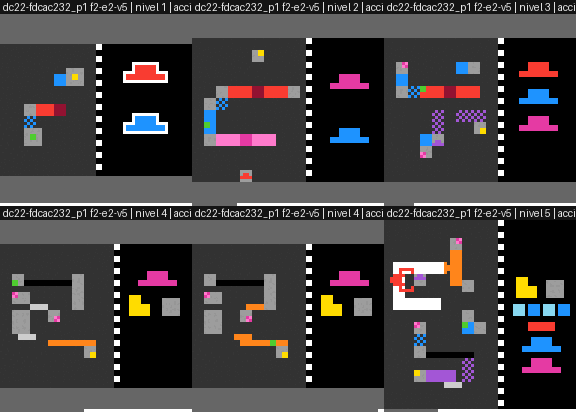
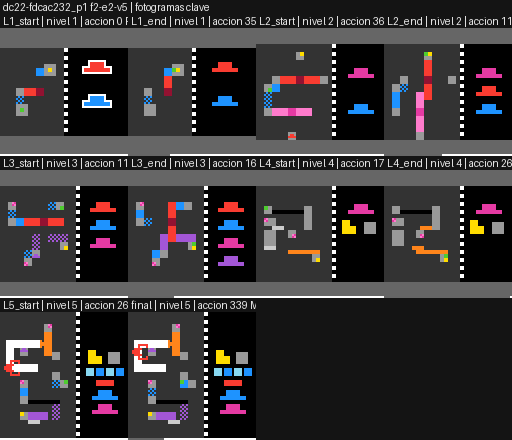
dc22 · 6 niveles · Base (F1): 0,00 / 47,62 · A/A (base repetida): 47,62 / 47,62 · E1: 14,29 / 12,51 · E2: 47,62 / 47,62
Pasada 0: no completó ningún nivel (135 acciones). Pasada 1: 4 de 6 niveles, con 35, 52, 69 y 89 acciones (un humano usa 59, 102, 67 y 98); se quedó en el nivel 5 con 294 acciones en total. Puntuación (cap 1,15): 0,00 y 47,62. Las pasadas difieren mucho: en este juego el ruido de la base es grande.
…e the dot UP to (38,10) [1 action] then press UP (a no-op against the wall, pushing the signal toward the block) [1 action]. Then move RIGHT to (38,12) and press UP. Then LEFT,LEFT to (38,8) and press UP (already tested, skip).
Let me do: UP, UP → check win. Then RIGHT, UP → check. Then LEFT,LEFT,UP? (skip, tested).
Also test pressing DOWN at (42,10) in this config? Hmm.
Let me do the two tests and check the results.
The green is now at (30,18) — standing on the darkred block D (the darkred node now has 12 px because the green covers 4 of its 16). D is safe ✓ (no death).
Now click the red target. Expected: the red block rotates to R2 (rows 24-29, cols 18-21). The green is on D at rows 30-31 cols 18-19 — safe.
Let me click and verify.
…vel's FIRST frame vs the current frame for the ORANGE bar — unchanged ✓.
Hmm.
Let me look at the level 4 board (from history) to recall the mechanics — maybe level 4 had the same "arrow" object and the red bar button, and I learned how it works. Let me check level 4's panel and objects. That's free (no actions).
Let me get level 4's first frame: find the history entries with level 4 and summarize the objects + panel.
Base (F1)
A/A (base repetida)
E1
E2
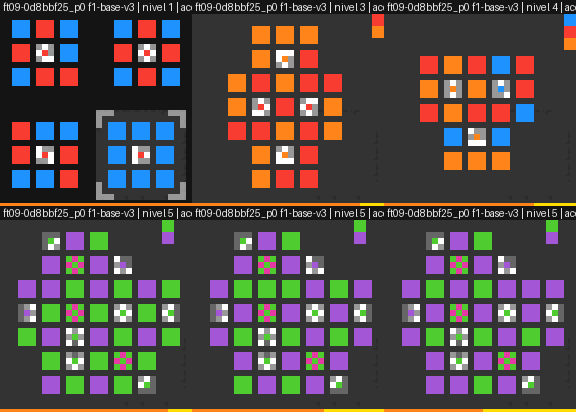
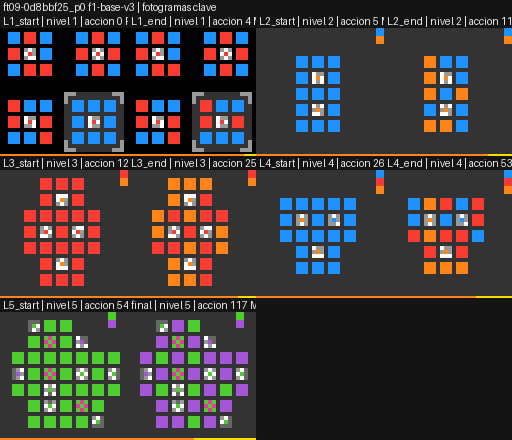
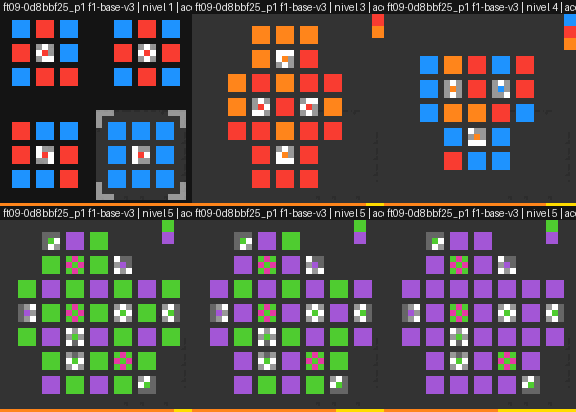
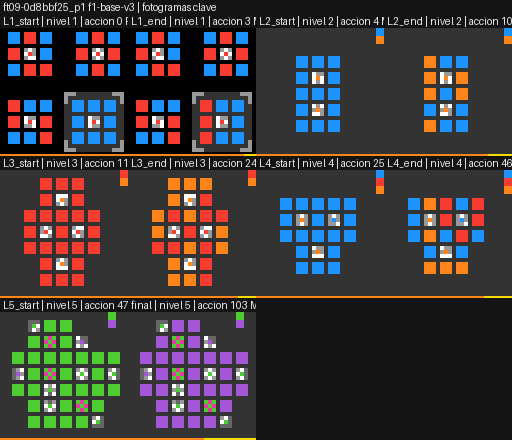
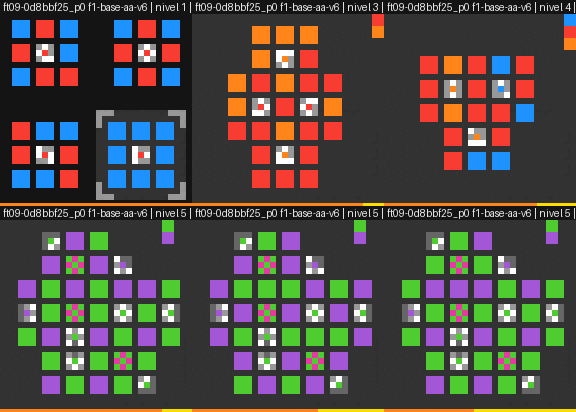
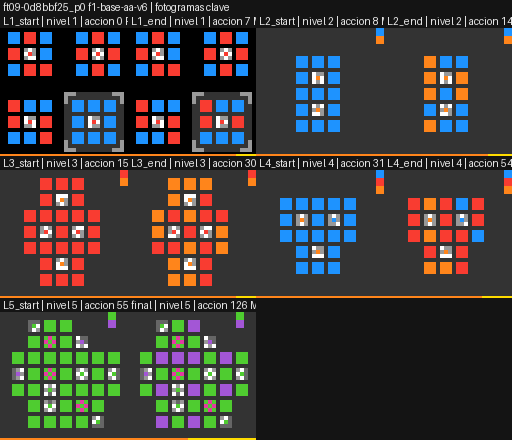
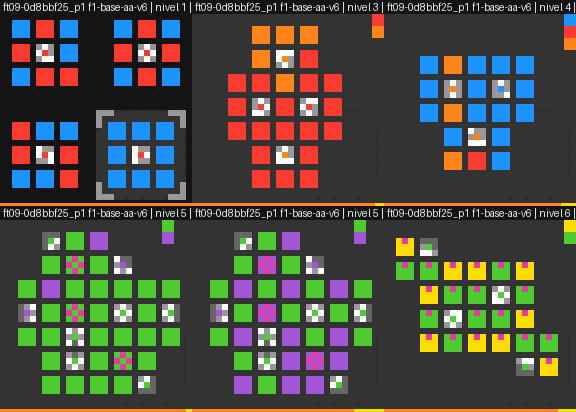
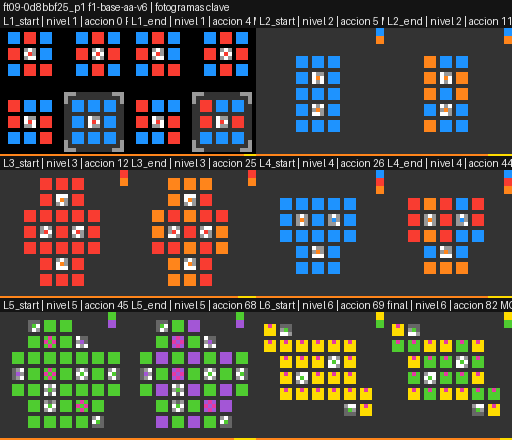
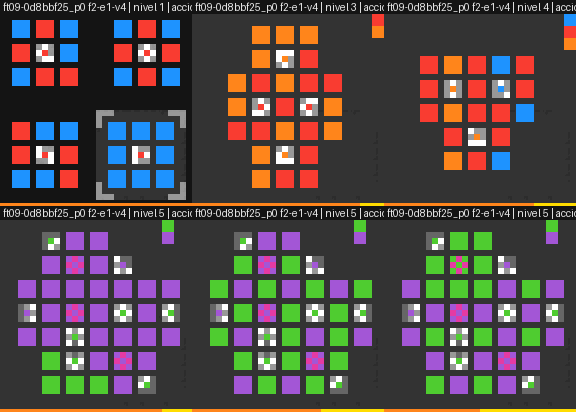
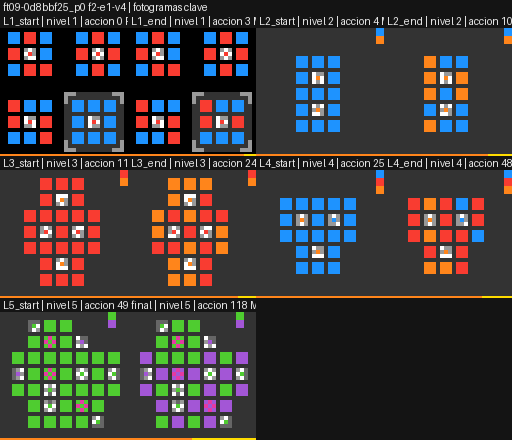
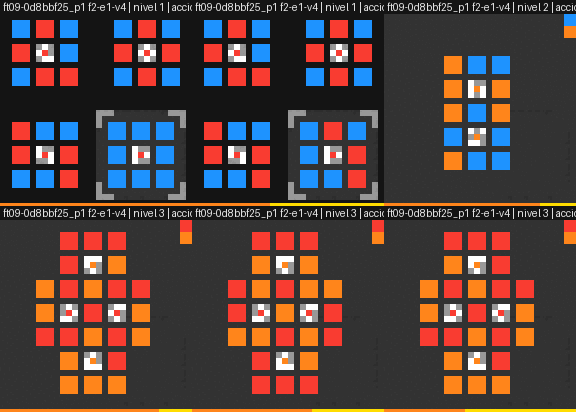
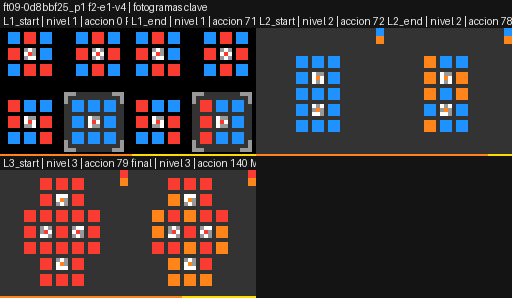
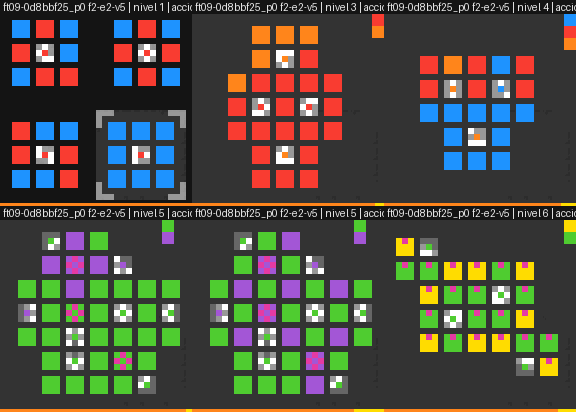
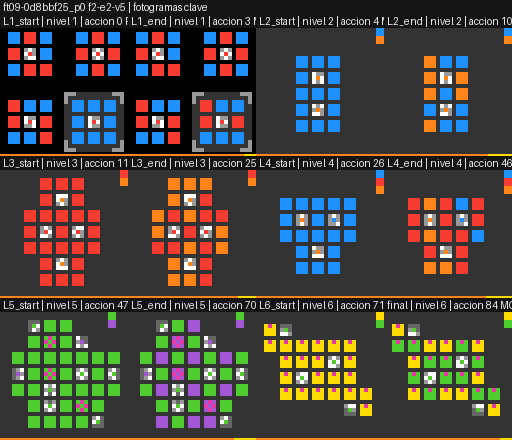
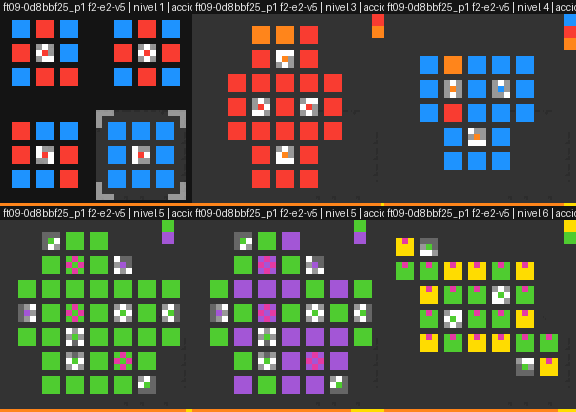
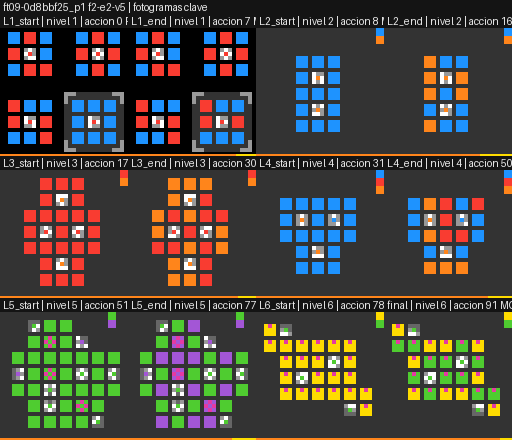
ft09 · 6 niveles · Base (F1): 47,62 / 47,62 · A/A (base repetida): 47,62 / 100,00 · E1: 47,62 / 12,65 · E2: 100,00 / 100,00
Pasada 0: 4 de 6 niveles, con 5, 7, 14 y 28 acciones (un humano usa 43, 12, 23 y 28); se quedó en el nivel 5 con 117 acciones en total. Pasada 1: 4 de 6 niveles, con 4, 7, 14 y 22 acciones (un humano usa 43, 12, 23 y 28); se quedó en el nivel 5 con 103 acciones en total. Puntuación (cap 1,15): 47,62 y 47,62.
…d to make the output match a combination? That seems complex.
Let me try clicking the center cell of BR and see what happens — maybe it "spins" and reveals a color, or maybe clicking center cycles through states.
Also let me check if there's any hidden info in the top-left corner (like a target preview). The board is 64x64 with 4 quadrants; the orange bar at bottom is the timer.
Let me probe: click BR center (47,47).
The spinner-neighbor codings are inconsistent under a single alignment. Testing per-mini alignment offsets as locally-valid options.
…areful: maybe clicking toggles between blue and red only. Let's click (46,38) and (54,38) — centers of blocks at rows 44-49 and 52-57, cols 36-41. Center row = 46, col = 38.
Also the timer bar: orange bar at row 63 shrinking (64 → 62 px). Time remaining 10414s, plenty. Each click costs 1 unit of the bar. Bar has 64 cells; so ~64 clicks max. Fine.
Let me batch the two clicks and then verify the panel matches the mini.
…and the purple count! If yellow ≈ purple_count/1.2... hmm.
Let me test the hypothesis "yellow = f(number of purple cells)" by regressing across frames: for each level-5 frame, record (purple_count, yellow). If yellow is a function of the purple count, that's a HUGE signal — a progress bar!
Let me compute that now. I have the purple count per frame from my earlier table plus yellow. Let me just compute both per frame.
Base (F1)
A/A (base repetida)
E1
E2
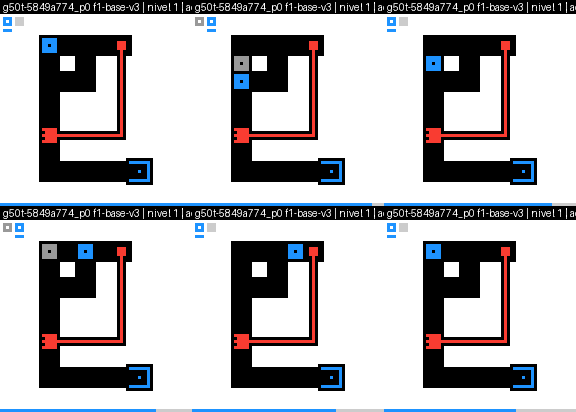
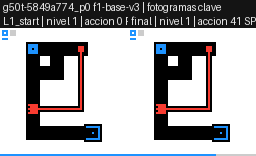
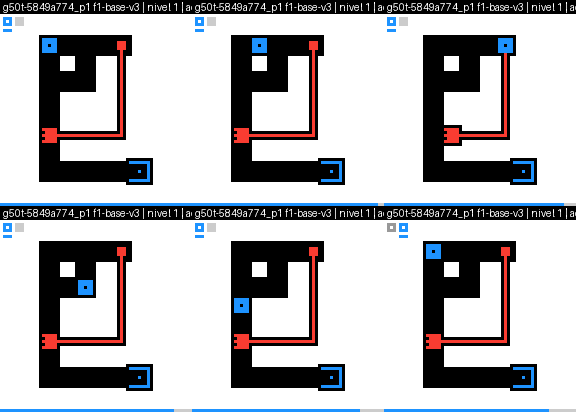
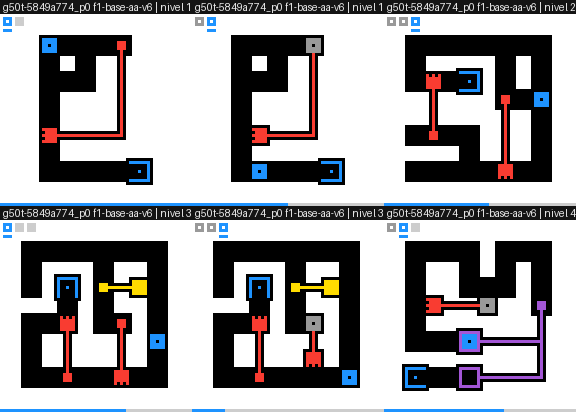
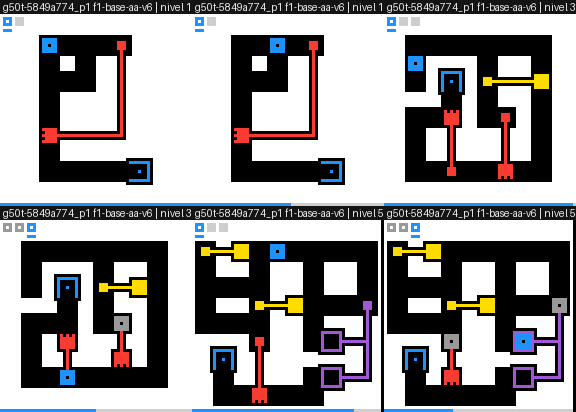
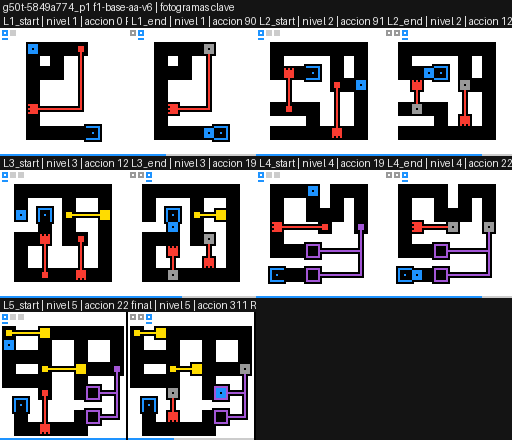
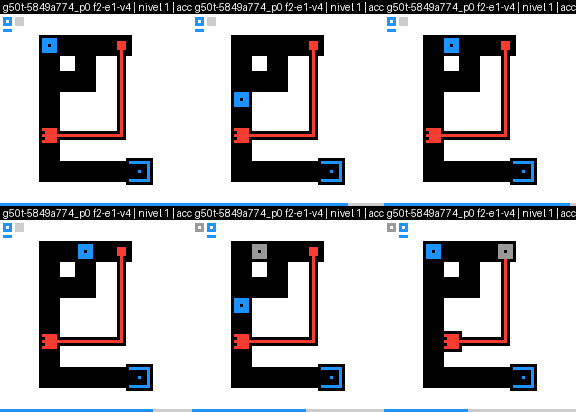
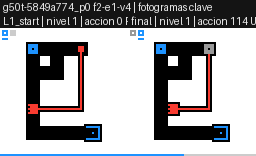
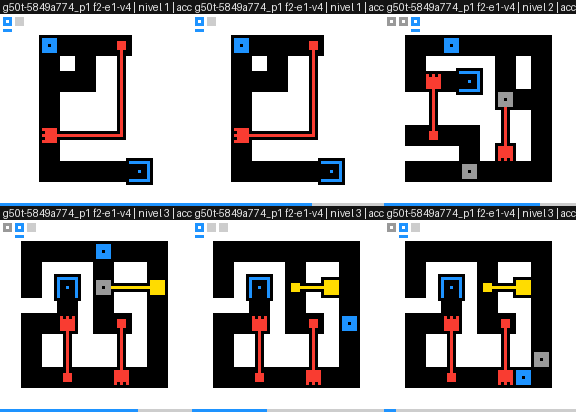
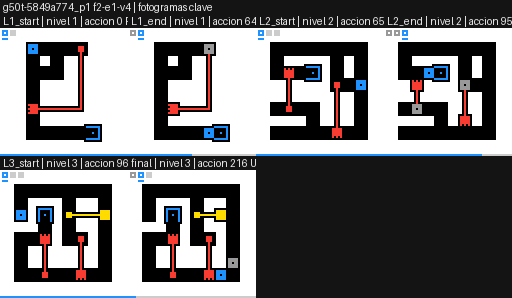
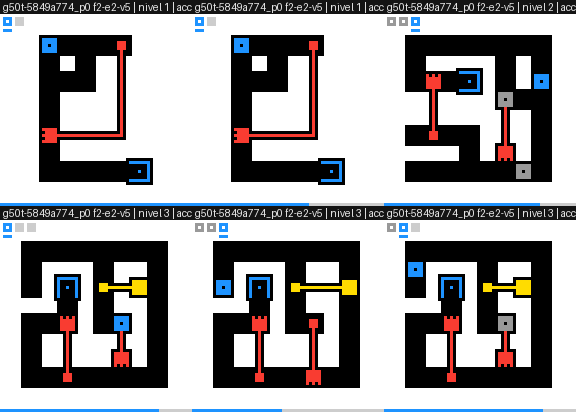
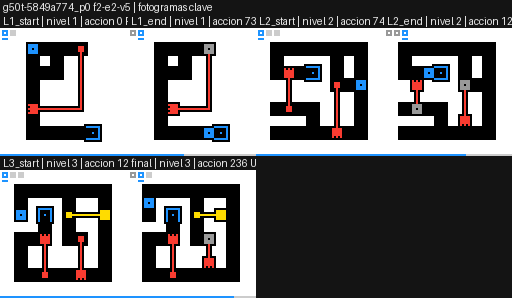
g50t · 7 niveles · Base (F1): 0,00 / 0,00 · A/A (base repetida): 21,43 / 35,71 · E1: 0,00 / 10,71 · E2: 10,71 / 10,71
Pasada 0: no completó ningún nivel (41 acciones). Pasada 1: no completó ningún nivel (19 acciones). Puntuación (cap 1,15): 0,00 y 0,00.
…that now. The player is at (8,14). Plan: RIGHT×4 → (8,38), LEFT → (8,32), RIGHT → (8,38), LEFT → (8,32), and print the red rows 38-42 after each. 8 actions. Worth it.
Actually, more efficient: RIGHT×4 (cover), then LEFT (uncover) → check the head. If the head is at (38,14) → binary. If at (38,20) → progressive. Let me also do a second cycle to see.
Let me run it and print the red cells at row 38 (the head's top row).
…just hidden while covered.
Hmm. So what if the marker is a "key" and covering it changes the HUD? Let me check the HUD at idx 8 vs idx 0! If the HUD changed when the block covered the marker, that would indicate progress. Let me check the HUD in the history frames.
Let me look at the HUD (rows 0-6, cols 0-10) across all history frames. That's cheap and might reveal the mechanic (e.g., a counter of "keys collected").
Base (F1)
A/A (base repetida)
E1
E2
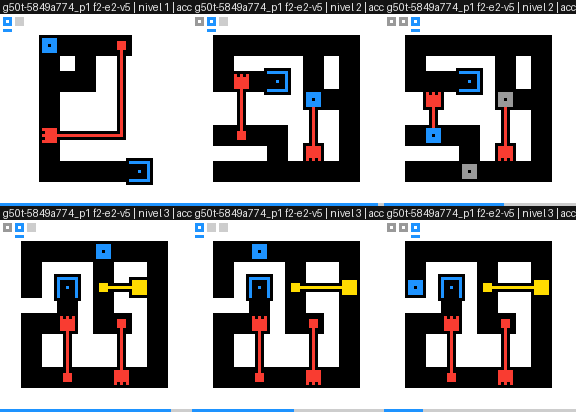
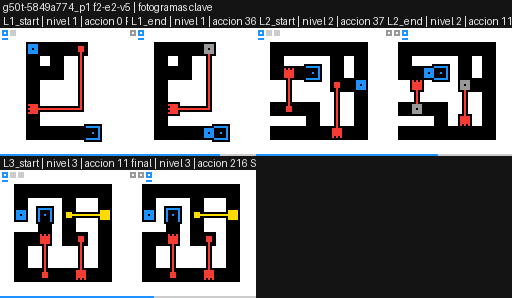
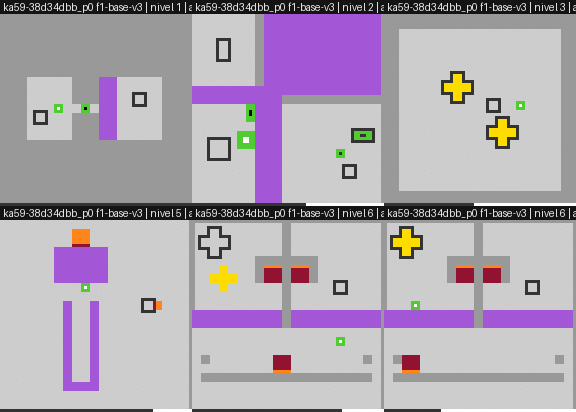
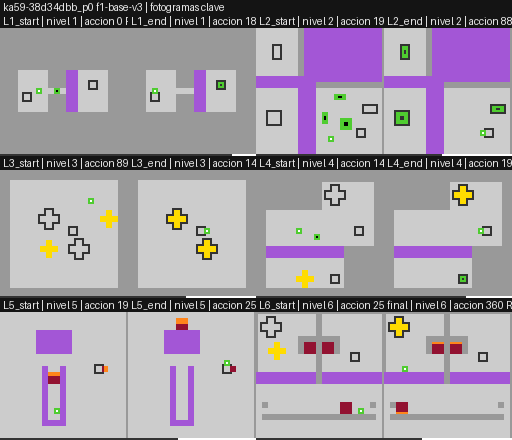
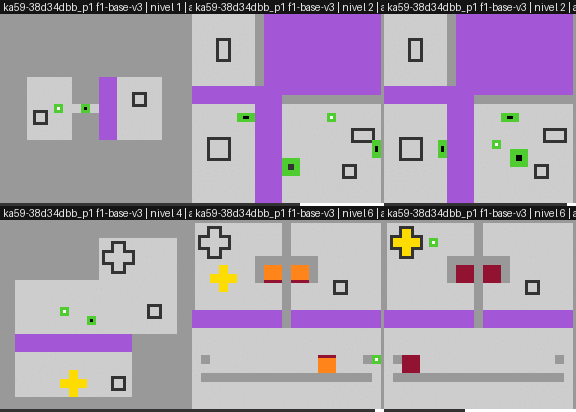
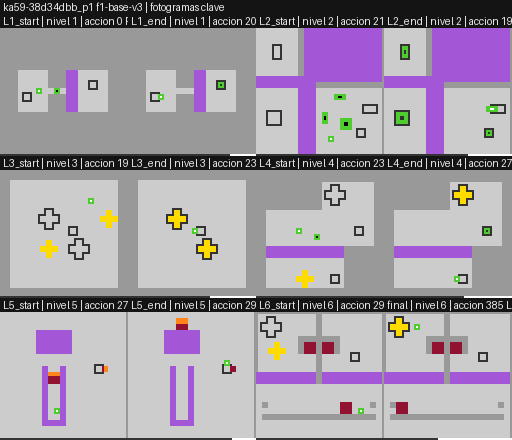
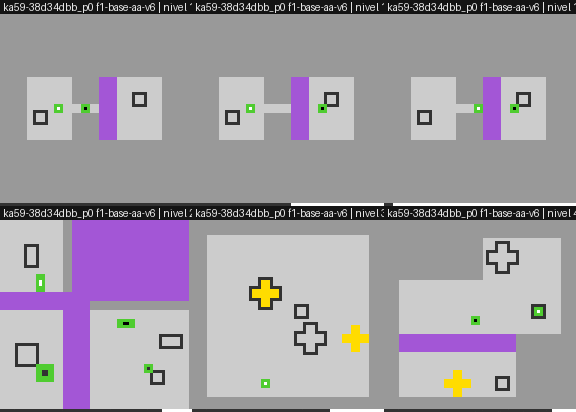
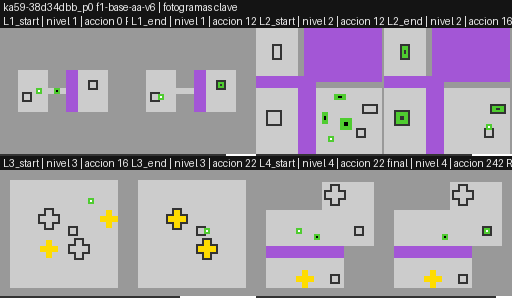
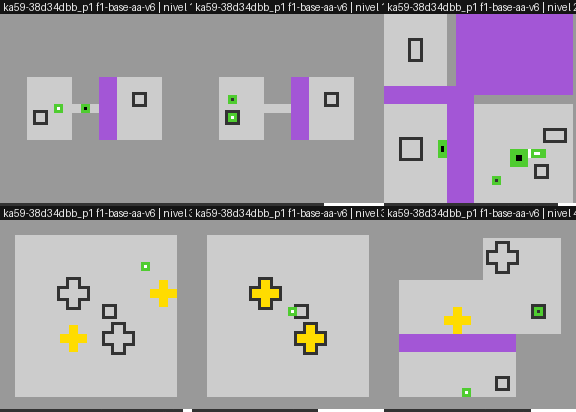
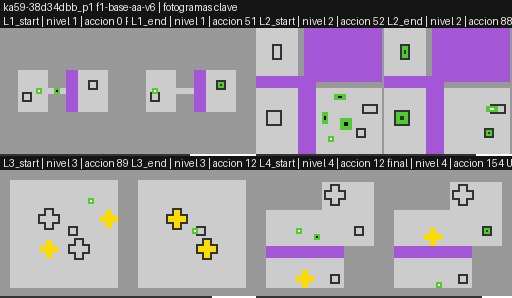
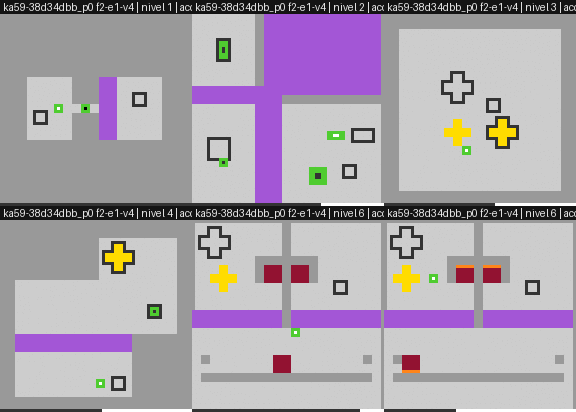
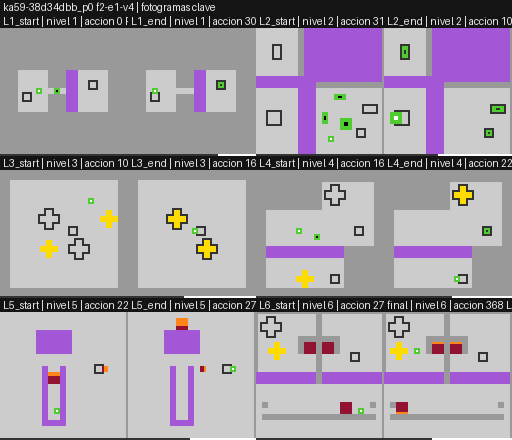
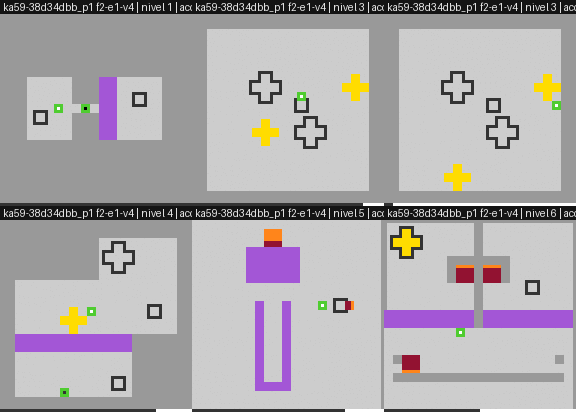
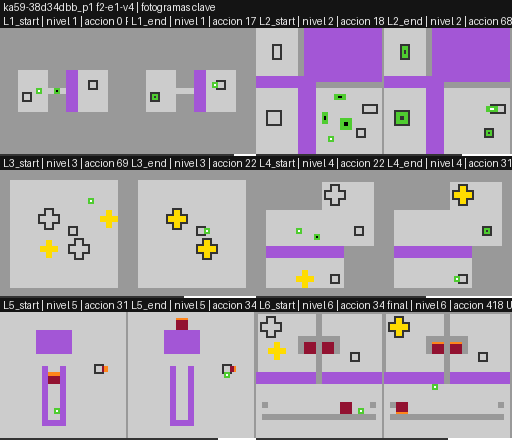
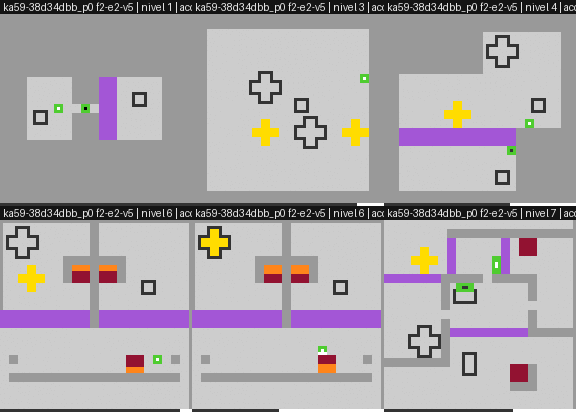
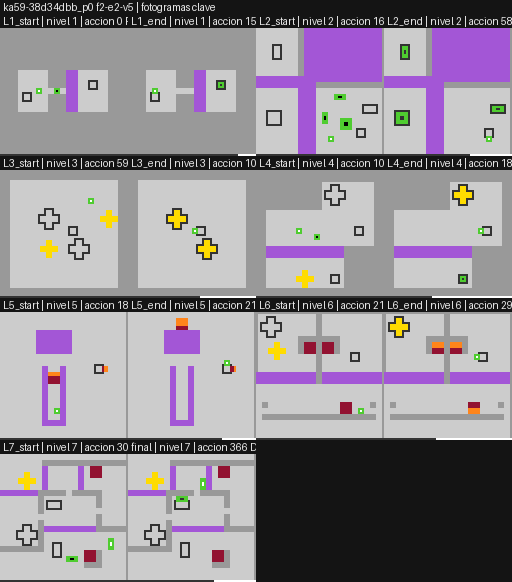
ka59 · 7 niveles · Base (F1): 42,70 / 53,57 · A/A (base repetida): 15,88 / 21,43 · E1: 36,88 / 38,88 · E2: 75,00 / 3,57
Pasada 0: 5 de 7 niveles, con 19, 70, 56, 47 y 62 acciones (un humano usa 28, 109, 51, 51 y 33); se quedó en el nivel 6 con 360 acciones en total. Pasada 1: 5 de 7 niveles, con 21, 173, 37, 48 y 20 acciones (un humano usa 28, 109, 51, 51 y 33); se quedó en el nivel 6 con 385 acciones en total. Puntuación (cap 1,15): 42,70 y 53,57.
…wait: is the crate allowed to be at cols 12-14 rows 30-32 (overlapping the frame's top border at row 32)? Yes, we saw overlap is fine.
One risk: DOWN from rows 30-32 at cols 12-14: rows 33-35 cols 12-14 = interior, floor. Good.
Let me batch LEFT×6, DOWN×1, checking after each with a loop that prints positions. I'll write a loop that executes one action at a time, printing the controlled crate's bbox, so I can verify.
…maybe the bar at the bottom is NOT a budget but something else, and there's no time limit at all — then the level would be permanently stuck (no reset). In that case I should keep exploring. Hmm. The bar shrinks with actions (24 → 19 over 12 actions) — it's a budget. When it hits 0 → game over → reset. Good.
Let me burn ~24 units = ~55 actions. I'll loop batches of 10 and check for game_over, stopping when it fires.
…areful: when moving LEFT from cols 30-32, the box passes through the corridor. Fine.
Also careful: moving the active box LEFT 3 times: after 3 lefts it's at cols 21-23. Is the panel's left region free? Yes.
Let me also double check the left ring hole: rows 33-35, cols 12-14 (node 12 w 9px at [33,12]). Yes.
Let me batch: click, then LEFT LEFT LEFT DOWN LEFT LEFT, and check after each. I'll do it in a loop with prints.
…s 1501s. Now step 386 → maybe ~900s left? Let me check the bottom bar length to estimate. The bottom bar 'c' at row 63 cols 0-30 (31 px) — earlier it was 0-38? Let me check the history: at step 358 it was... I recall the bar was at cols 0-30 now vs 0-38 earlier → hmm, it shrinks by ~1 per ~4 actions? Let me compute the bar length over recent steps to estimate the remaining budget.
Let me do that quickly, then decide.
Base (F1)
A/A (base repetida)
E1
E2
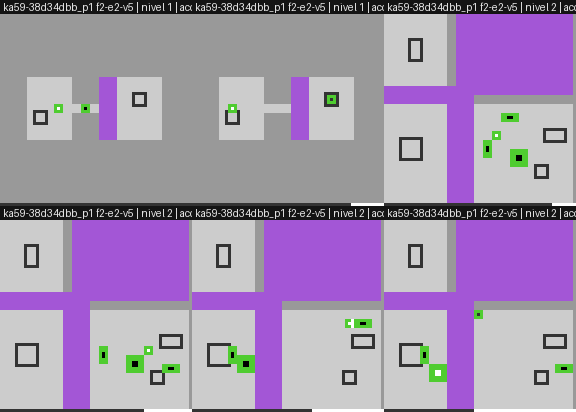
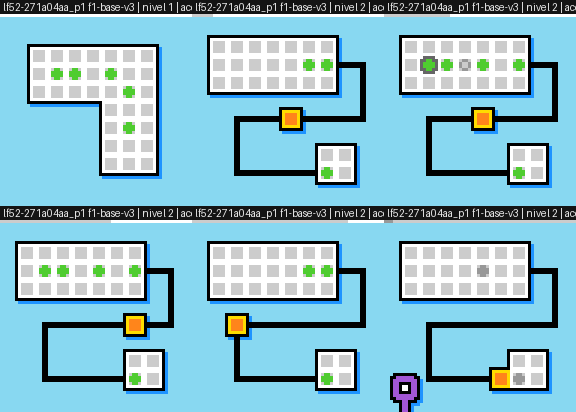
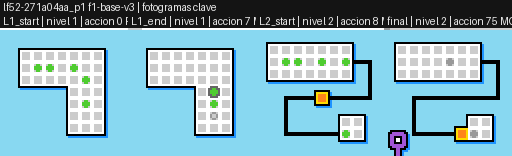
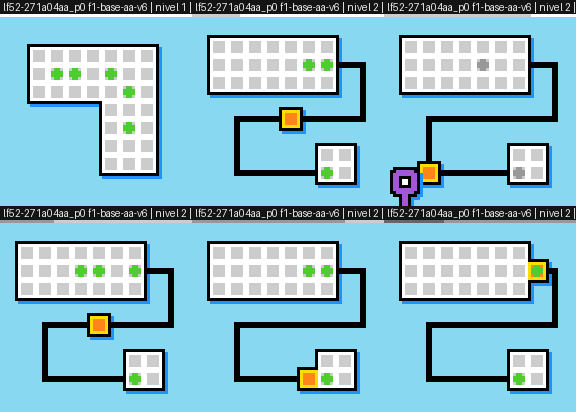
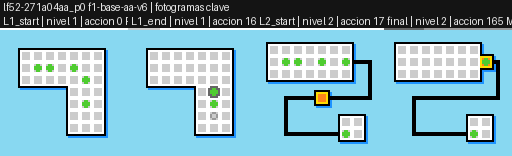
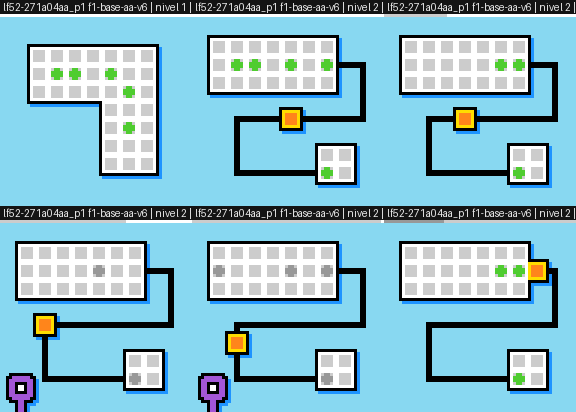
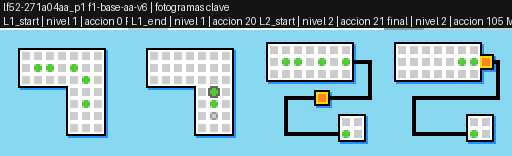
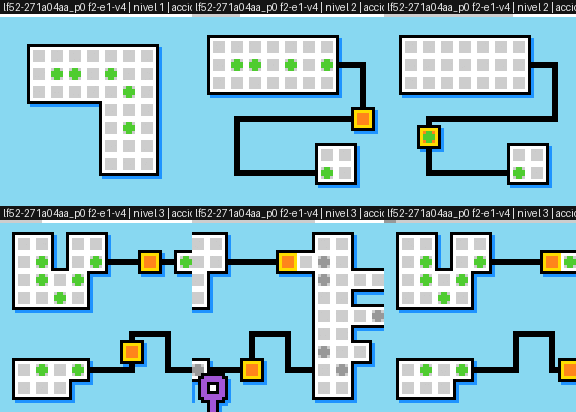
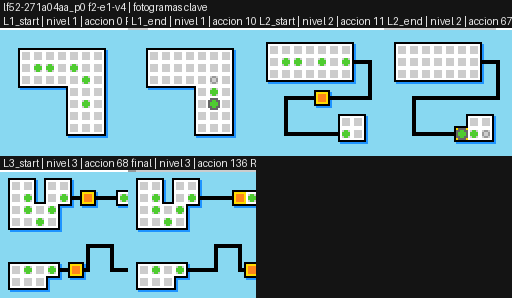
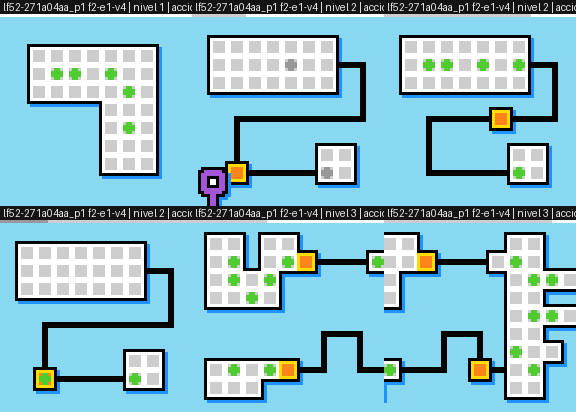
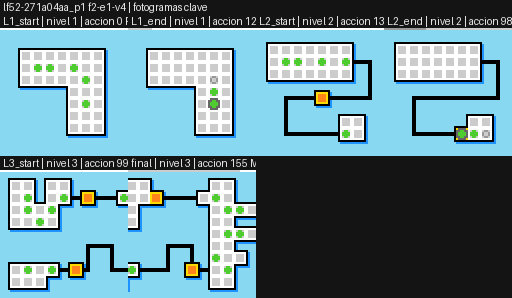
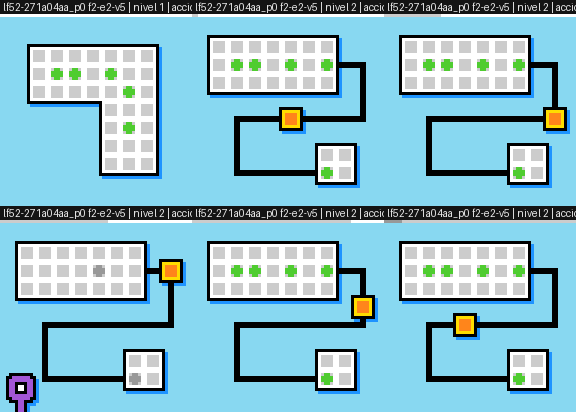
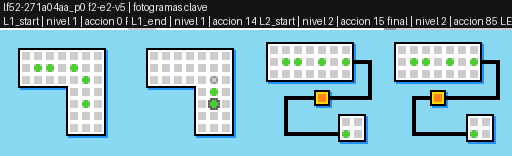
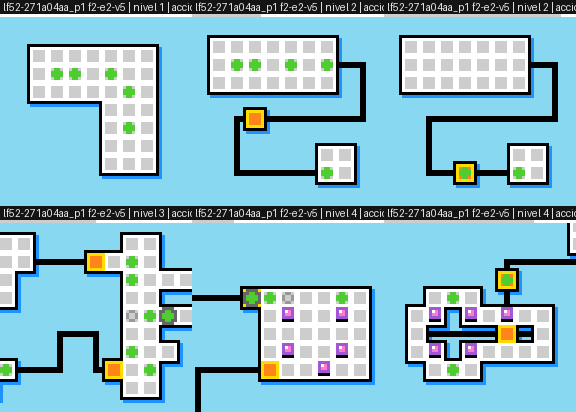
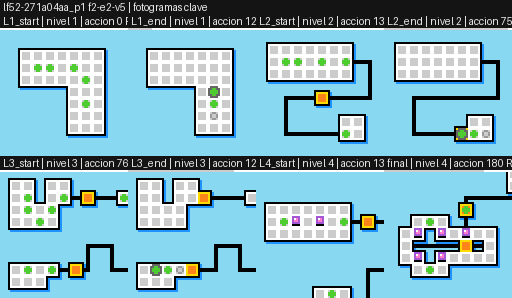
lf52 · 10 niveles · Base (F1): 5,45 / 1,82 · A/A (base repetida): 1,82 / 1,82 · E1: 5,45 / 5,32 · E2: 1,82 / 10,91
Pasada 0: 2 de 10 niveles, con 16 y 76 acciones (un humano usa 32 y 81); se quedó en el nivel 3 con 133 acciones en total. Pasada 1: 1 de 10 niveles, con 8 acciones (un humano usa 32); se quedó en el nivel 2 con 75 acciones en total. Puntuación (cap 1,15): 5,45 y 1,82.
…st pair, verify, then batch the rest.
Actually, let me be efficient but safe: batch pair 1, check state, then batch pairs 2 and 3 with verification in between via separate calls. Let me do pair 1 now and check.
Actually, I can do a loop in Python: for each (peg, landing) pair: click peg, verify ghost at landing, then click landing, verify peg count decreased. Let me write that with verification and abort on mismatch.
…,10),(7,11) in D; (7,1),(7,3) in C. Lamp2 at (7,9), lamp1 at (1,8).
Let me click the peg at (2,11) and read the ghosts. With Δc=24: view px = world px - 24. World (2,11) interior top-left = (18, 72) → view (18,48) → center (20,50).
Let me click and read ghosts (color? earlier the ghost appeared as a gray cross — let me detect 'w' nodes with 12 px, or 'g'/'G' colors).
Let me click and dump ALL small nodes with colors.
…ed (19,18) before which worked for cell (1,1). Fine, use row = rowc[r]+1 and col = colc[c]+1.
Move 2: peg (1,3) → click (19,30); landing (1,5) → click (19,42).
Move 3: peg (1,5) → click (19,42); landing (3,5) → grid row 3 → rows 30-33, center 31; col 41-44 center 42 → click (31,42).
Move 4: peg (3,5) → click (31,42); landing (5,5) → grid row 5 rows 42-45 center 43 → click (43,42).
Let me do move 2 pair first, verify.
Stuck state: pegs grayed at idx4 and C(7,6); the key appeared at (52,4). The orange cell stayed at the bottom-right (adjacent to panel C) after the stuck state ✓ (the orange cell's position persists across the stuck state).
Now click the key to restart, then run the v3 test.
Note: after restart, will the orange cell return to its initial position? Let's check.
Base (F1)
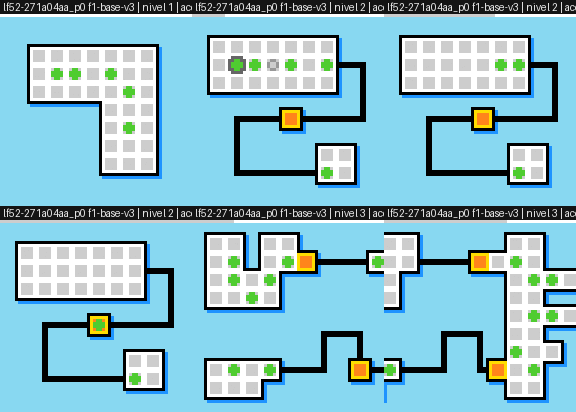
A/A (base repetida)
E1
E2
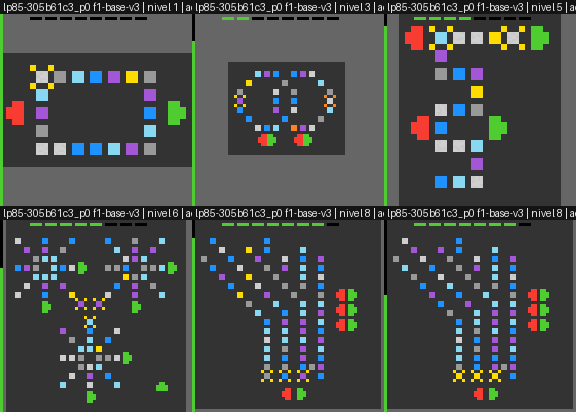
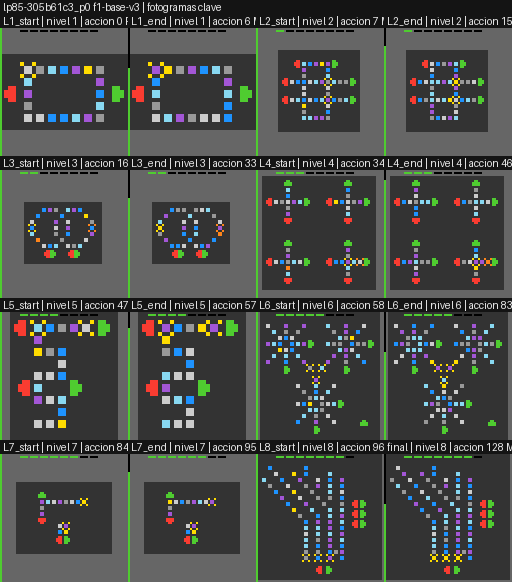
lp85 · 8 niveles · Base (F1): 100,00 / 100,00 · A/A (base repetida): 100,00 / 100,00 · E1: 100,00 / 100,00 · E2: 41,67 / 100,00
Pasada 0: completó los 8 niveles en 128 acciones (un humano usa 388). Pasada 1: completó los 8 niveles en 118 acciones (un humano usa 388). Puntuación (cap 1,15): 100,00 y 100,00.
…licks. Hmm, but the top black segments (8) might be the real move budget.
Actually wait: the appeared B at rows 0-4 col 0 — maybe it's not a bar shrinking; maybe black bar appears at the top-left corner as a "timer" counting up? Let me check current state of col 0 and the top bar.
Let me also test the green arrow to see if it rotates CW.
Plan: inspect current board HUD (col 0, row 1), then click green arrow and diff.
…block is at the exit, then click the green arrow to release it. But which block is "correct"?
Let's test clicking the green arrow and see what happens. That costs a step but gives info. Note the budget: 59/5 ≈ 11 steps left. Let's do it.
Actually wait. Let me first reconsider: maybe clicking the green arrow rotates the ring in the opposite direction, which is the more likely design (two rotation buttons). Let's test.
Base (F1)
A/A (base repetida)
E1
E2
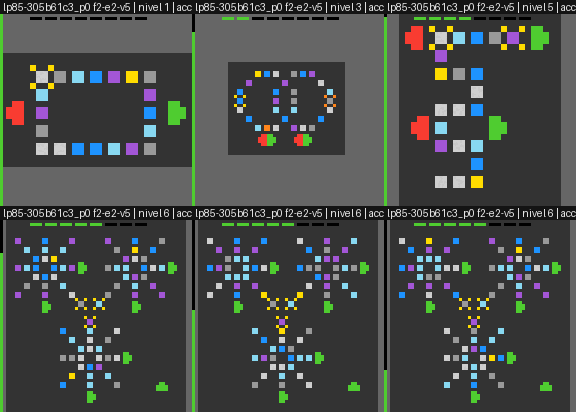
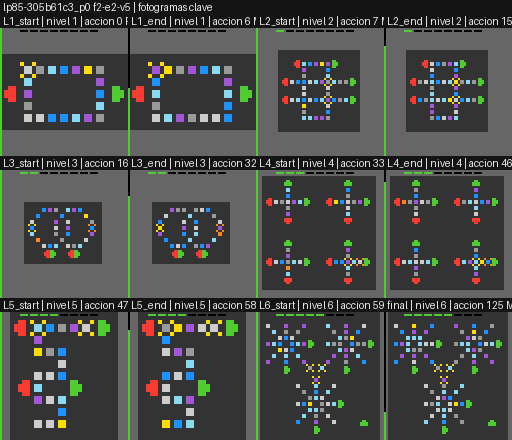
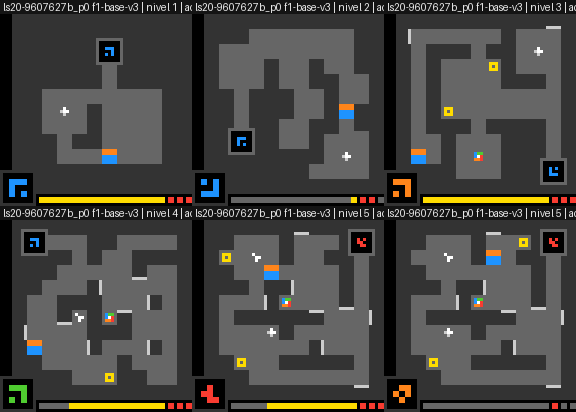
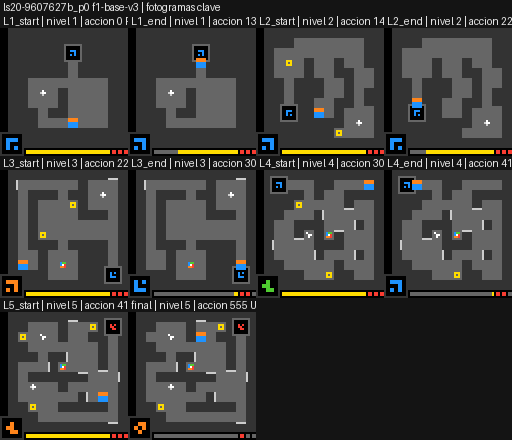
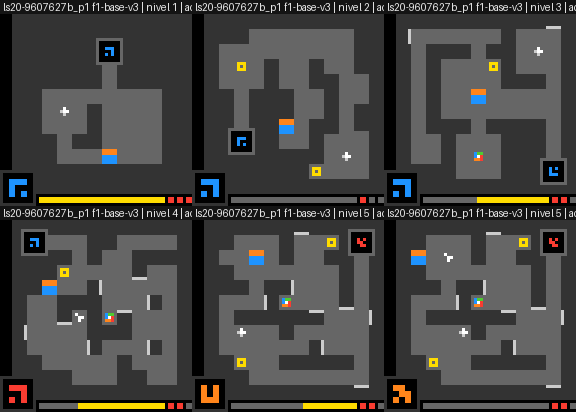
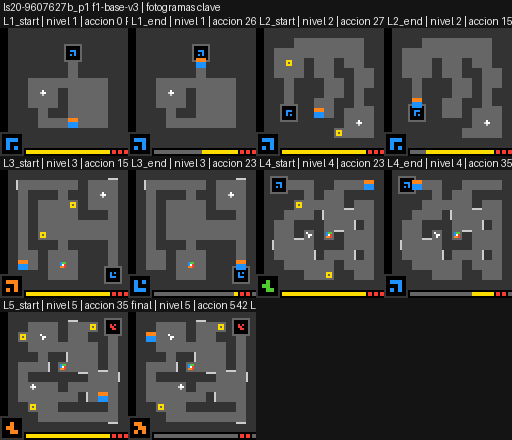
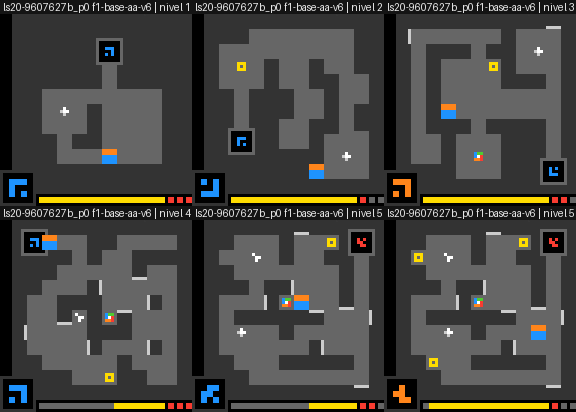
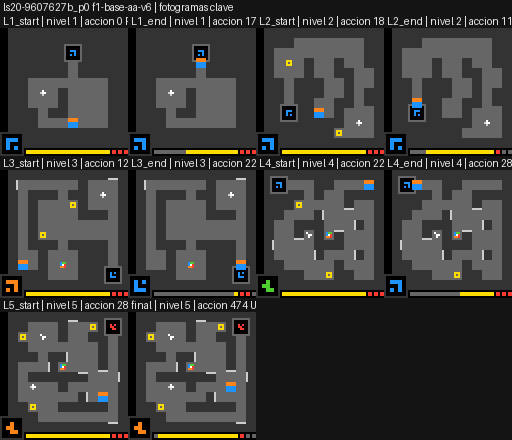
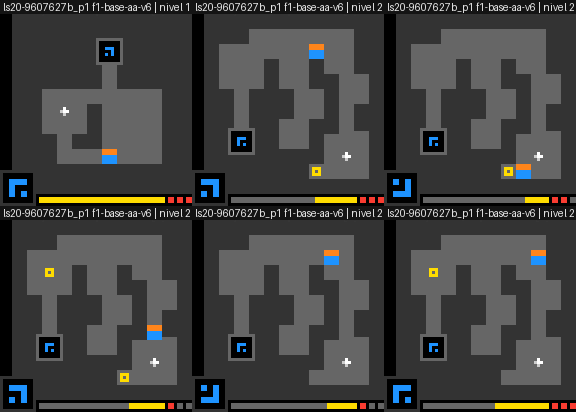
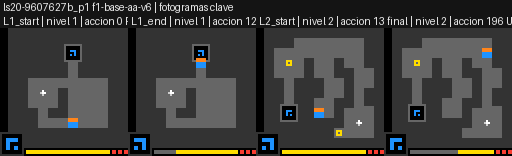
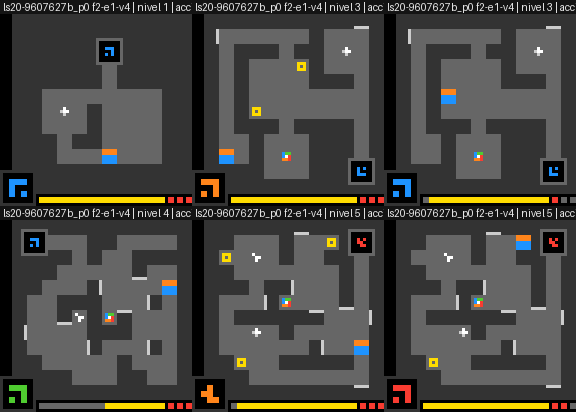
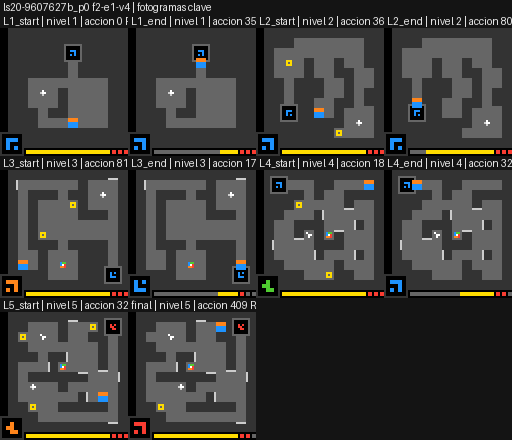
ls20 · 7 niveles · Base (F1): 22,83 / 24,20 · A/A (base repetida): 34,13 / 3,57 · E1: 20,17 / 32,85 · E2: 26,11 / 3,00
Pasada 0: 4 de 7 niveles, con 14, 207, 86 y 109 acciones (un humano usa 22, 123, 73 y 84); se quedó en el nivel 5 con 555 acciones en total. Pasada 1: 4 de 7 niveles, con 27, 126, 85 y 119 acciones (un humano usa 22, 123, 73 y 84); se quedó en el nivel 5 con 542 acciones en total. Puntuación (cap 1,15): 22,83 y 24,20.
…ent the block covered the plus. Maybe the logo is a "compass" showing the direction you should go next? Or it's the game's logo doing a spin flourish.
Now, the block is at rows 20-24 in the corridor, right below the box frame (row 16 is the frame; rows 17-19 corridor above it). Next UP target: rows 15-19 → row 15 is black (box interior) and row 16 is G frame. Let's test if it can move up into/through.
Let's press UP.
…moves toward RA + 1 extra → death. Then next turn: plan the full run from the fresh level.
Hmm, one consideration: after the reset, will the shape/color reset to S0/orange? Yes (the level resets fully).
Let me do it: send ['DOWN','RIGHT','RIGHT','RIGHT','UP','UP'] (the first 5 move toward RA; the 6th triggers death). Actually if the bar dies at action 5, the 6th may not execute (the level resets on the death). Fine.
…ects flashed (both boxes? the corridor?).
Actually, hmm: the timeline bbox is rows 9-62, cols 1-39, which includes the top box (rows 9-15, cols 33-39) and the legend (rows 53-62, cols 1-10). Both flash. But also 'O>G' and 'G>O' etc. are the player moving (frame 0 = before-move state? no...). Actually the animation frame 0 might be an intermediate.
Let me diff the animation frames to find the white cells' coordinates.
…the shape? No, the capsule only changes the dial color ✓. Does a plate press change the color? No ✓.
Now, the death: trigger it with a harmless move. Let me move RIGHT (back to (10,14)) → death → reset.
Actually, hmm, one thought: maybe I don't need to die! Is there any chance the game only kills when the budget is 0 AND ... no, evidence is clear.
Let me trigger the death and immediately prepare the execution script.
Base (F1)
A/A (base repetida)
E1
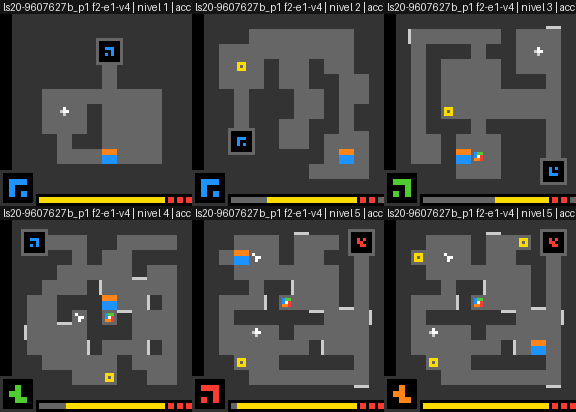
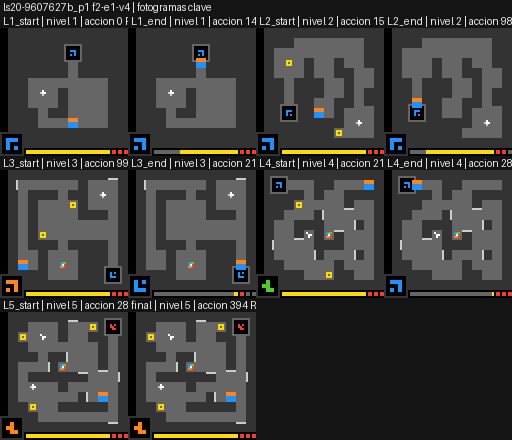
E2
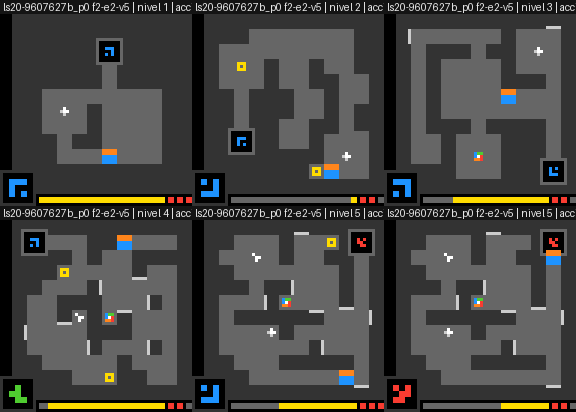
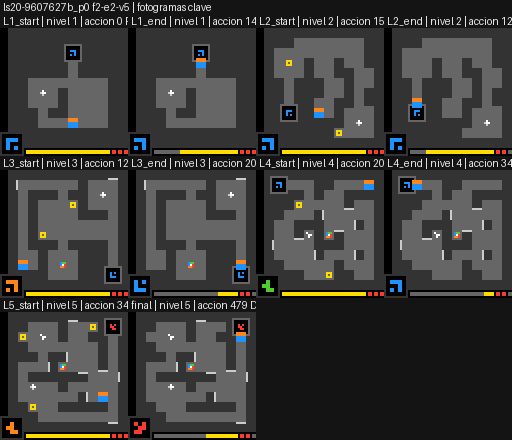
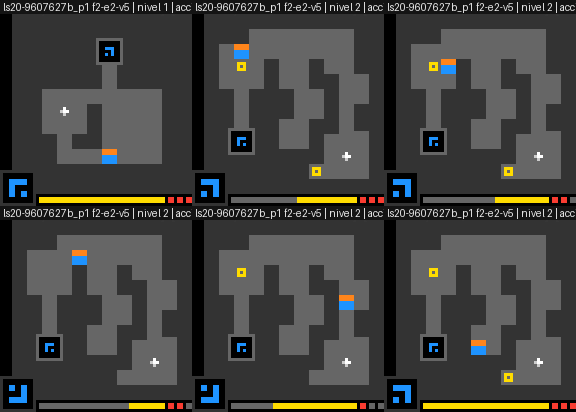
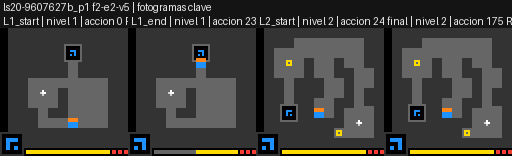
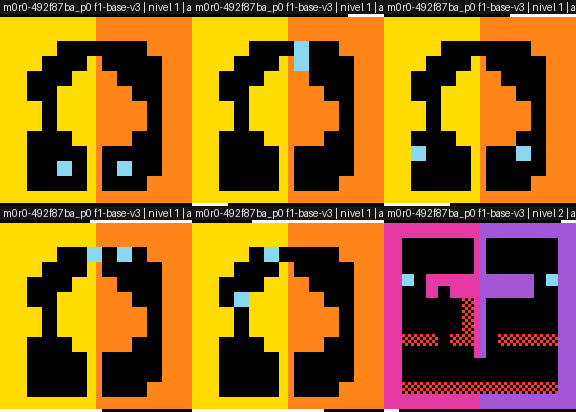
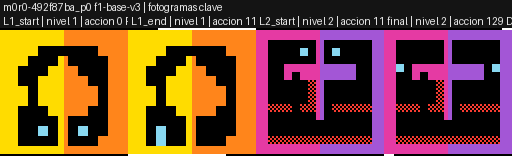
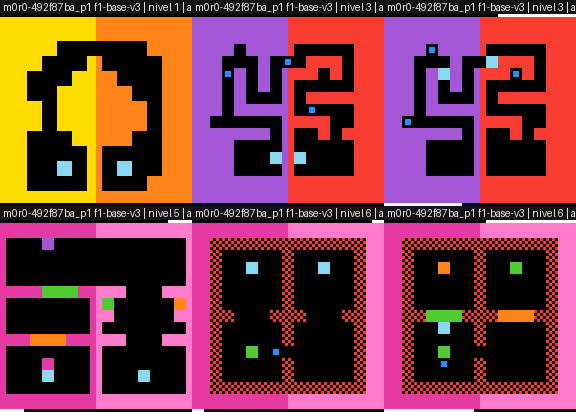
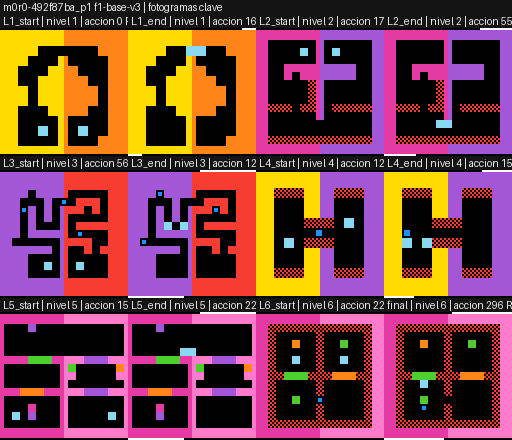
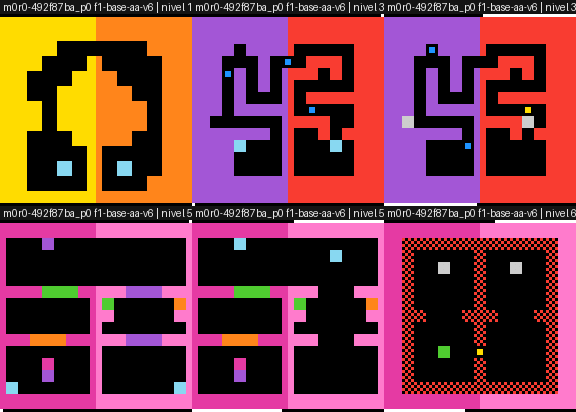
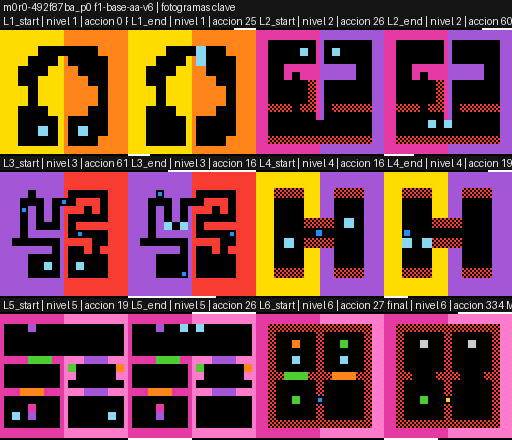
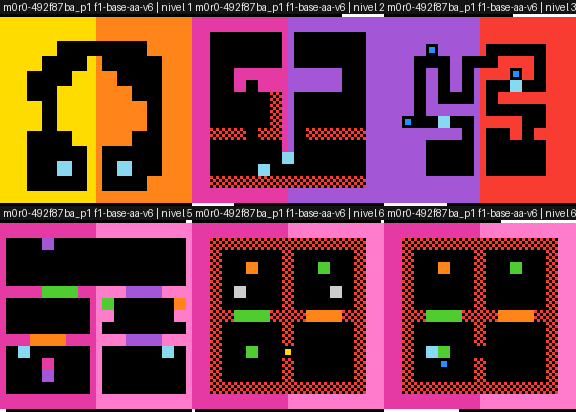
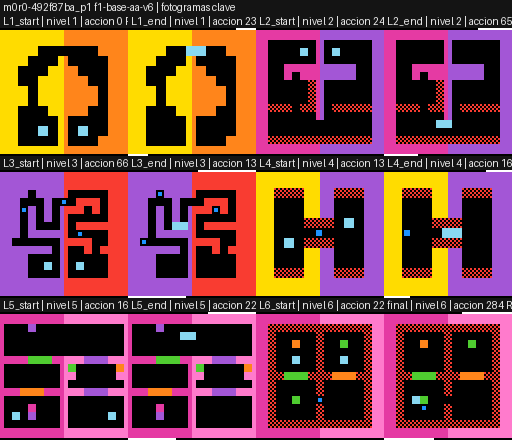
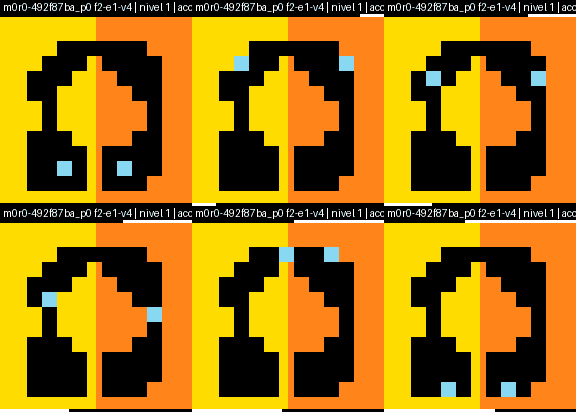
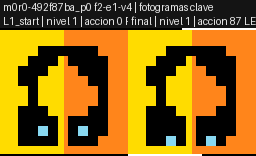
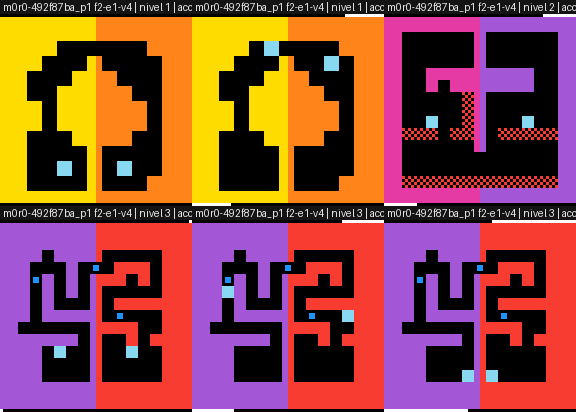
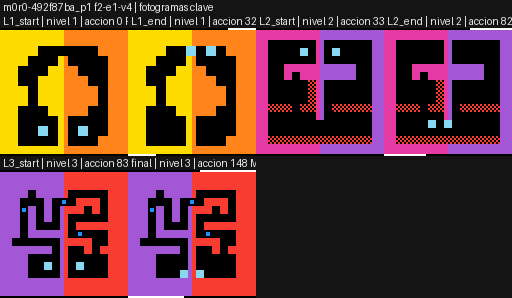
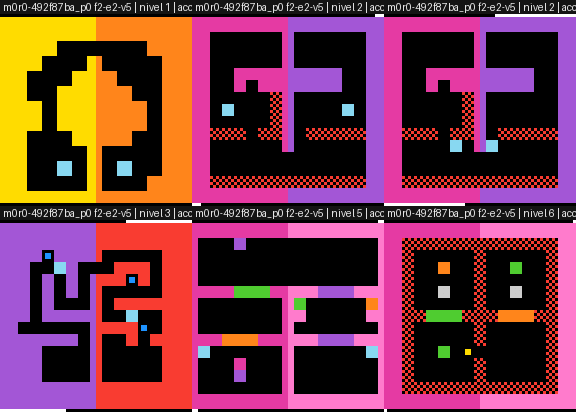
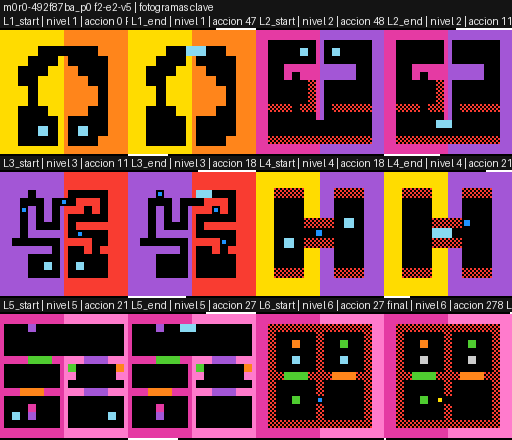
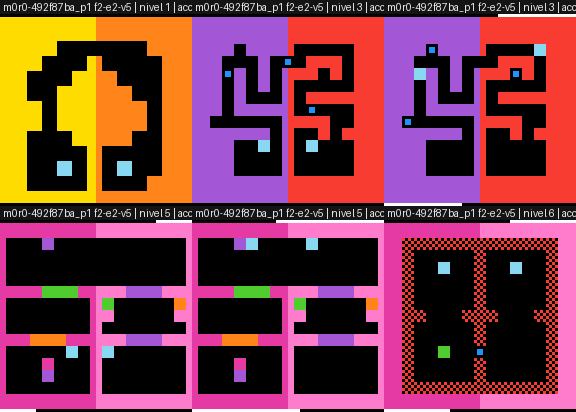
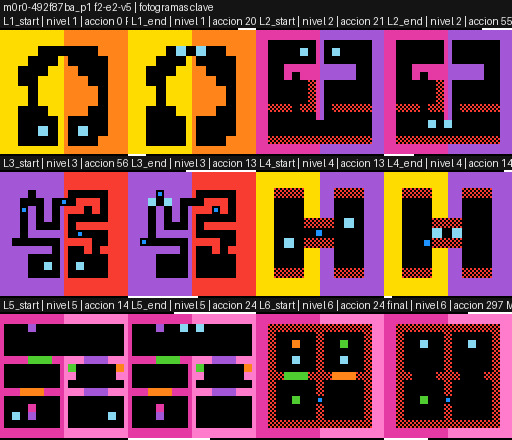
m0r0 · 6 niveles · Base (F1): 0,31 / 100,00 · A/A (base repetida): 71,43 / 100,00 · E1: 0,00 / 14,29 · E2: 70,02 / 71,43
Pasada 0: 1 de 6 niveles, con 117 acciones (un humano usa 30); se quedó en el nivel 2 con 129 acciones en total. Pasada 1: completó los 6 niveles en 296 acciones (un humano usa 1107). Puntuación (cap 1,15): 0,31 y 100,00. Las pasadas difieren mucho: en este juego el ruido de la base es grande.
Lroom was defined in a previous snippet's locals but not retained (it's a variable, not a function). Let me define a helper function that builds the rooms — or just inline the sets. Note: inroomL(s)/inroomR(s) are retained functions — let me check what they do (they were defined earlier). Let me just use them.
Let me print their source? I can't easily. Let me just inline the room sets.
…s 13-16: DOWN×4 → left (8,3)→(9,3)→(10,3)→(11,3)→ blocked at (12,3) hazard → stays (11,3). Right: (7,7)→(8,7) ✓ the gap! →(9,7)→(10,7)→(11,7) ✓.
Final: left (11,3), right (11,7) ✓ both at row 11.
Then DOWN: both try row 12 (hazard). Test!
Let me run this with verification, then the DOWN test.
I'll run the 16 moves with per-step verification, then a separate action call for DOWN so I can carefully observe the outcome.
The batch format needs full action names: 'LEFT','UP','RIGHT','DOWN'. My dict used {'action': 'L'} — wrong. Let me map letters to names and re-execute.
Note the step count: history has 5 entries with steps [0,1,2,3,4] — so the environment step is 4 now? Earlier it said step 5. Whatever; the bar had 62 black at step 4 → budget 64 total. Let me now execute the correct sequence.
Base (F1)
A/A (base repetida)
E1
E2
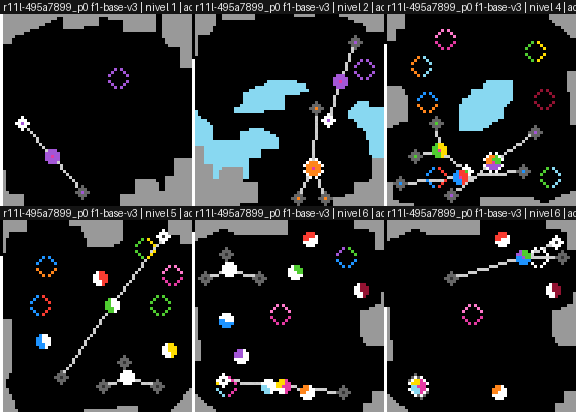
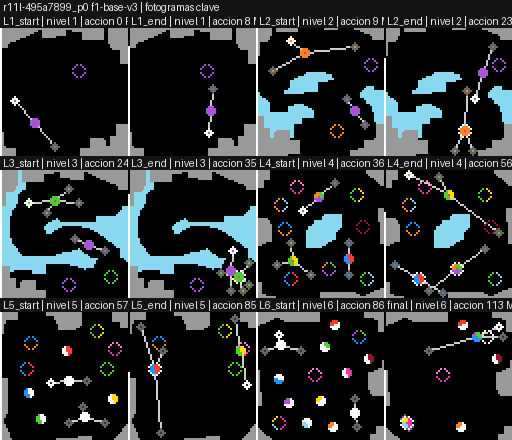
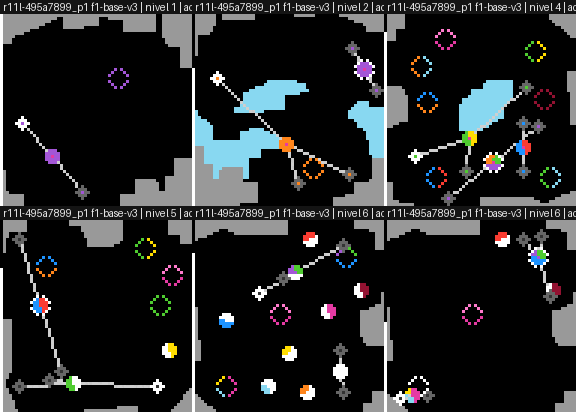
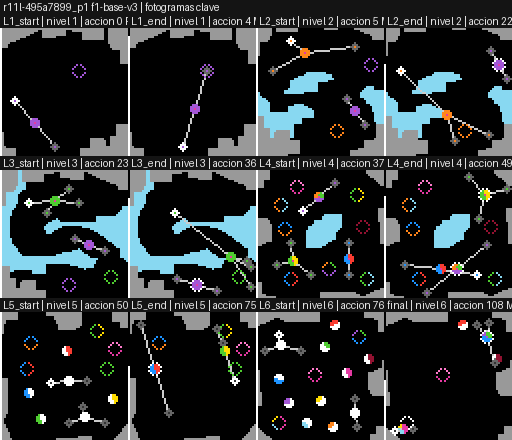
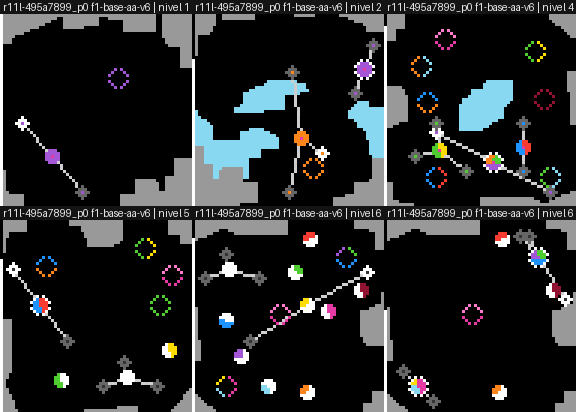
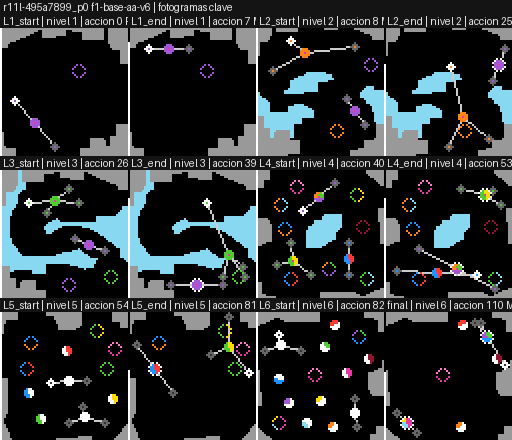
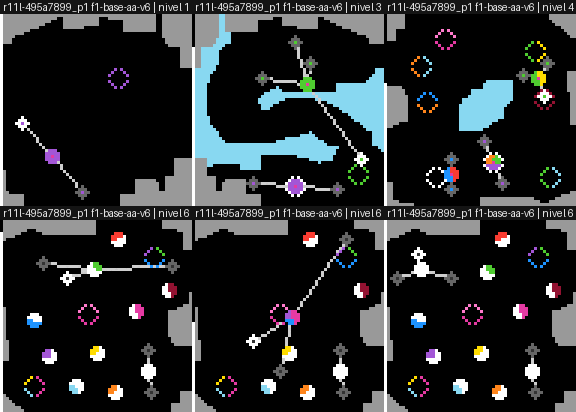
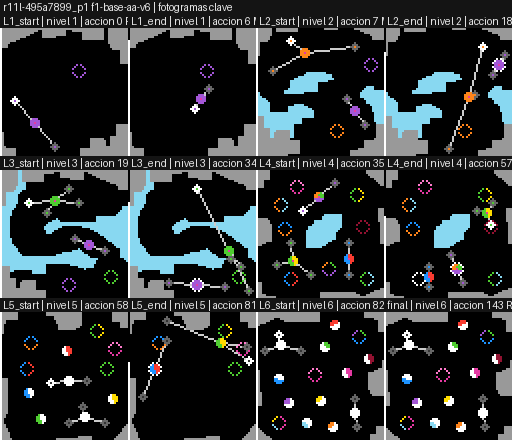
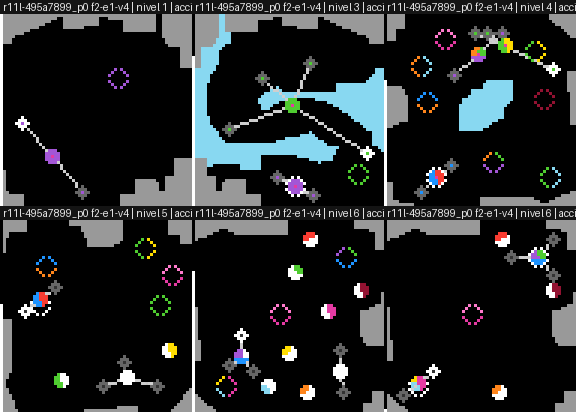
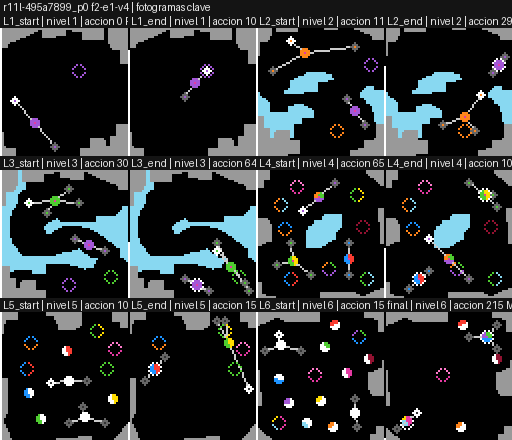
r11l · 6 niveles · Base (F1): 100,00 / 100,00 · A/A (base repetida): 100,00 / 71,43 · E1: 84,40 / 71,75 · E2: 100,00 / 100,00
Pasada 0: completó los 6 niveles en 113 acciones (un humano usa 233). Pasada 1: completó los 6 niveles en 108 acciones (un humano usa 233). Puntuación (cap 1,15): 100,00 y 100,00.
…st: 3 clicks. We have ~57 steps left. Even if wrong, cheap.
But maybe a cheaper test first: is the goal maybe to get the *white* diamond to the ring while the gray... no, we already tried that.
Hmm, one more consideration: maybe the goal is to get the blob to the ring, but the ring might be a "hole" that the blob must fall into... whatever, same condition.
Let me check the black region membership for candidate cells.
…G=(21,39). Purple = (18,42).
2. Click (21,39) [gray's location] → swap: W=(21,39), G=(15,45). Purple = (18,42).
3. Click (27,33) → W=(27,33), G=(15,45). Purple = (21,39) = ring center.
Let me verify (15,45) and (27,33) are inside the black region and not on the ring or other objects. Ring spans rows 18-24, cols 36-42. (15,45) is outside the ring rows. Good.
Let me check the ascii at those cells first, then execute.
Base (F1)
A/A (base repetida)
E1
E2
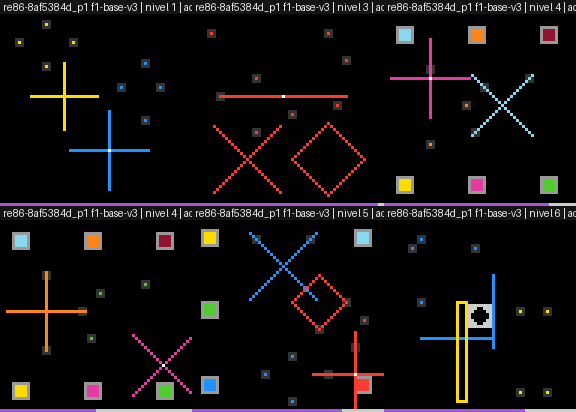
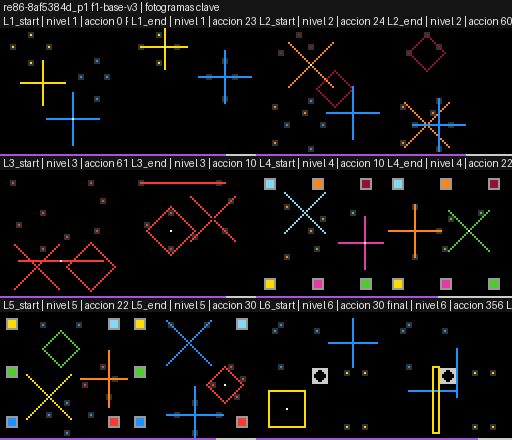
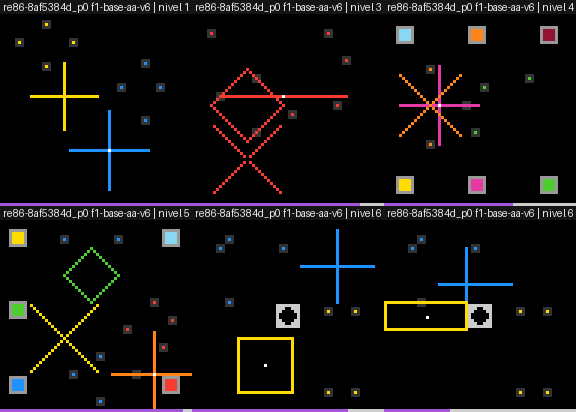
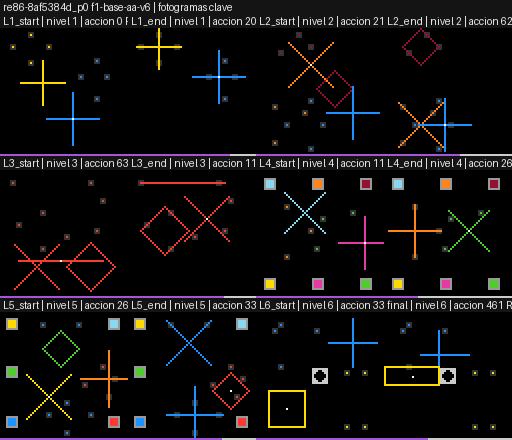
re86 · 8 niveles · Base (F1): 58,33 / 41,67 · A/A (base repetida): 40,22 / 41,67 · E1: 58,33 / 77,78 · E2: 41,67 / 41,67
Pasada 0: 6 de 8 niveles, con 20, 42, 48, 57, 79 y 99 acciones (un humano usa 26, 42, 86, 108, 189 y 139); se quedó en el nivel 7 con 408 acciones en total. Pasada 1: 5 de 8 niveles, con 24, 37, 47, 116 y 79 acciones (un humano usa 26, 42, 86, 108 y 189); se quedó en el nivel 6 con 356 acciones en total. Puntuación (cap 1,15): 58,33 y 41,67.
…9,24) ✓.
Plan: batch UP×6, LEFT×2, then inspect. Then decide.
Actually careful: consuming dots via sweeping — order matters not. Let me also double check that yellow dots get consumed by the yellow cross (they should, matching color). Also, does the blue cross consume yellow dots? Probably not (color mismatch) — the blue cross passed near yellow dots? Not really.
Let's do it: batch 6 UP + 2 LEFT, checking after each.
…the 4 R dots, it must STAY there while I position the other two objects ✓ (they don't collide with it ✓ objects pass through each other).
Let me execute the pink path in 2 batches (14 + 13) and verify the state after each batch against the model's prediction. Let me first compute the predicted state sequence so I can compare.
Batch 1: the first 14 presses; predicted state after 14 presses. Let me compute with pstep2.
…hether the yellow cross is still intact.
Hmm, but the yellow cross currently: after SPACE, the diff shows the yellow cross center became white and the arms got restored to full (45 pixels? resized shows Y before 45 at [16,10] → after 11 at [16,21]... that's segmentation splitting due to color change of center). And blue became one object of 53 pixels (all 4 arms joined through the center now blue).
Let's test UP x 6.
…hen action(['UP']*2) → check.
Let me be careful about the budget: the bar. Let me also read the bar each time.
Let me implement loopgeom(fr) that returns (t,bo,l,ri,n) excluding the 4 yellow dot pixels (which are at fixed positions (30,45),(30,54),(57,45),(57,54)).
Also note: when the loop is selected, its marker 'W' appears on it, which doesn't affect the loop's geometry (the marker is white, not yellow).
Let me go.
Base (F1)
A/A (base repetida)
E1
E2
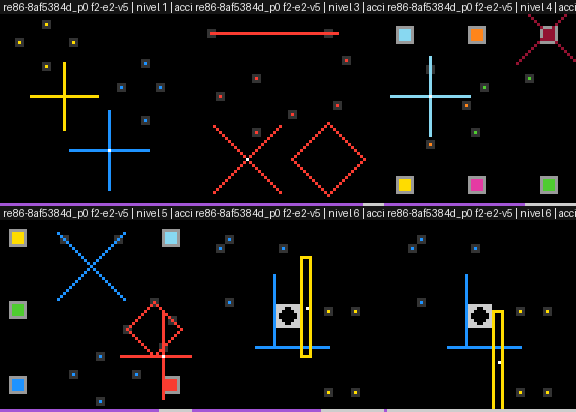
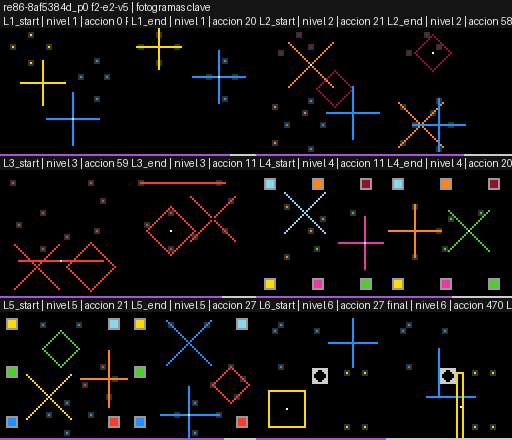
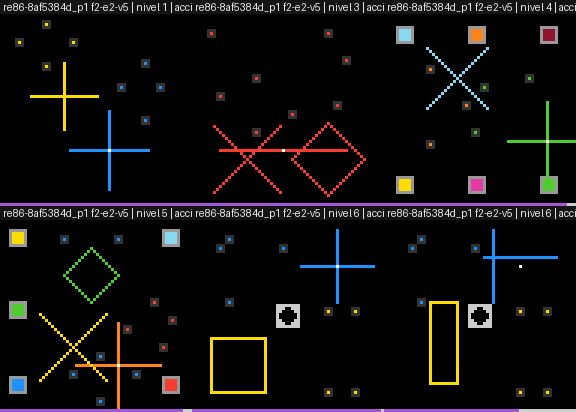
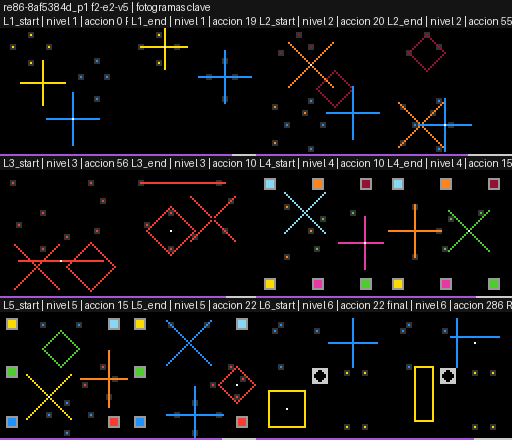
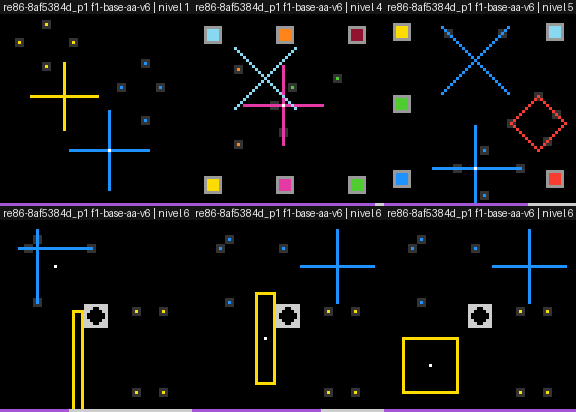
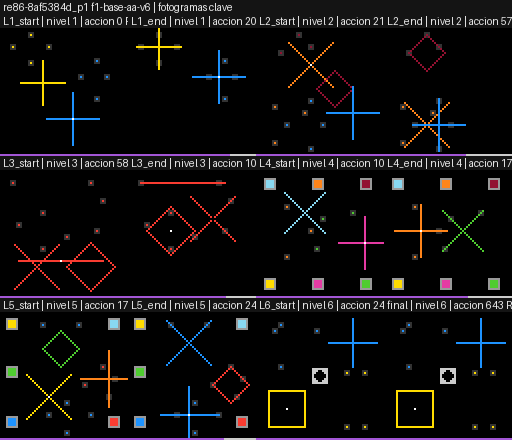
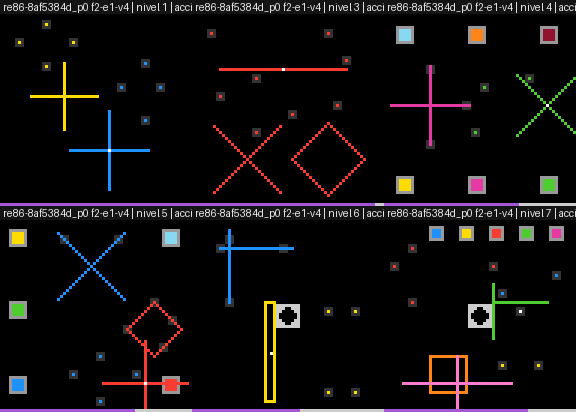
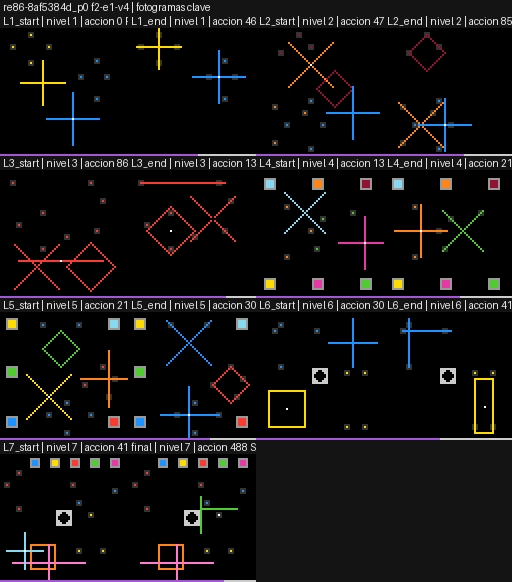
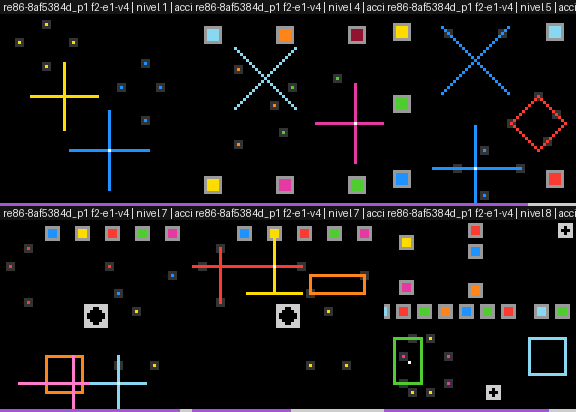
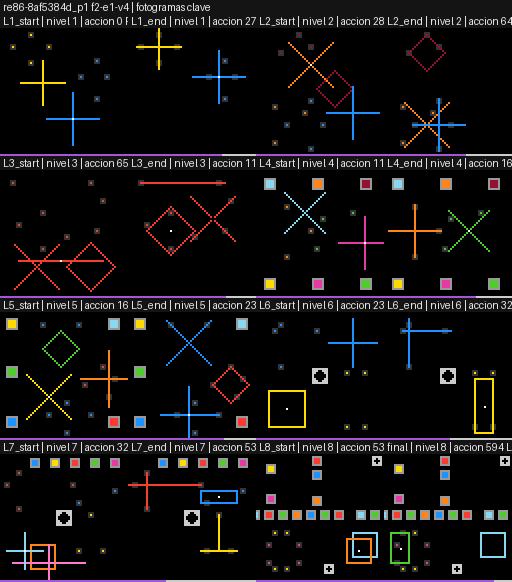
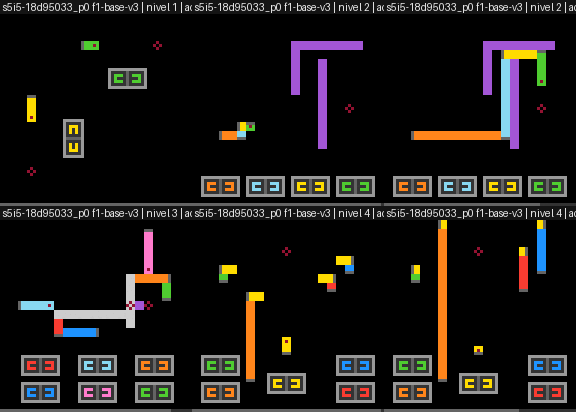
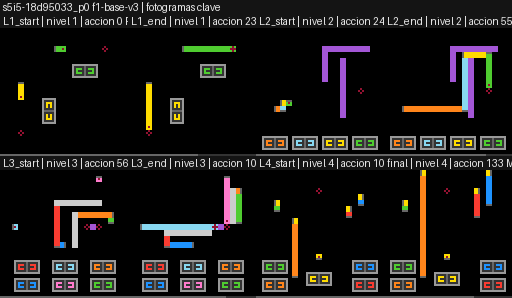
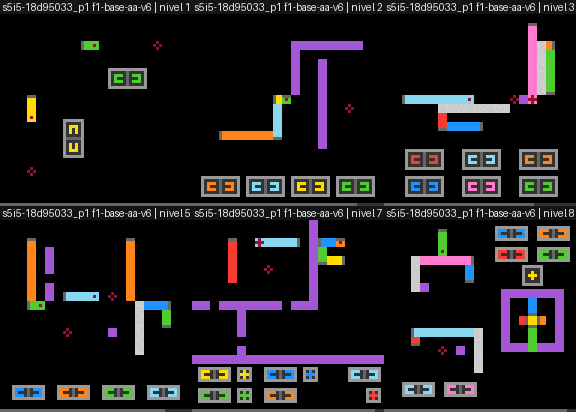
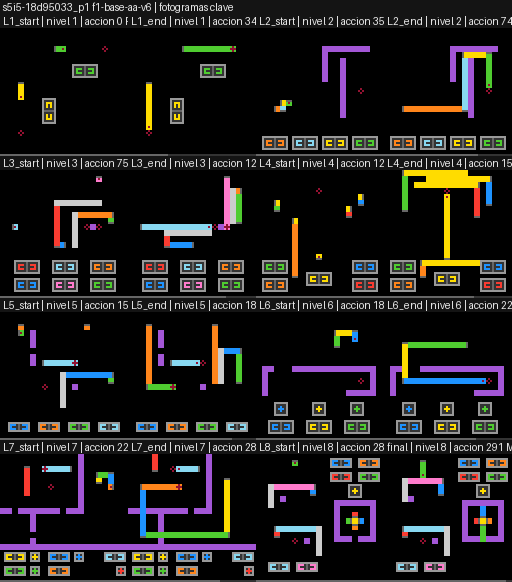
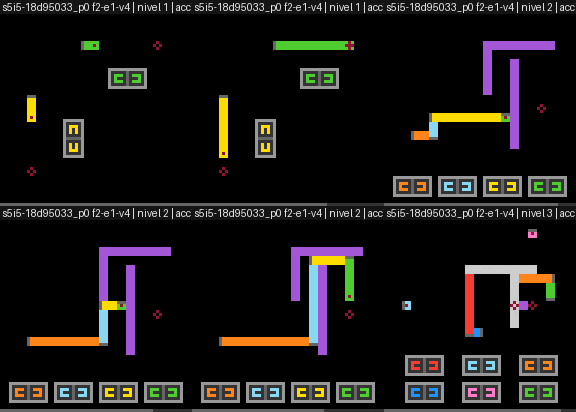
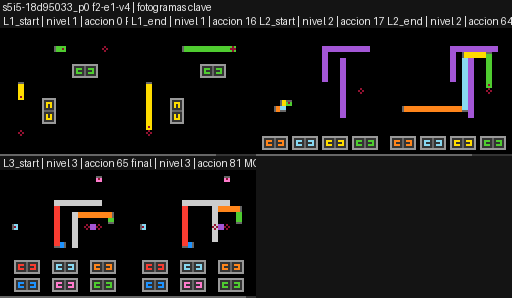
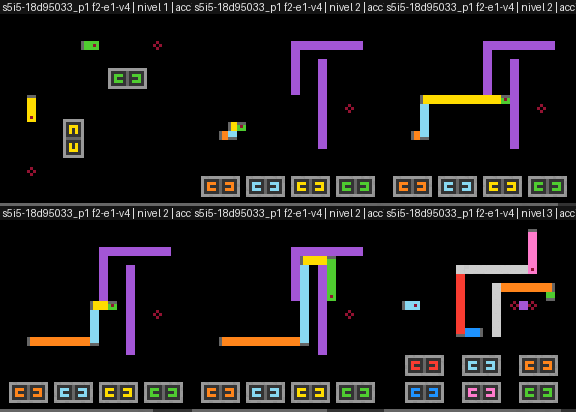
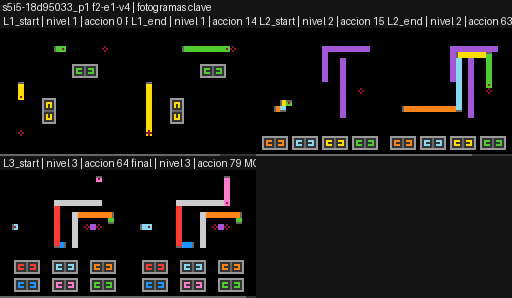
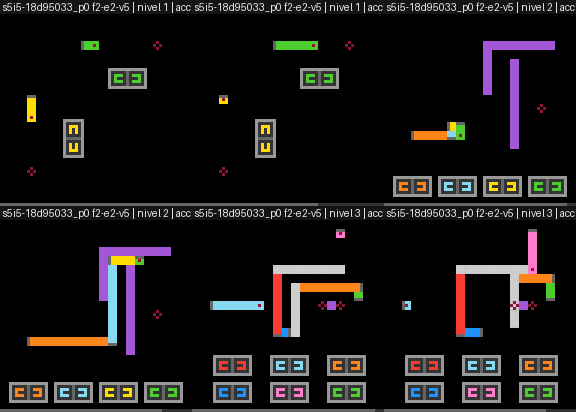
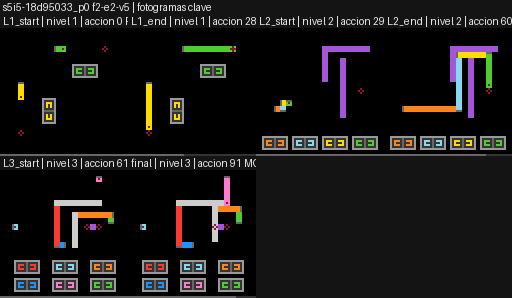
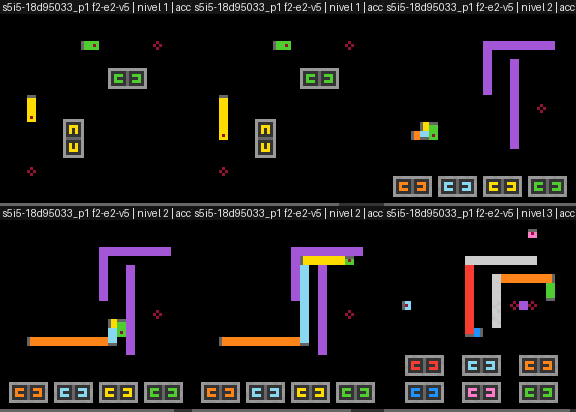
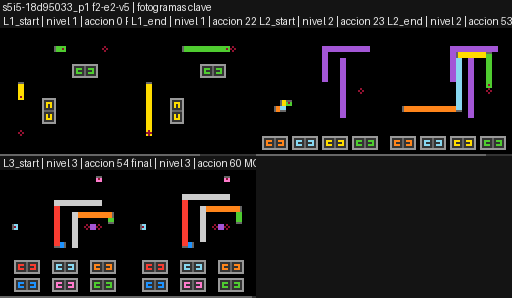
s5i5 · 8 niveles · Base (F1): 16,67 / 2,78 · A/A (base repetida): 8,33 / 77,78 · E1: 8,33 / 8,33 · E2: 7,71 / 8,33
Pasada 0: 3 de 8 niveles, con 24, 32 y 48 acciones (un humano usa 20, 89 y 106); se quedó en el nivel 4 con 133 acciones en total. Pasada 1: 1 de 8 niveles, con 18 acciones (un humano usa 20); se quedó en el nivel 2 con 34 acciones en total. Puntuación (cap 1,15): 16,67 y 2,78. Las pasadas difieren mucho: en este juego el ruido de la base es grande.
…to distinguish the bar from the glyph: use the bar = N object adjacent to the G cap at col 27 / or the N object containing row 10 near col 28). I'll identify by bbox containing (10,28) region... better: the N object whose bbox touches col<=30 and row<=12.
Simplest: compute directly from ascii rows: for green, find the run of N/r/G cells in row 10 starting at col 27; for yellow, find run in col 10 starting at row 27.
I wasted a call. Execute now: red grow x2, green grow x3, then the orange shrink test.
State check function: define `stt()` inline (avoid the reserved name `st`? the retention complained about a conflict with the provided name... my function was named `st` inside `st()` — conflict with something. Use a different name).
The green knob moves +3 per click: 31 → 34 → 37 → 40. No clamping. The bar grows with it.
Now the goal hypothesis: move the knob to the cross at col 52 (row 10). Currently at 40. Need 4 more clicks: 43, 46, 49, 52. Let's do 4 clicks and see what happens when the knob reaches the cross (col 52). Maybe the knob must overlap the cross center.
Let me batch 4 clicks and observe.
…he cross has only 4 red cells (the center is something else).
Hmm, maybe in level 1 the crosses were 4-cell pluses without centers? Hmm, 10 = 5+5.
Hmm, maybe the knob is red only when... hmm.
Let me just look at the ascii around the cross and around the yellow's tip to identify the knob colors.
Let me do that now: print rows 26-33 cols 33-42 (yellow tip + green cap + knob) and rows 28-34 cols 48-56 (the cross).
Base (F1)
A/A (base repetida)
E1
E2
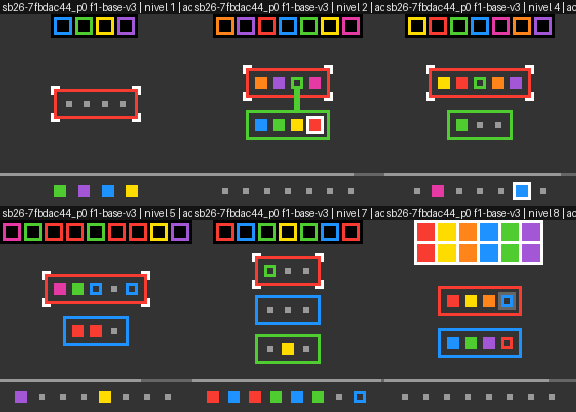
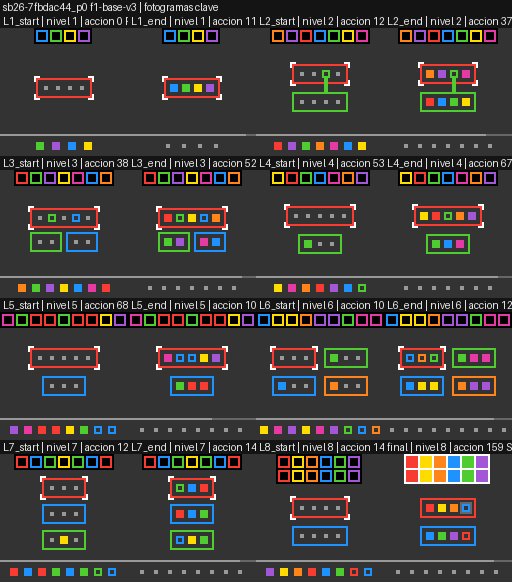
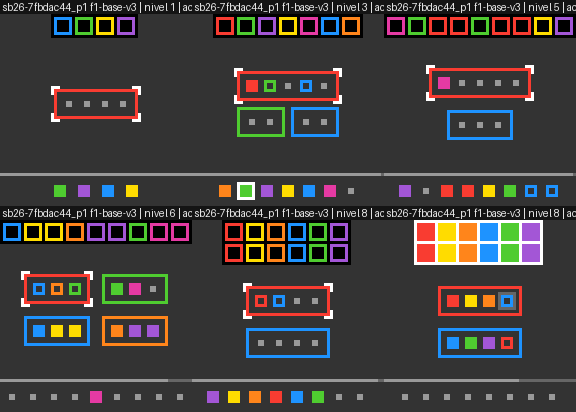
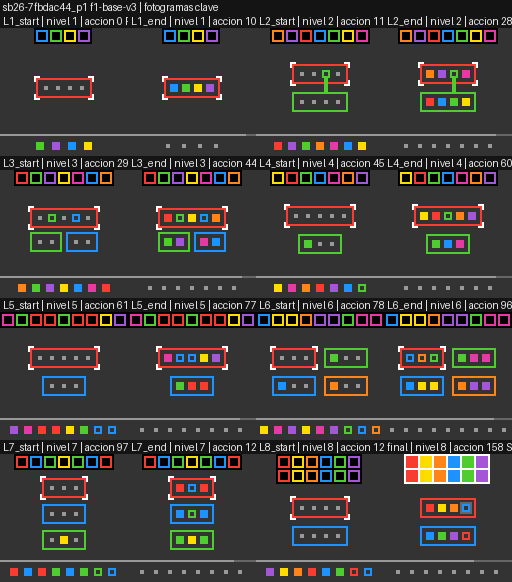
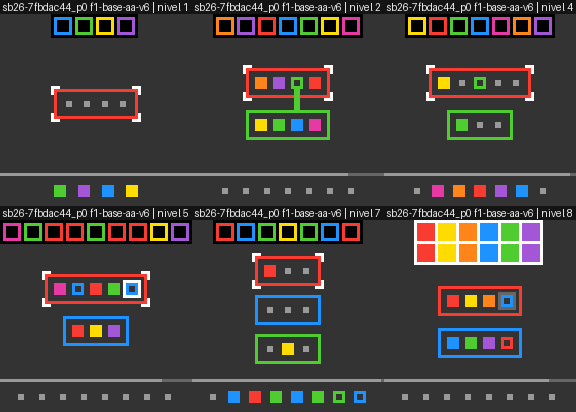
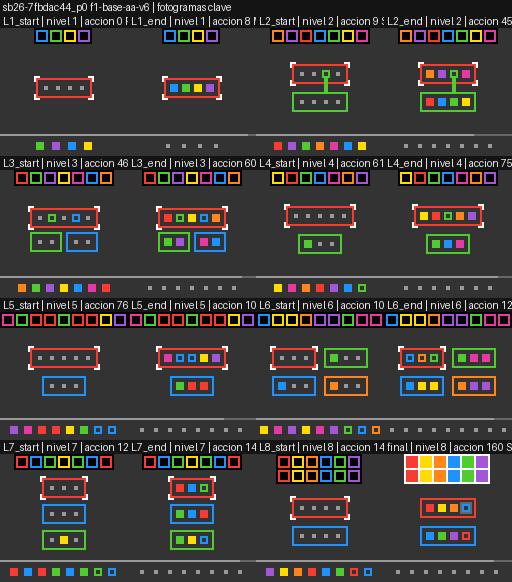
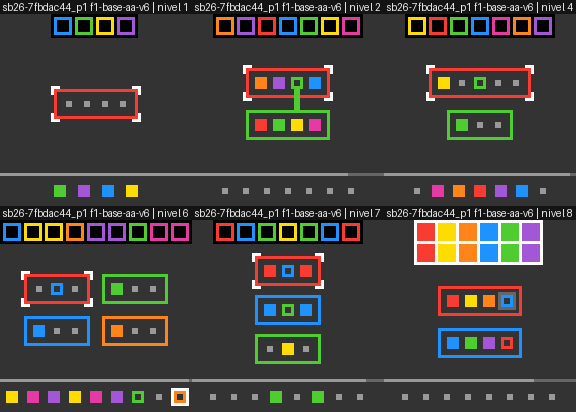
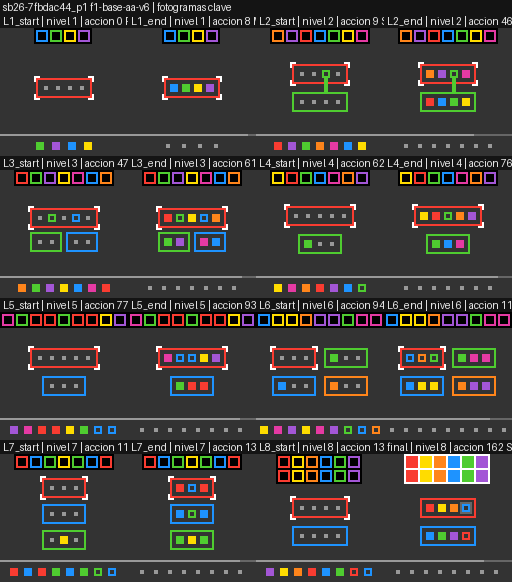
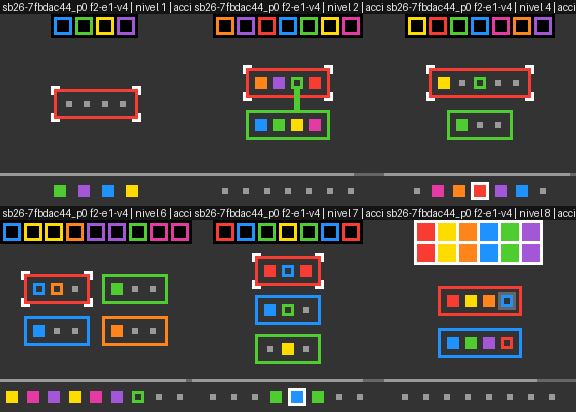
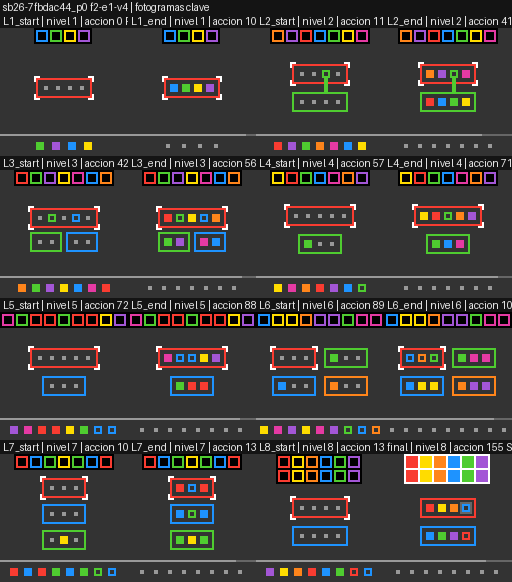
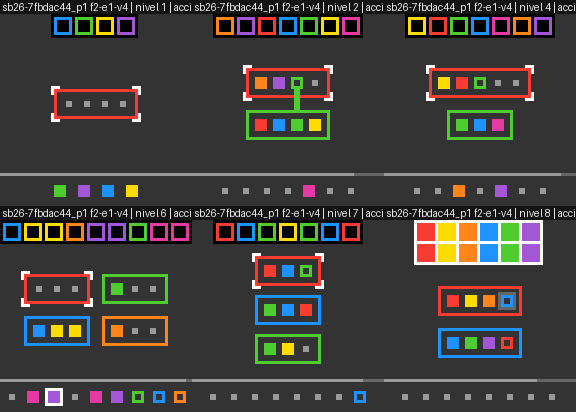
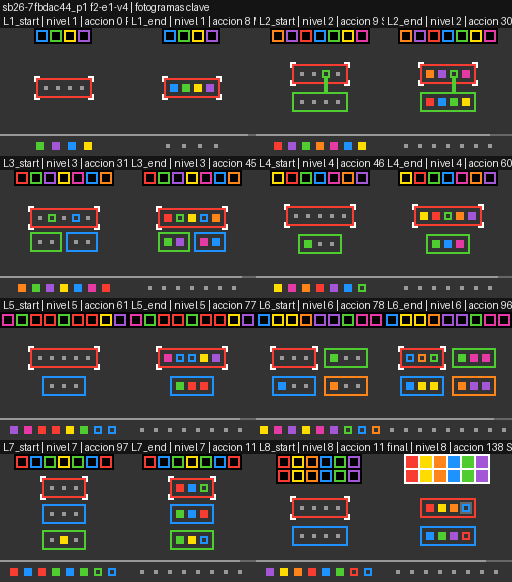
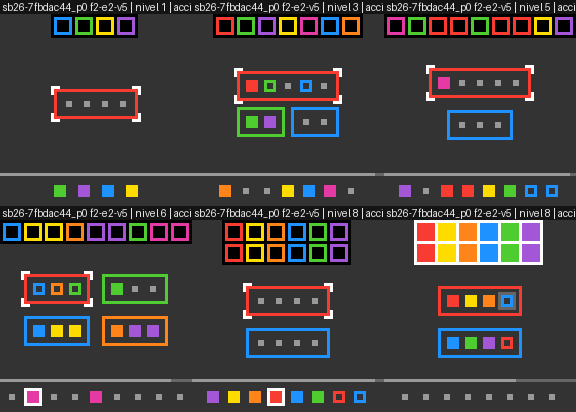
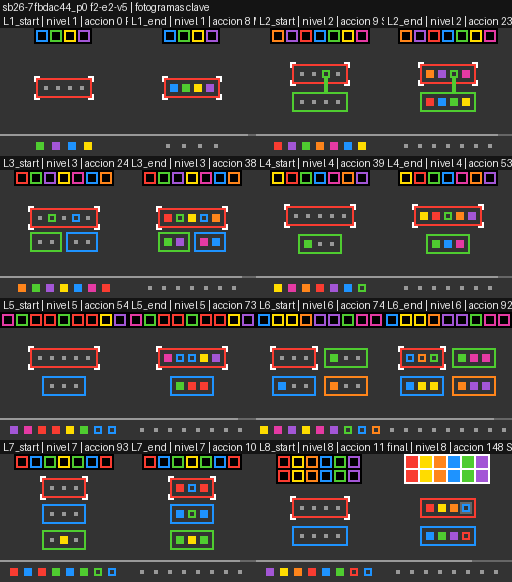
sb26 · 8 niveles · Base (F1): 100,00 / 95,32 · A/A (base repetida): 100,00 / 91,66 · E1: 100,00 / 100,00 · E2: 94,43 / 96,77
Pasada 0: completó los 8 niveles en 159 acciones (un humano usa 213). Pasada 1: completó los 8 niveles en 158 acciones (un humano usa 213). Puntuación (cap 1,15): 100,00 y 95,32.
Working as expected. Panel now: b, N, g, g. Palette: g, p, g, Y. Continue: yellow→slot2, purple→slot3.
Note the timer bar shrinks ~1 per placement (now 2 dark cells at right). Plenty left.
Batch: click Y(58,43), click slot2(29,34), click p(58,27), click slot3(29,40).
…click purple (58,27), click slot4 (29,40) → box [blue, green, yellow, purple] → hopefully complete.
Batch all 6 and check. If the goal isn't this order, we can adjust (we'd still be able to swap).
Note: the palette positions are fixed slots; pieces swap between palette slot and box slot. So after green goes to box slot2, the gray from slot2 goes to palette col35. Fine.
Let's batch 6 actions and check level_completed.
Base (F1)
A/A (base repetida)
E1
E2
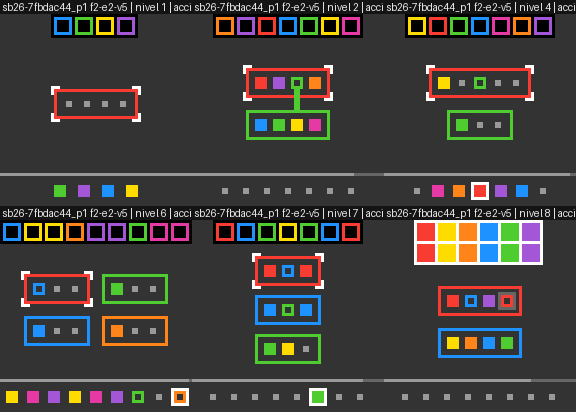
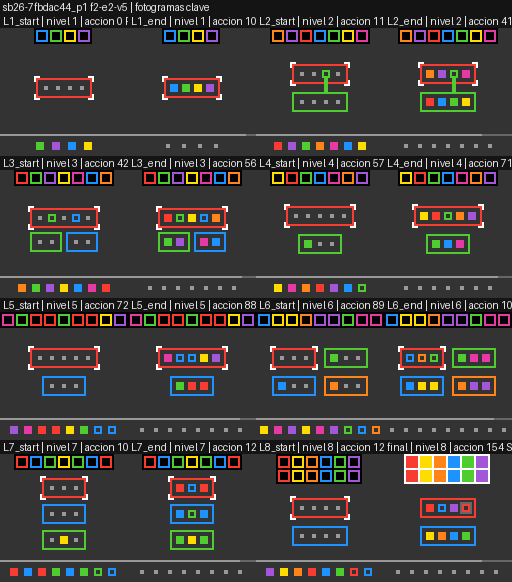
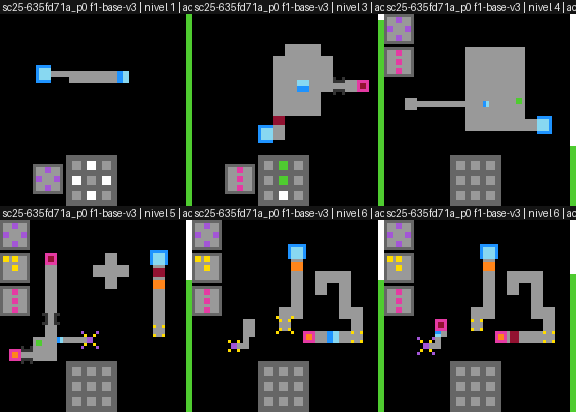
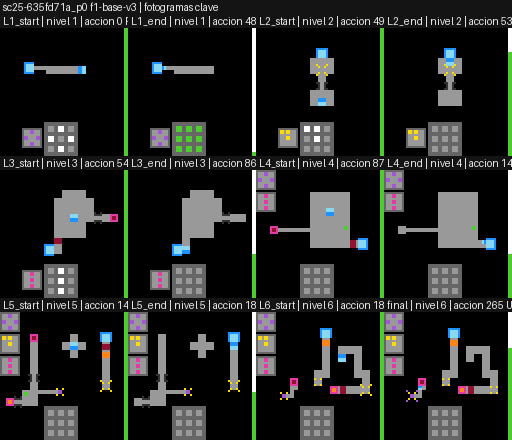
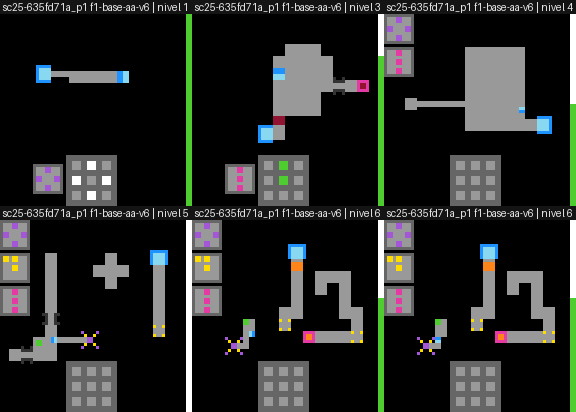
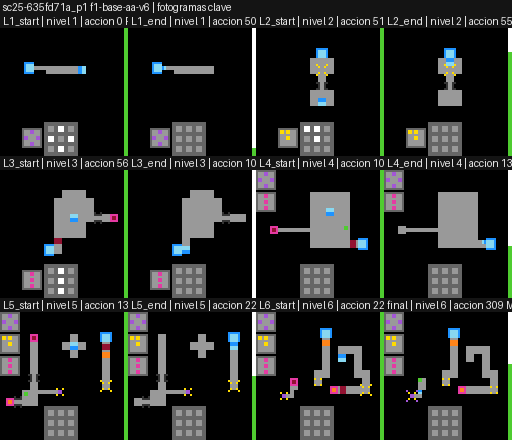
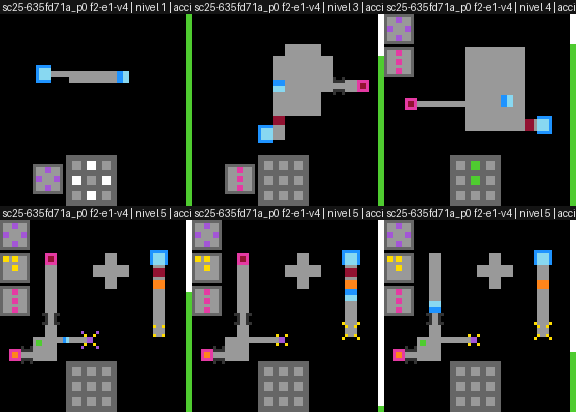
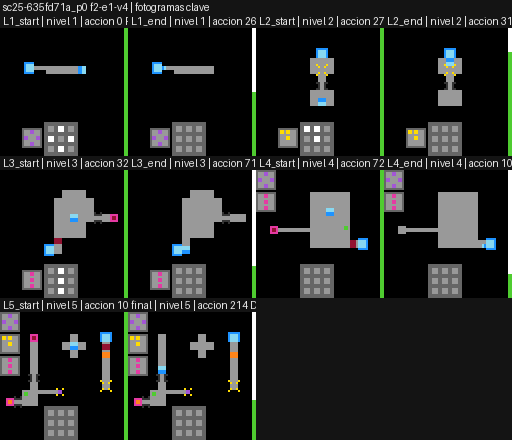
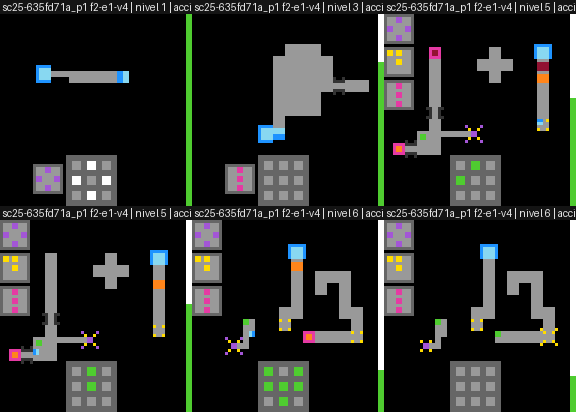
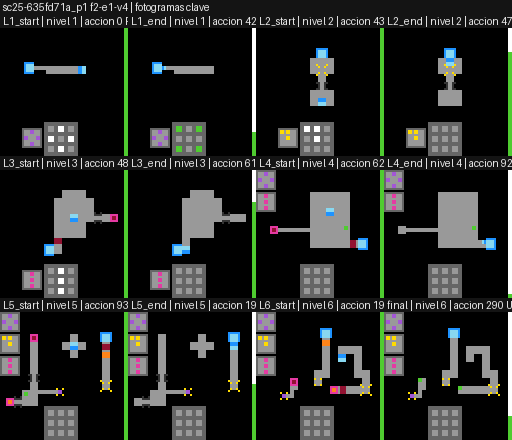
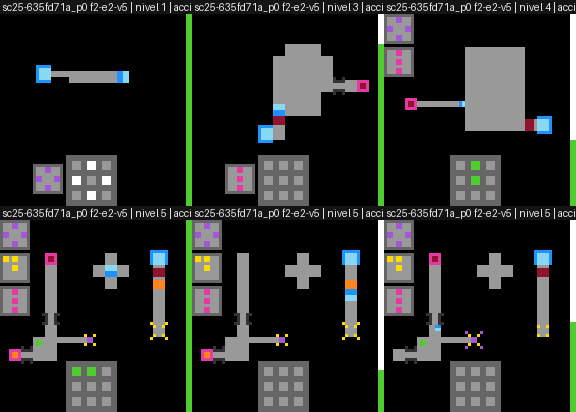
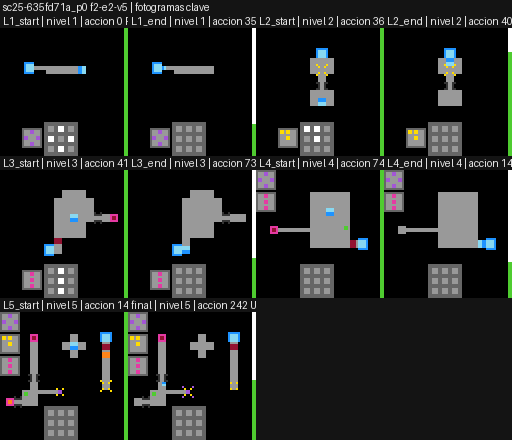
sc25 · 6 niveles · Base (F1): 71,43 / 47,62 · A/A (base repetida): 69,95 / 69,23 · E1: 47,48 / 87,60 · E2: 47,62 / 71,43
Pasada 0: 5 de 6 niveles, con 49, 5, 33, 57 y 45 acciones (un humano usa 36, 6, 32, 83 y 143); se quedó en el nivel 6 con 265 acciones en total. Pasada 1: 4 de 6 niveles, con 44, 5, 31 y 25 acciones (un humano usa 36, 6, 32 y 83); se quedó en el nivel 5 con 186 acciones en total. Puntuación (cap 1,15): 71,43 y 47,62.
…e. Stop on win/death or after ~10 actions.
Let me write it to also record the bar so I know the budget.
Actually, I should be careful: if the bar runs out → game over → reset. I have ~18 rows ≈ 13 actions. A 10-action probe is acceptable.
Let me do: loop up to 10 LEFT; after each, record tip; break on done/gameover or if tip x doesn't decrease.
Note: the move step might be 2 or 4 depending on the tip size. Let's see.
The teleport worked: the tip is now at rows 41-42 cols 13-14 (the p socket) ✓. Bar 52. The keypad is clear ✓.
Note: the tip's arrangement shows 'bb' in the top row → the split is horizontal (b on top, S on bottom) → facing UP (inherited from the earlier shrink? whatever).
Now step C: RIGHT 2 → cols 17-18; UP 2 → rows 37-38; FIRE (beam UP into the r box) ✓.
Let me execute and verify.
…he head's left edge ranges 23..39 in steps of 2 or 4. Hmm.
Honestly, let me try the empirical route: with the remaining budget, do a few cheap, high-information probes:
1. Click the knob (19,14) → see if anything happens.
2. Click the plug head (20,24) → see.
3. Click the left panel dot (51,15) → see if the dots toggle.
Each is 1 action. Then reassess.
Let me do probe 1 and 2 in one call, checking the result of each.
…e charcoal at rows 46-47 cols 7-10 and 31-34 etc.).
Hmm, but is the head "centered" for growth? The head at rows 43-44, cols 15-16 → growing outward by 1 in each direction → rows 42-45, cols 14-17. Check gray: row 42 cols 14-17 ✓ (gray), row 45 cols 14-17 ✓ (gray), col 14 rows 42-45 ✓, col 17 rows 42-45 ✓. Should fit.
Fire the diamond: (50,30),(55,25),(55,35),(60,30) → 4 clicks ≈ 12-16 px. Then check the head's size.
Base (F1)
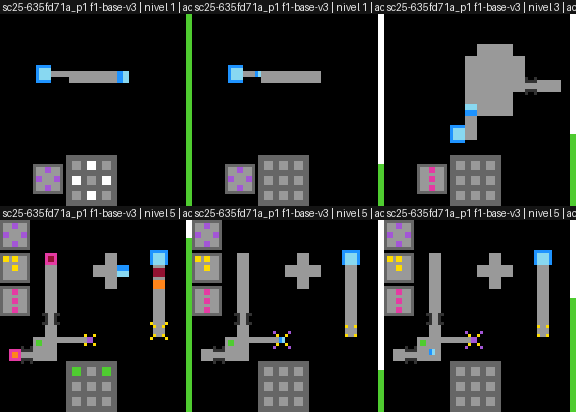
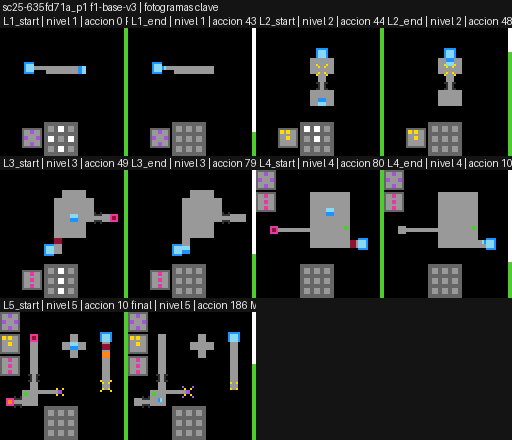
A/A (base repetida)
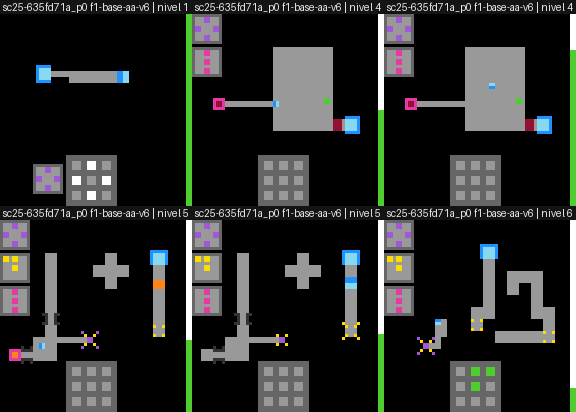
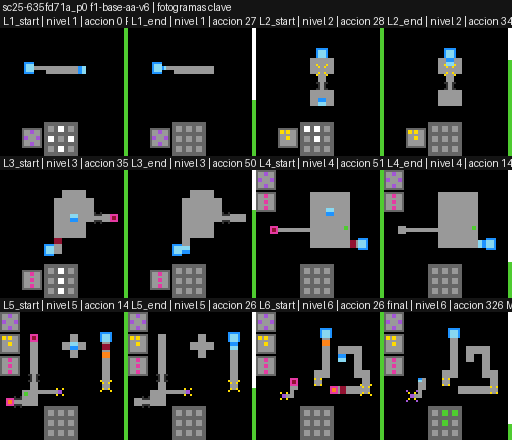
E1
E2
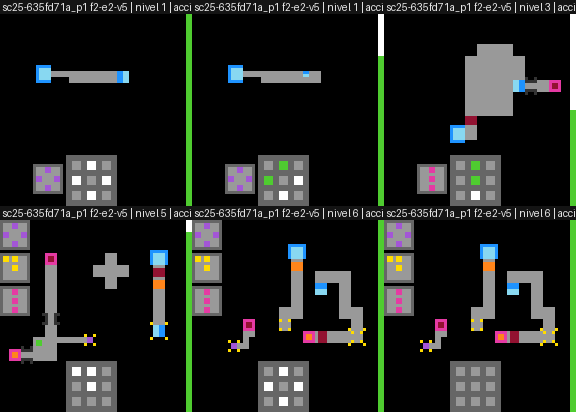
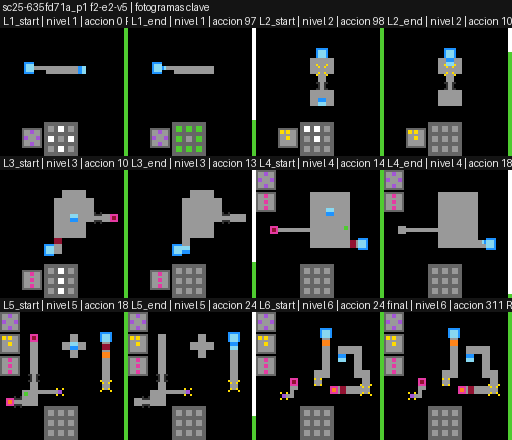
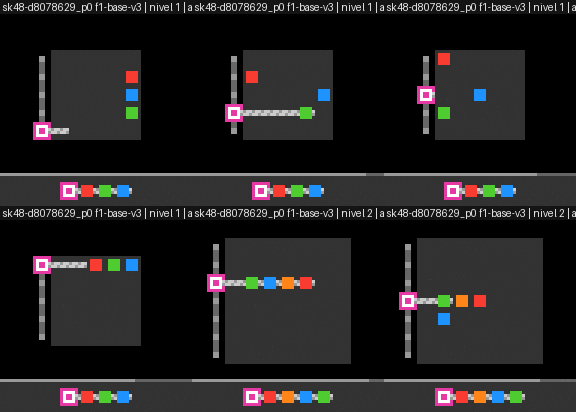
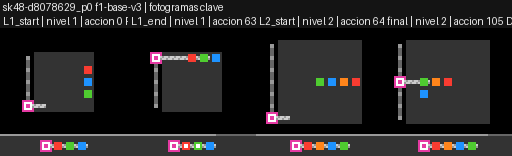
sk48 · 8 niveles · Base (F1): 2,52 / 0,00 · A/A (base repetida): 2,78 / 2,78 · E1: 0,00 / 0,00 · E2: 0,00 / 1,25
Pasada 0: 1 de 8 niveles, con 64 acciones (un humano usa 61); se quedó en el nivel 2 con 105 acciones en total. Pasada 1: no completó ningún nivel (48 acciones). Puntuación (cap 1,15): 2,52 y 0,00.
…d need to go to 36-39, 42-45, 48-51 → blocked by the wall → maybe the push fails and the arm passes through? Let's test: press RIGHT and see.
Actually, that's a good experiment: it tells me what happens when the chain can't be pushed. If the arm passes through, I get the panel picture (arm threaded through the chain at the wall). Then if the level completes → win.
Let me try RIGHT x2 (careful: 2 presses). Then check.
…he blocked one. If the game allows the head to move and pushes N to (5,2) while b stays at (5,1) → we'd see b stay ✓ (the release works). If the whole action is a no-op → the release doesn't work that way.
Hmm, but there's a subtlety: b at (5,1) and N at (5,2) — no collision ✓.
Let me run: DOWN, RIGHT, DOWN and observe.
Actually, careful: DOWN#1 might behave differently. Let me do it step by step and observe each.
…verification.
Let me be careful about the attach semantics for a chain: if a push chain fails because of the wall, all blocks in the chain stay, and the rightmost one (at the wall) becomes attached. I'll implement: attempt the chain; on failure, no moves; and mark the block that failed (the one at the wall) as attached.
Let me implement and search. I'll represent the state as (h, tip, tuple of (color, rt, cl, att)).
Base (F1)
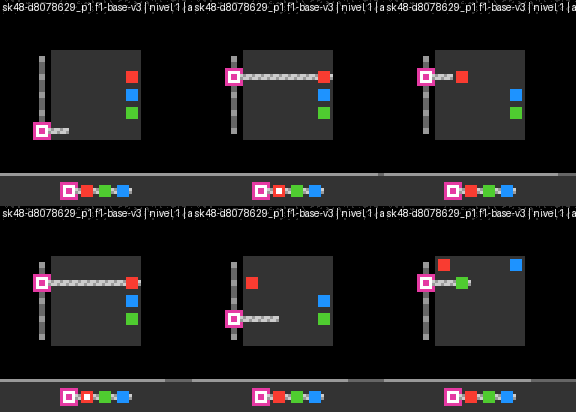
A/A (base repetida)
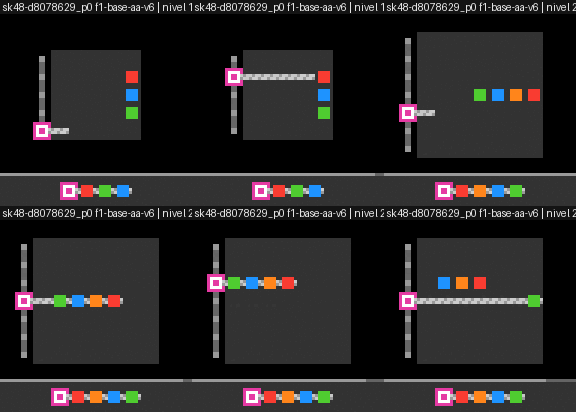
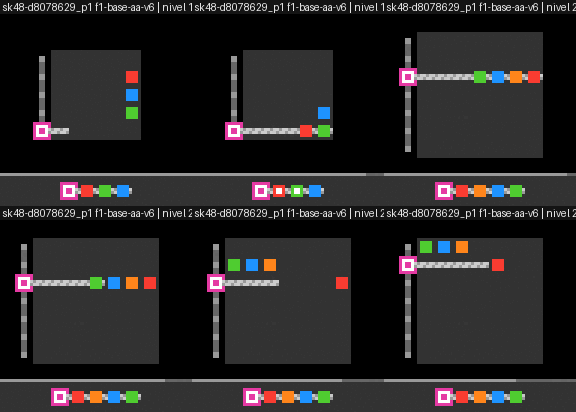
E1
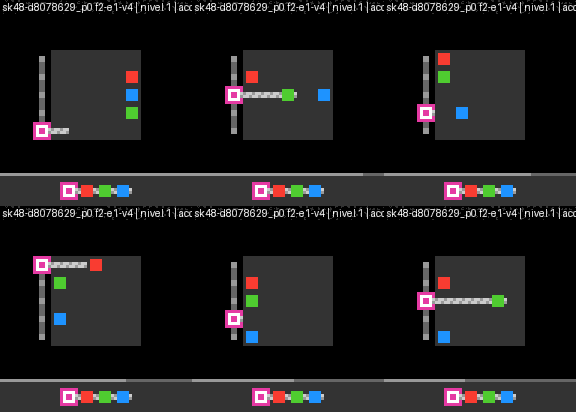
E2
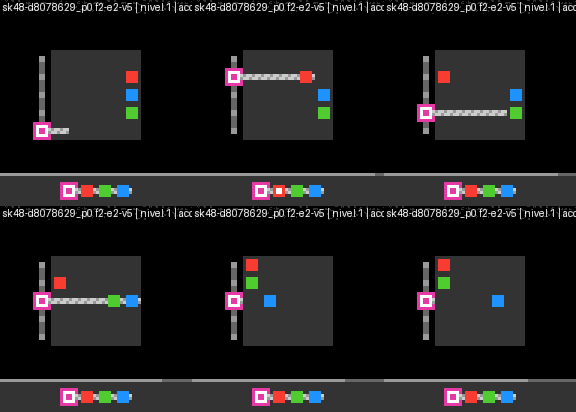
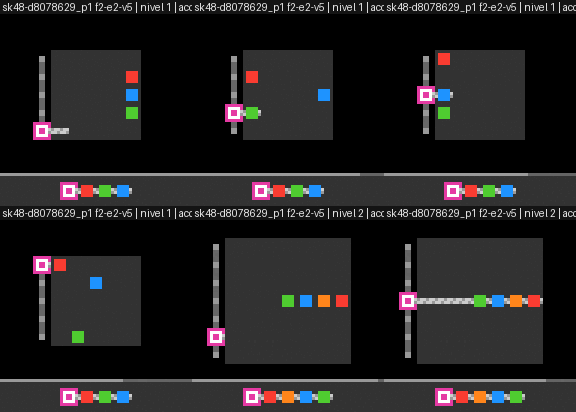
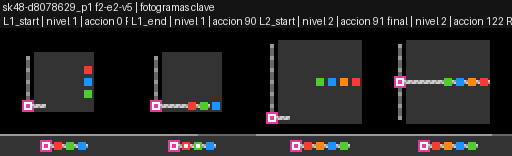
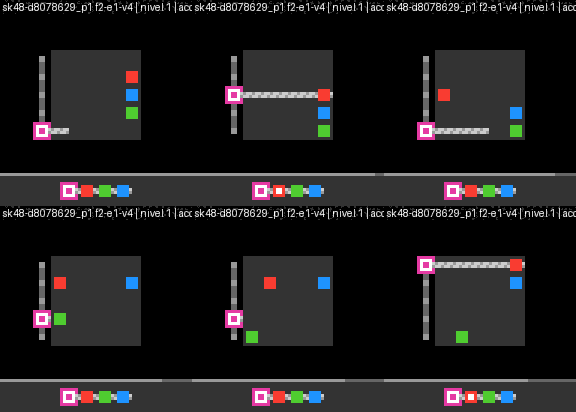
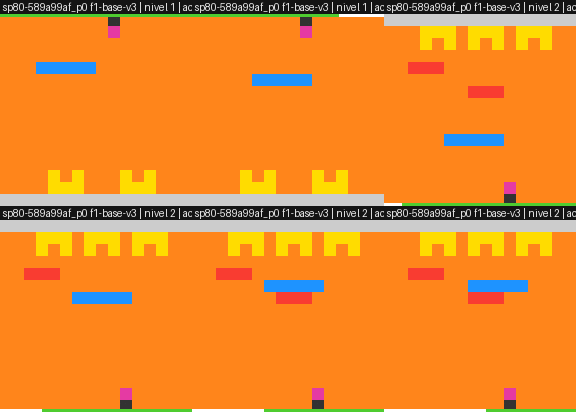
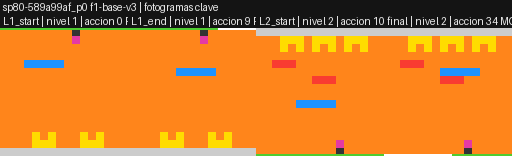
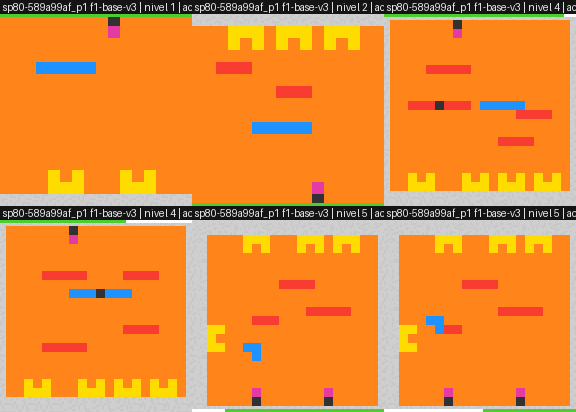
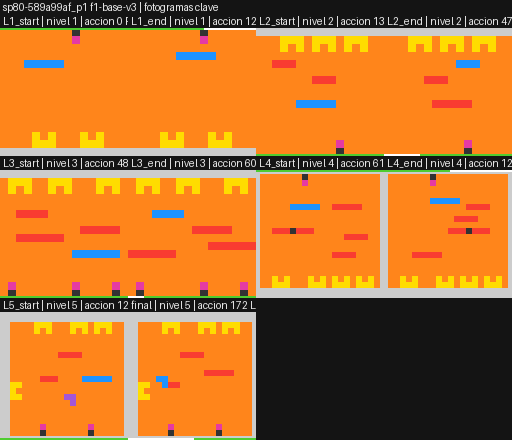
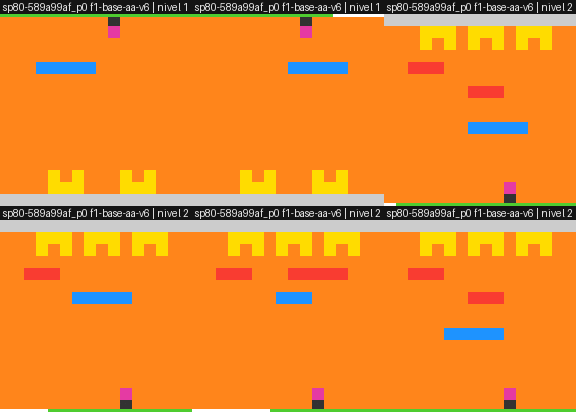
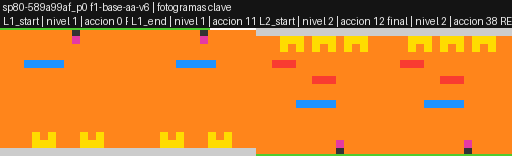
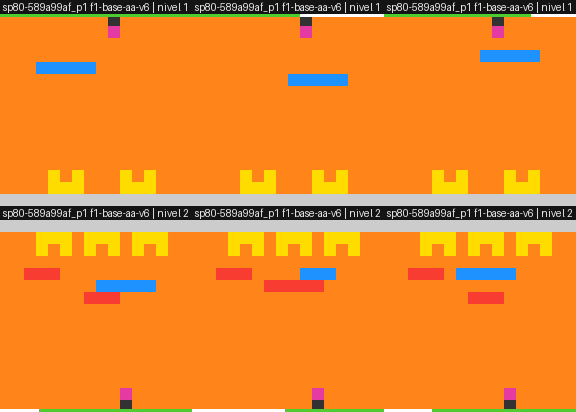
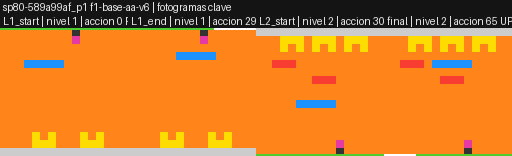
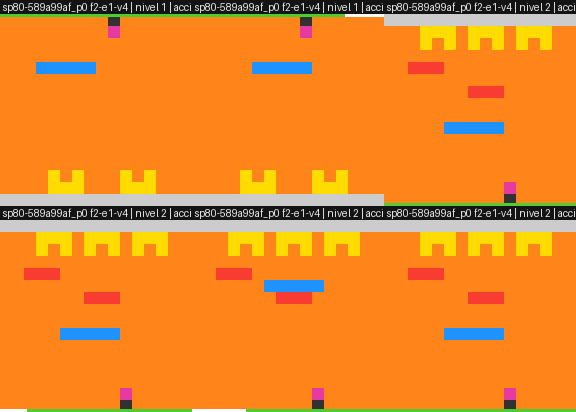
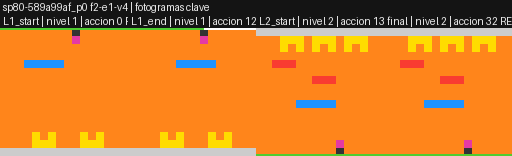
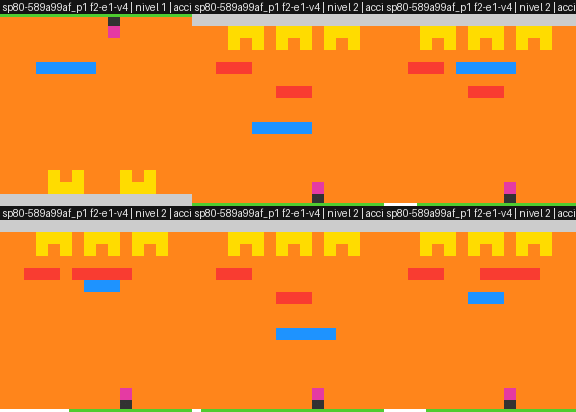
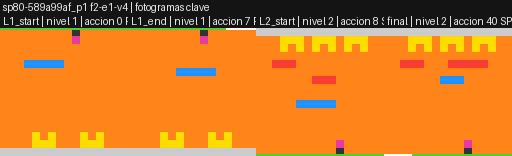
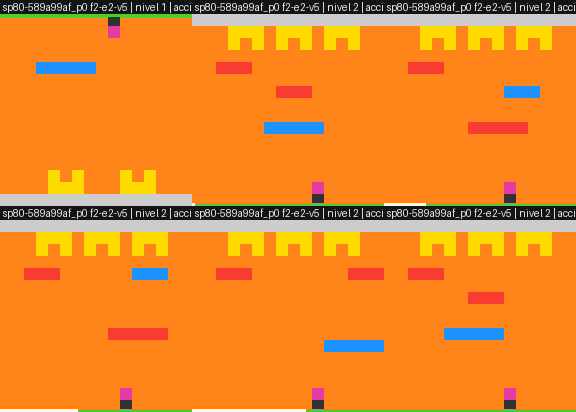
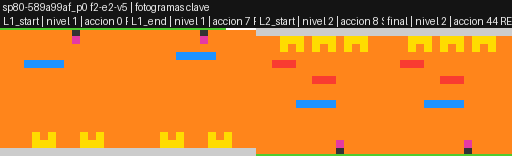
sp80 · 6 niveles · Base (F1): 4,76 / 47,62 · A/A (base repetida): 4,76 / 4,76 · E1: 4,76 / 4,76 · E2: 4,76 / 4,76
Pasada 0: 1 de 6 niveles, con 10 acciones (un humano usa 39); se quedó en el nivel 2 con 34 acciones en total. Pasada 1: 4 de 6 niveles, con 13, 35, 13 y 60 acciones (un humano usa 39, 58, 25 y 148); se quedó en el nivel 5 con 172 acciones en total. Puntuación (cap 1,15): 4,76 y 47,62. Las pasadas difieren mucho: en este juego el ruido de la base es grande.
My nested action list was malformed. Correct format: action([{'action':'MOUSE','row':21,'col':30}]).
Let me test MOUSE on the blue bar.
…ups 1,2,3 in one pour and the trick is that the bar can be at row 4 with red bar 1 REMOVED... The red bars might be removable by the bar absorbing them permanently after some condition, e.g., if the bar covers a red bar and then the fluid pushes the bar into it? Hmm, too speculative.
Hmm, alternatively: what if the red bars can be destroyed by the fluid hitting them from the side? Hmm.
Let me just run the (4,8) test.
Fix: rows range 0..60 but g has 64 rows; the error is in the "keep" comprehension? No, IndexError: list index out of range — g[r+i] where r+i up to 62, fine. Hmm, `range(0,60)` for r → r+3 ≤ 62 ok; c+3 ≤ 62 ok. g[r+i] — g has 64 lines. Unless a line is shorter than 63? Let me check line lengths. Actually the ascii lines are 64 chars. Hmm, maybe the last frame has fewer lines? Let me just guard.
…ways tries to rise at (11,3) → and (10,3) is always free (forbidden for pieces) → the fluid rises to band 9 and beyond → and can only be stopped at band ≤ 9 by a piece, after which it pools at band 9 and spreads and escapes... unless the band-9 pool is bounded...
Hmm, hold on! What if the fluid rises through (11,3),(10,3) and is blocked at (9,3) by a piece, and the band-10 pool is bounded on the right by a piece at
Base (F1)
A/A (base repetida)
E1
E2
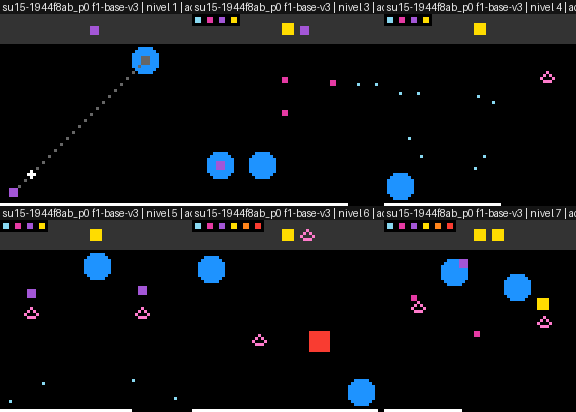
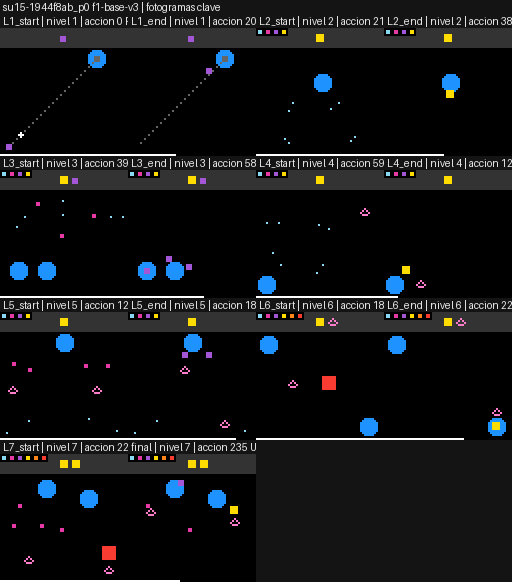
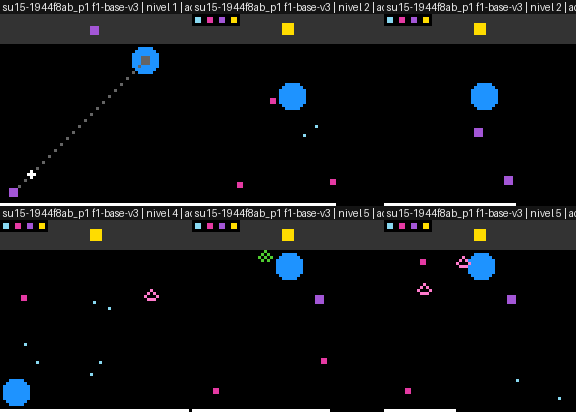
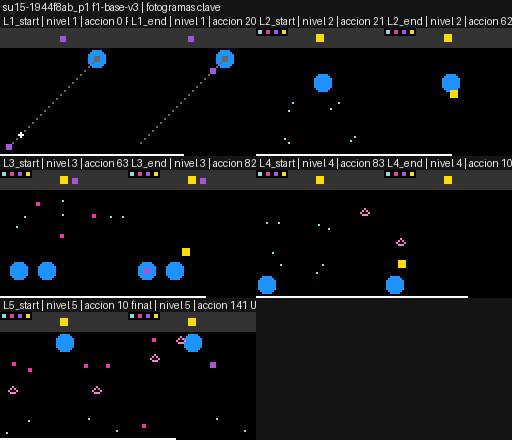
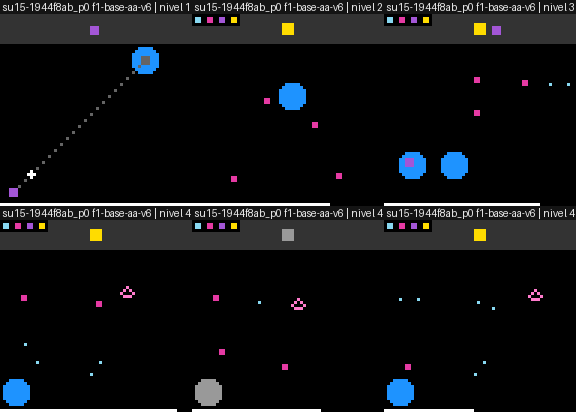
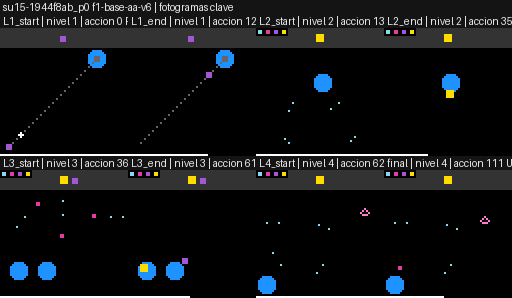
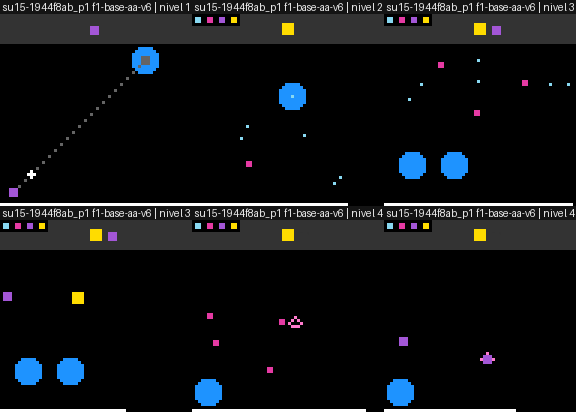
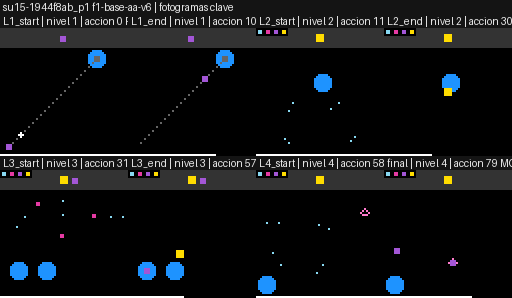
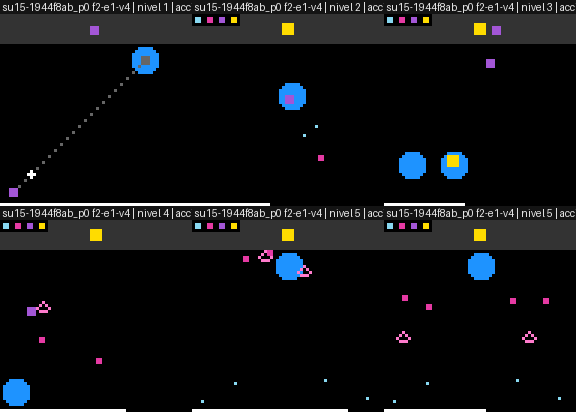
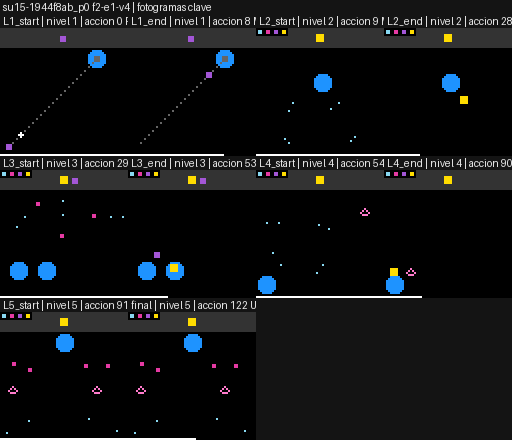
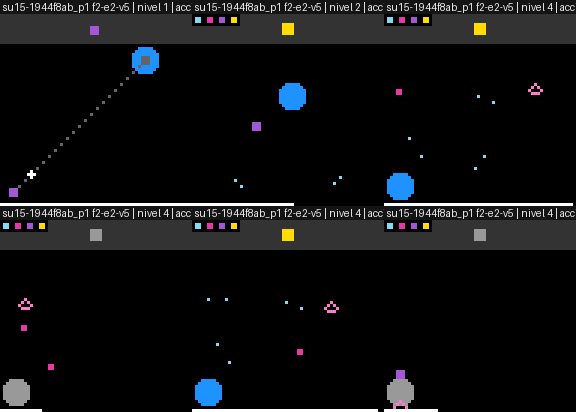
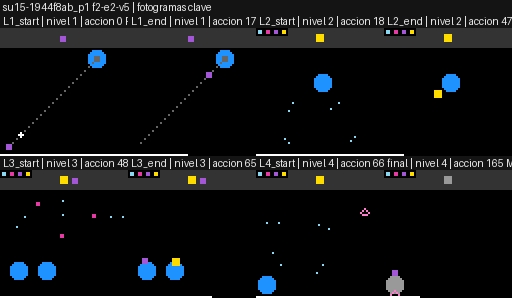
su15 · 9 niveles · Base (F1): 38,31 / 22,22 · A/A (base repetida): 13,33 / 13,33 · E1: 22,22 / 1,48 · E2: 13,33 / 13,33
Pasada 0: 6 de 9 niveles, con 21, 18, 20, 64, 64 y 37 acciones (un humano usa 22, 42, 26, 115, 36 y 31); se quedó en el nivel 7 con 235 acciones en total. Pasada 1: 4 de 9 niveles, con 21, 42, 20 y 20 acciones (un humano usa 22, 42, 26 y 115); se quedó en el nivel 5 con 141 acciones en total. Puntuación (cap 1,15): 38,31 y 22,22. Las pasadas difieren mucho: en este juego el ruido de la base es grande.
…determine R once with a couple probes, then plan optimally.
Let me do: probe at Euclid ~14 in the goal direction: from (41,16) toward (15,48): unit vector = (26,-32)/41.2 → direction (-0.631, +0.777). At distance 14: (41-8.8, 16+10.9) = (32.2, 26.9) → (32,27). Try that. If it moves, R≥14 and we can use ~14 steps per click. If not, try distance 10 → (34.7,23.8) → (35,24). Then 8, then 6.
Let me implement with checks.
…alternative: the icons show the recipe [Y][Y] but their color changes to gray when a piece is eaten (a "shock" state) and would return to yellow next turn? Let me just test with an action and see if the icons recolor.
Cheapest test: UNDO (reverts the last click) → then check the icons. If the icons return to yellow and the Y comes back, I've restored the position and I'll pursue the 2-yellow merge plan.
Let me UNDO.
…²+6²)=8.49 worked, sqrt(8²+8²)=11.3 failed. Hmm, so Euclidean ≤ ~8.5? Or maybe the limit is a "knight-like" rule of exactly 3 slots max?
Data: 1 slot worked, 3 slots worked, 4 slots failed. So max = 3 slots (dr=6,dc=6). Let's assume max 3 slots = 6 cells each direction.
So from (45,18): go to (39,24) [3 slots], then (33,30), then (27,36), then (21,42), then (15,48) [3 slots].
That's 5 clicks. Let's do it with checks.
…e loop condition `if k==j and step<=6.5+1e-9` — for the lunge case (step=13), the k==j branch is skipped, but the `elif k!=j` branch checks other pieces → so a lunge could still "bite" another piece it passes over. That's fine/conservative.
Another bug: `work()` returns 6 for non-win states, making the beam ordering mostly driven by the min distance term. Fine.
Let me test: glyphs frozen (gs empty) → search depth 12.
Base (F1)
A/A (base repetida)
E1
E2
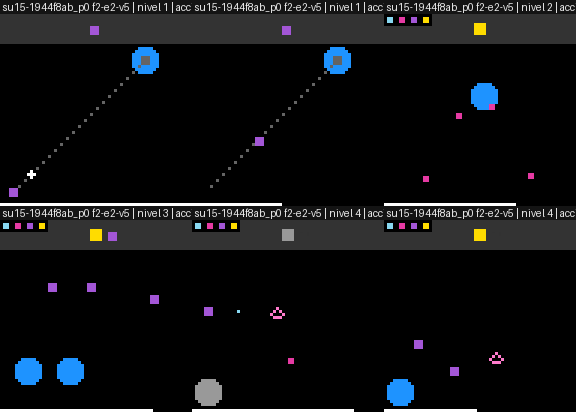
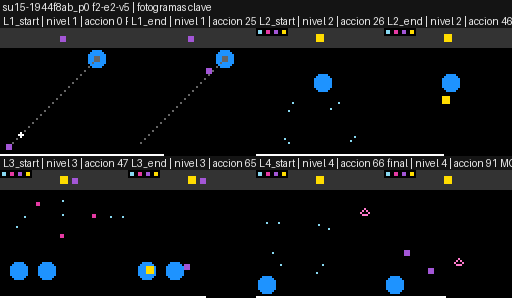
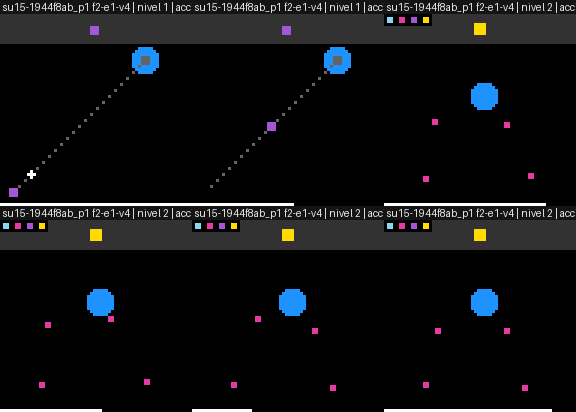
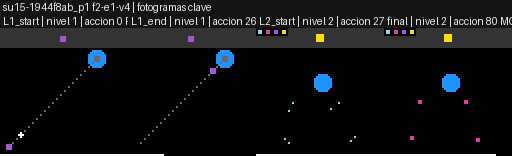
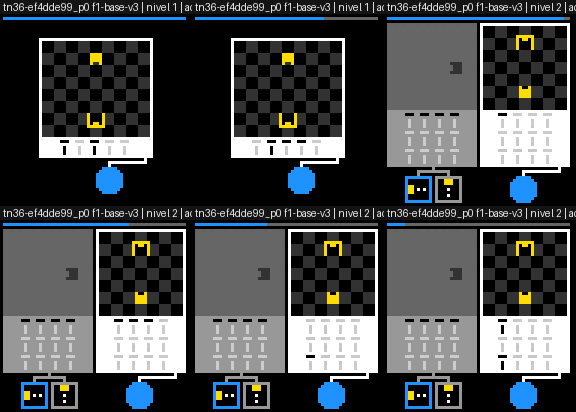
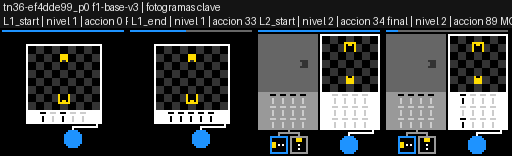
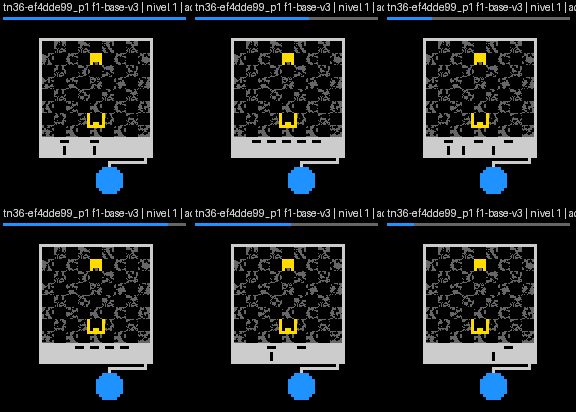
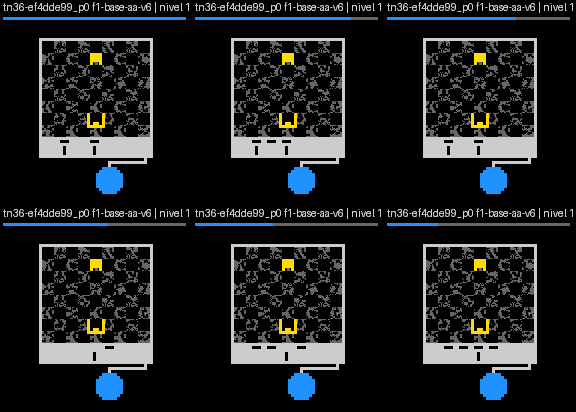
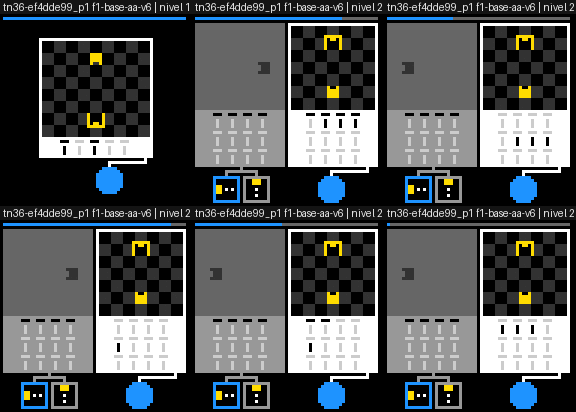
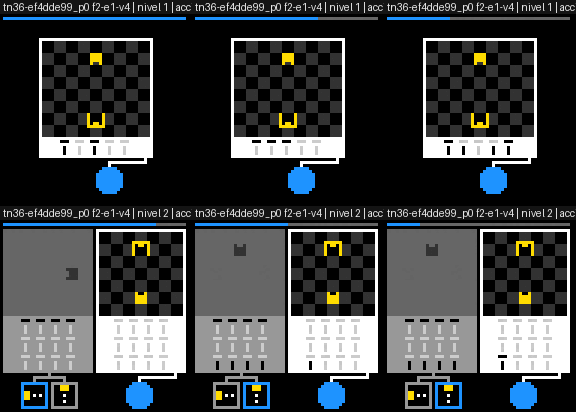
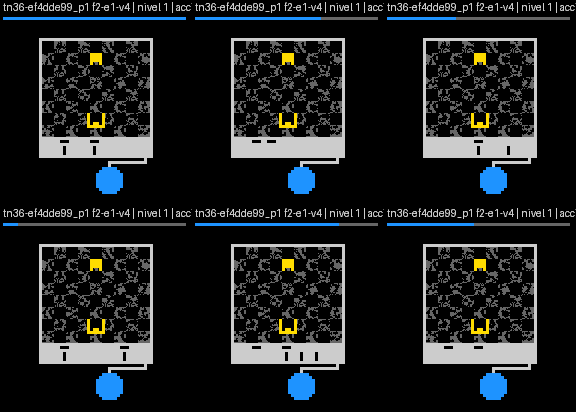
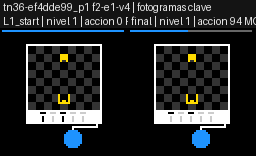
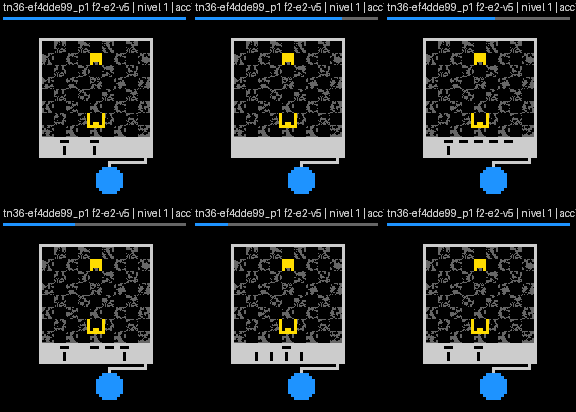
tn36 · 7 niveles · Base (F1): 3,16 / 0,00 · A/A (base repetida): 0,00 / 3,57 · E1: 1,46 / 0,00 · E2: 3,57 / 0,00
Pasada 0: 1 de 7 niveles, con 34 acciones (un humano usa 32); se quedó en el nivel 2 con 89 acciones en total. Pasada 1: no completó ningún nivel (114 acciones). Puntuación (cap 1,15): 3,16 y 0,00.
…and tests the "confirm" hypothesis. Let's do it.
Also, another thought: maybe clicking the plug/socket works only if the pattern is right; but the pattern might be all-black, so testing confirm now is well-targeted.
Let me also consider: maybe the interaction is drag-like: click plug then click socket (already tried in the very beginning with an all-gray-ish initial state). Let me try both orders now with all-black.
…48,54) [6 clicks] + mouse = 9 clicks. The timer has maybe 4 left → the level will reset mid-way. Hmm.
Given the timer, the best plan: let it reset now (or trigger the reset), and on the fresh level, run a systematic single-switch mapping with the remaining budget, prioritizing row 3's other columns and row 1's other columns.
Actually, let me first check the timer bar's remaining length to know how many clicks I have.
…,31),(42,21),(42,21),(42,26),(42,26),(42,21),(42,21),(42,36) ✓ 40 clicks.
Let me replay from all-gray and collect states. Then decide the remaining 9 clicks.
Actually, I realize there might be a smarter high-level move: since the walk is mangled anyway, let me use the remaining 9 clicks for the most plausible untested states, and design a proper self-tracking walker for the next budget.
Let me compute the replay now.
Base (F1)
A/A (base repetida)
E1
E2
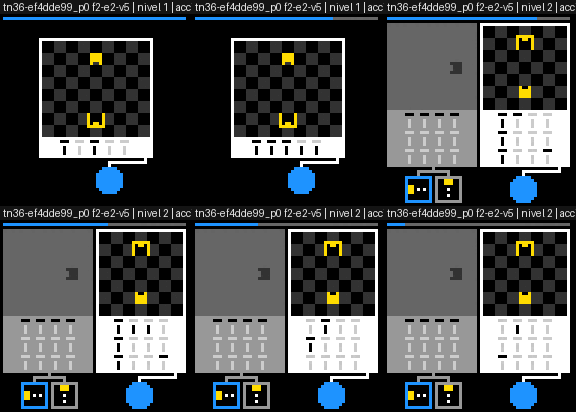
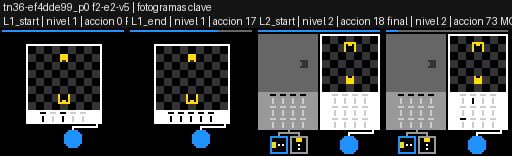
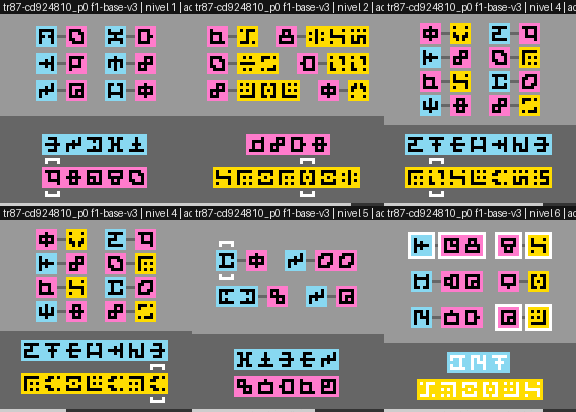
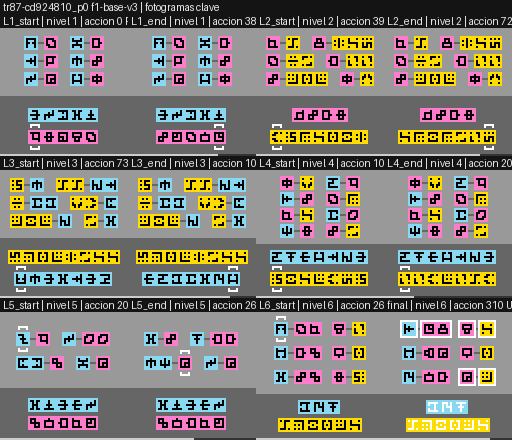
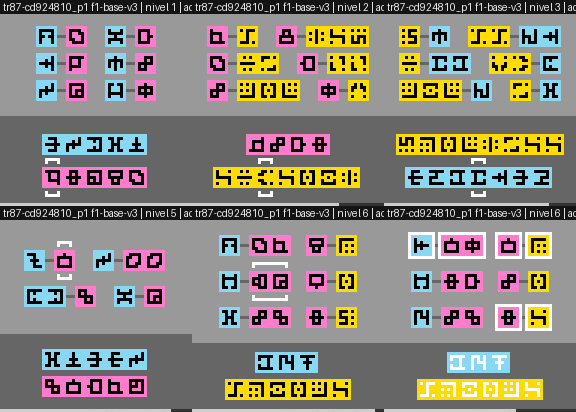
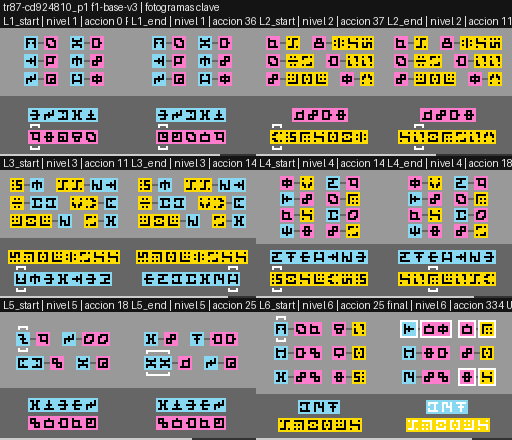
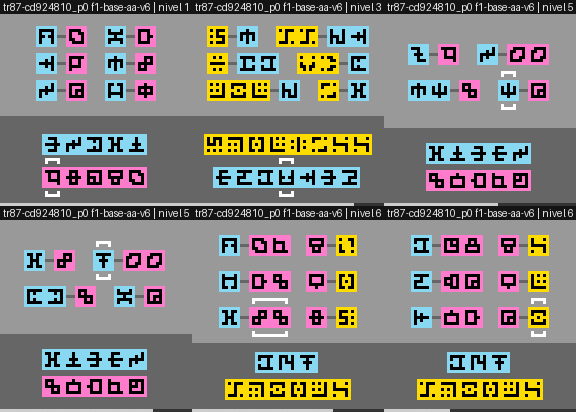
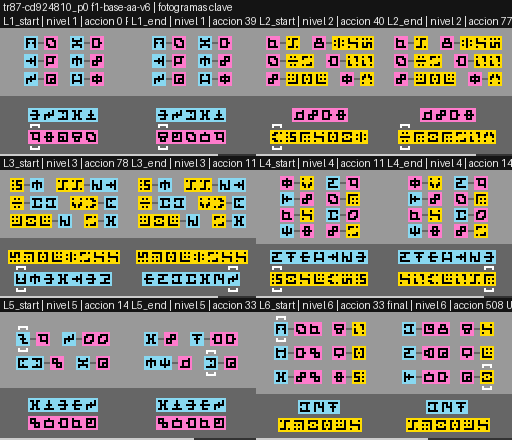
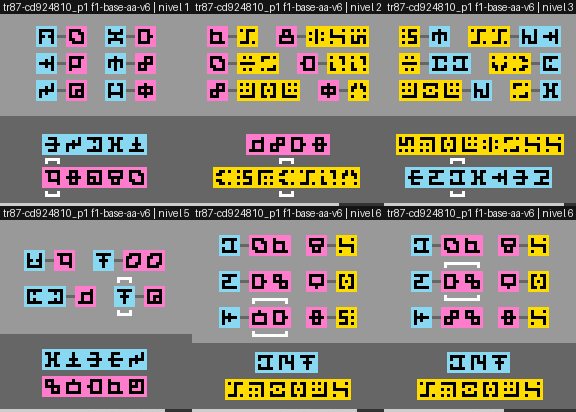
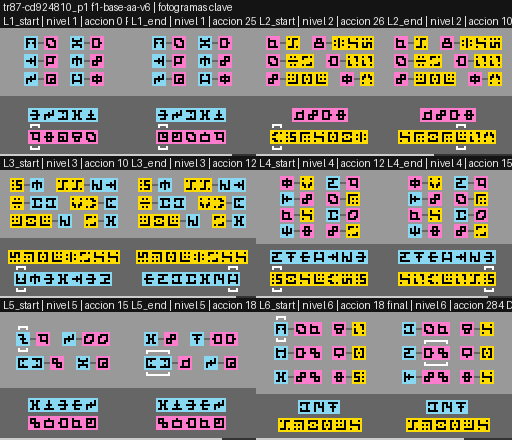
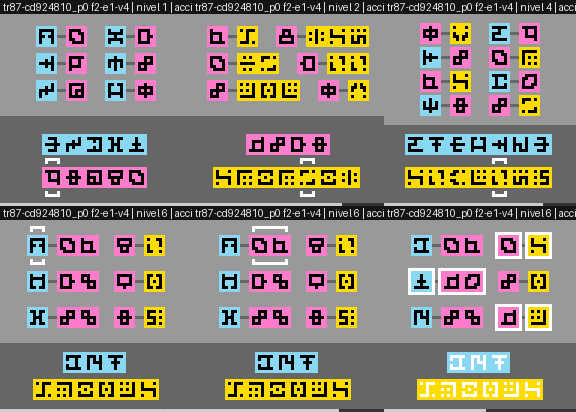
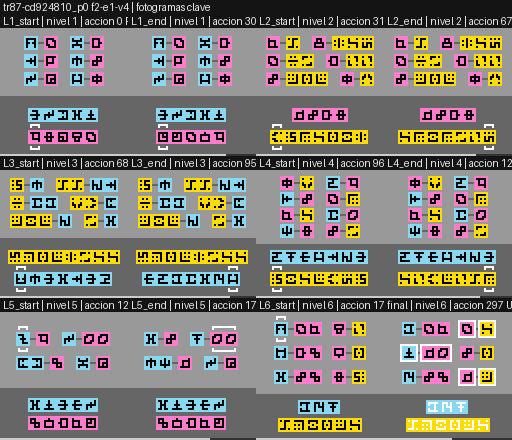
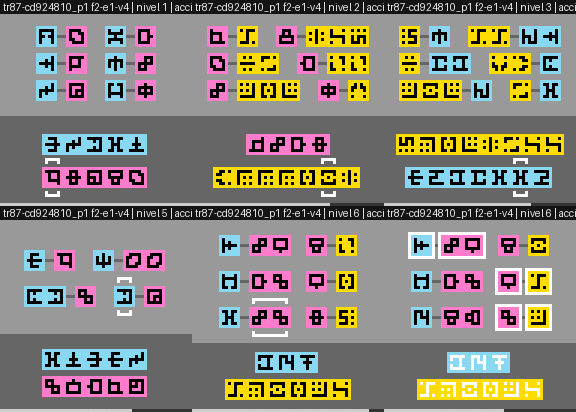
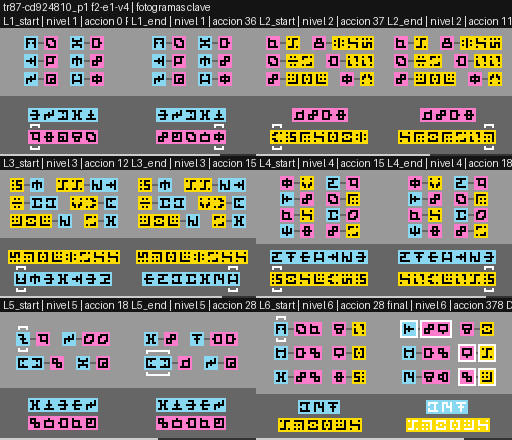
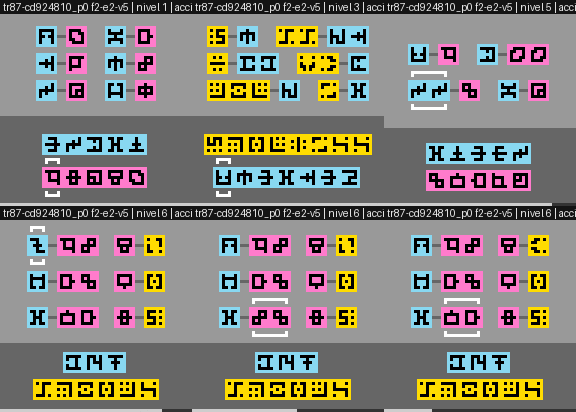
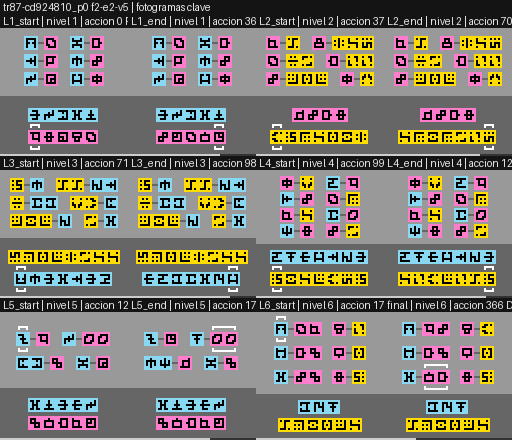
tr87 · 6 niveles · Base (F1): 96,95 / 100,00 · A/A (base repetida): 56,62 / 71,43 · E1: 100,00 / 93,56 · E2: 71,43 / 47,62
Pasada 0: completó los 6 niveles en 310 acciones (un humano usa 414). Pasada 1: completó los 6 niveles en 334 acciones (un humano usa 414). Puntuación (cap 1,15): 96,95 y 100,00.
…ed by gray bars: (row0: tile col0-col1 connected at cols 19-21; tile col2-col3 connected at cols 42-44). Yes, 6 pairs.
And the bottom blue row glyphs match the top blue tiles (all 5 distinct, from different pairs: (1,2),(2,0),(0,0),(0,2),(1,0)) → partners (1,3),(2,1),(0,1),(0,3),(1,1). Good, all distinct targets.
Now write the solver. I'll do it in one call with careful logging, and stop if game_over/level_completed.
…ce with checks and stop if the level completes.
Sequence:
[{'DOWN'}] at col1 → check idx4
LEFT → col0
DOWN → check
RIGHT,RIGHT → col2
UP,UP,UP → check idx0
RIGHT → col3
DOWN → check
RIGHT → col4
DOWN,DOWN → check
Then check state.
I'll track the expected index per slot using the known cycle order [1,3,X,7,9,5,11] identities. I'll just log the glyph strings and verify identity via the topvars mapping.
Let me write it.
Base (F1)
A/A (base repetida)
E1
E2
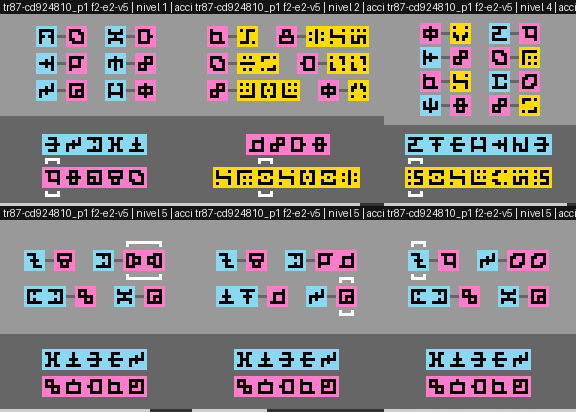
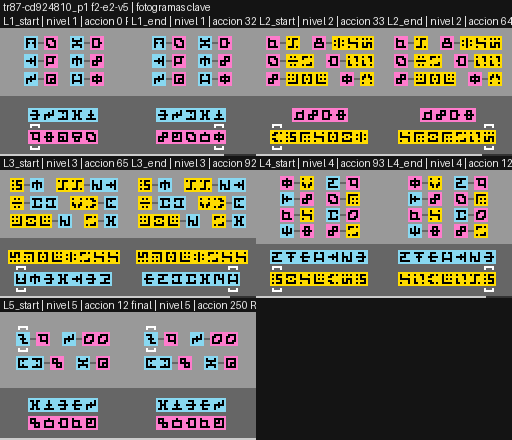
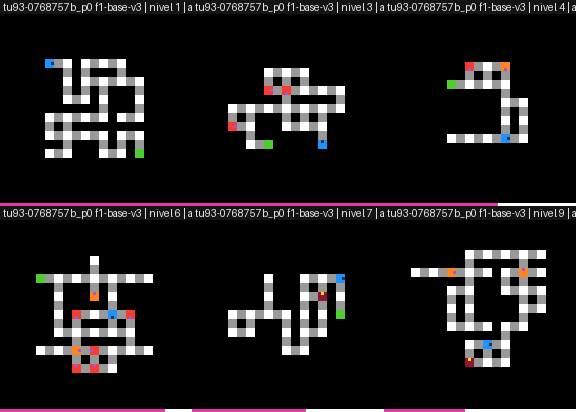
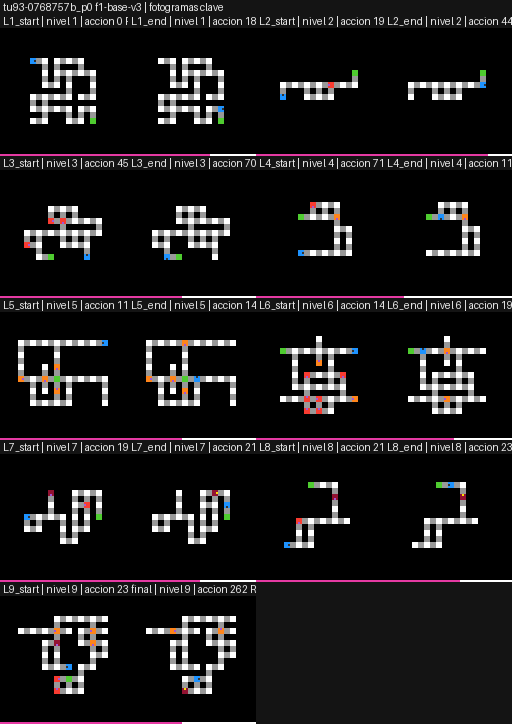
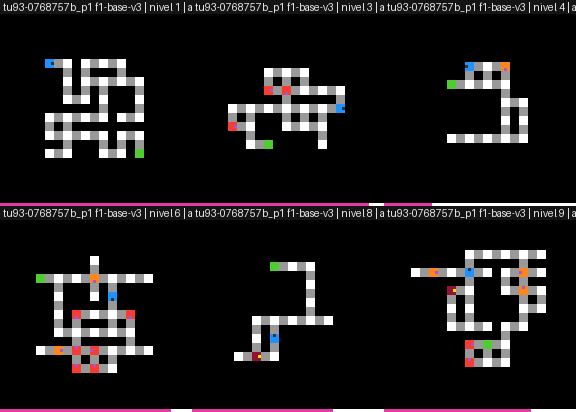
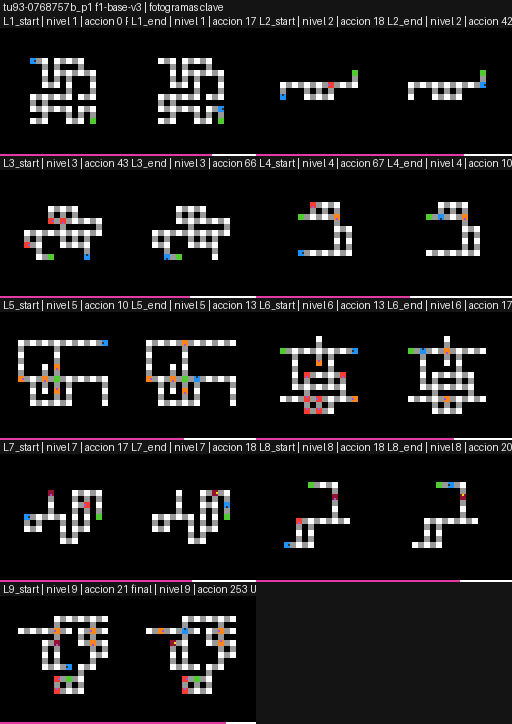
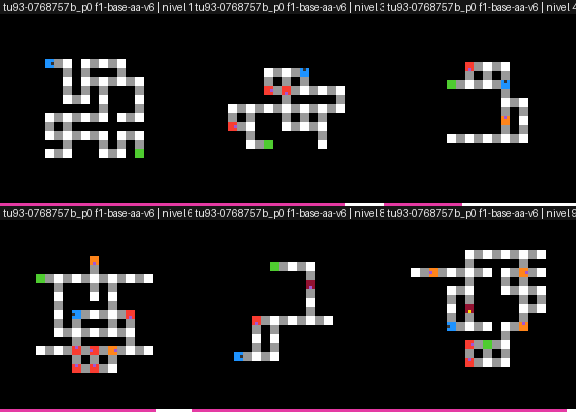
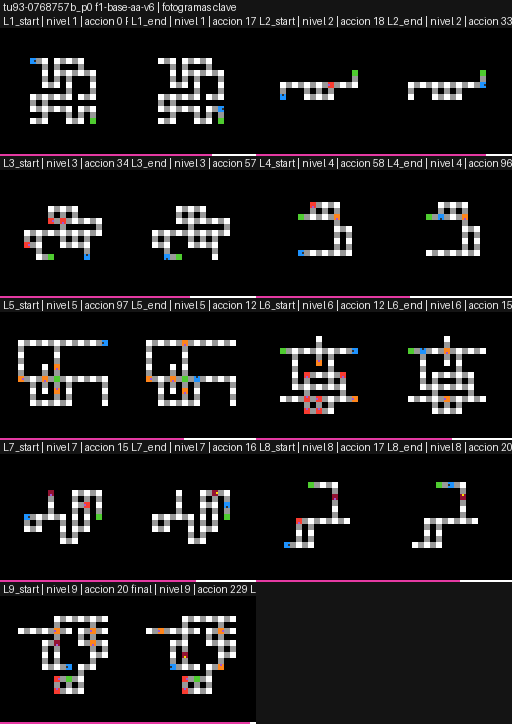
tu93 · 9 niveles · Base (F1): 100,00 / 80,00 · A/A (base repetida): 74,61 / 95,72 · E1: 80,00 / 53,08 · E2: 33,33 / 80,00
Pasada 0: completó los 9 niveles en 262 acciones (un humano usa 462). Pasada 1: 8 de 9 niveles, con 18, 25, 24, 36, 34, 36, 16 y 21 acciones (un humano usa 19, 16, 34, 42, 123, 80, 14 y 23); se quedó en el nivel 9 con 253 acciones en total. Puntuación (cap 1,15): 100,00 y 80,00.
…me redo with 2-step moves.
Also note: the reachable set with the 2-step model should be much bigger. Let's compute and find the path.
Also, the step budget: bar shrinks by 1 per action? Let's check M count now (step 5): earlier after step 1 it was 63. Let's check now — it should be 60ish. Actually the diff image at bottom-right showed a white cell at (63,63) growing. Let me count M now.
Let me BFS with 2-step moves.
…actions may still have executed). Safer: chunk into 8 + 8. Let's do 8 first.
Actually, the loop calls action() which updates globals; each action likely takes <1s. 16 should be OK but let me be safe with 9 per call.
Also note: the goal detection — when the player lands on the N block, the block becomes 'b' and the level probably completes. ppos won't equal (10,14) unless it lands there; check level_completed anyway.
…t at step 17 an orange at (2,12) (its old position) gets captured, exactly as observed in reality at step 236 ✓ (the same event).
Good. The plan is consistent with everything observed. Let me now execute it with per-step verification. I'll abort on any mismatch (player, chaser (accounting for hidden-under-orange), or orange set).
I'll execute all 29 steps in one snippet with verification, stopping on mismatch or win.
Base (F1)
A/A (base repetida)
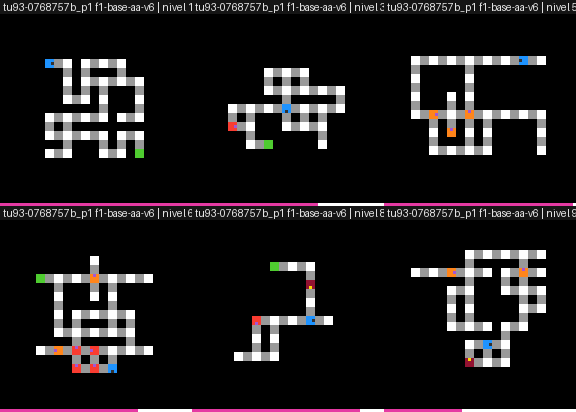
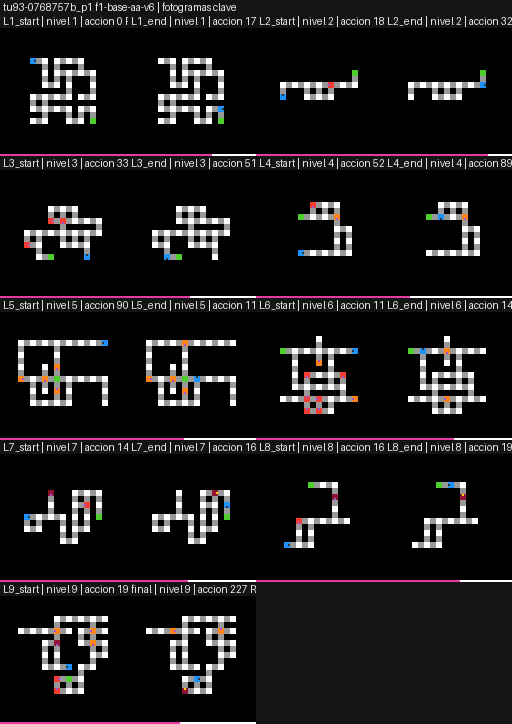
E1
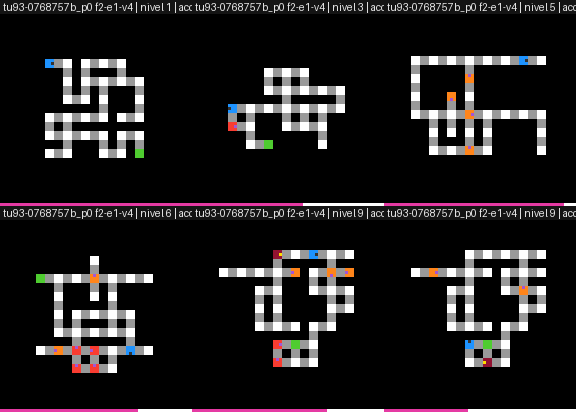
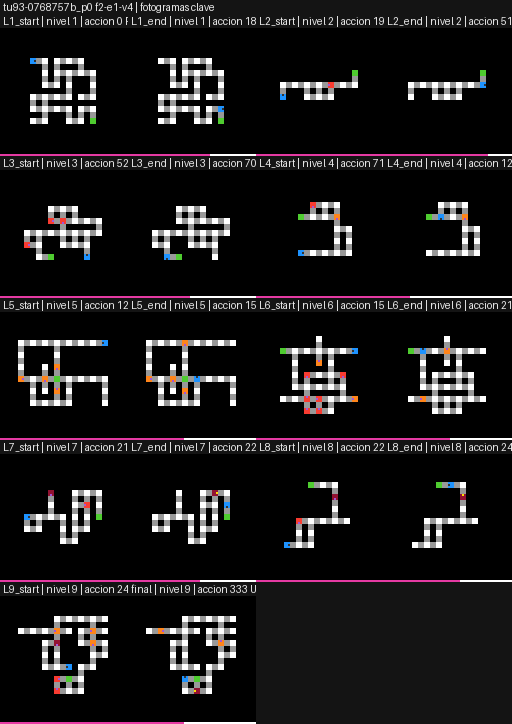
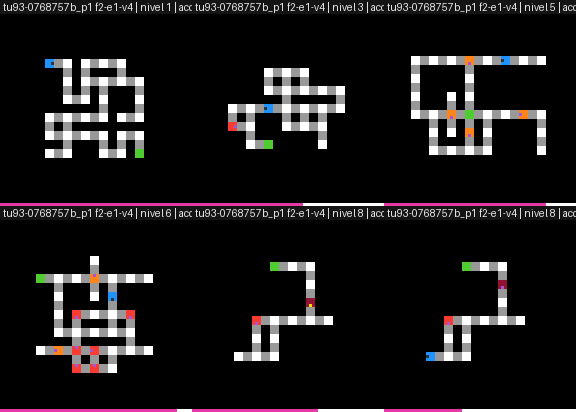
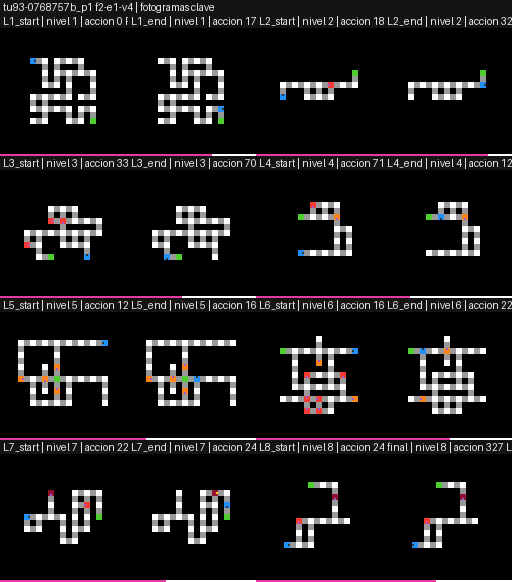
E2
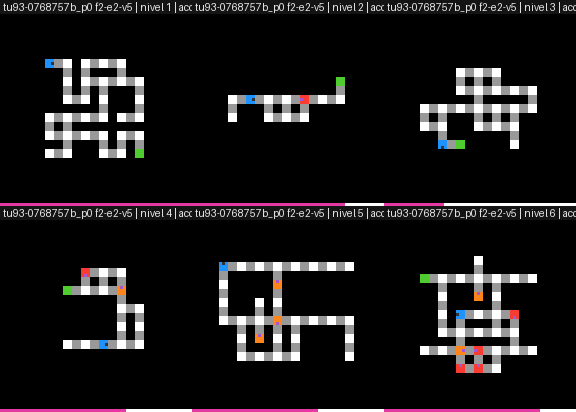
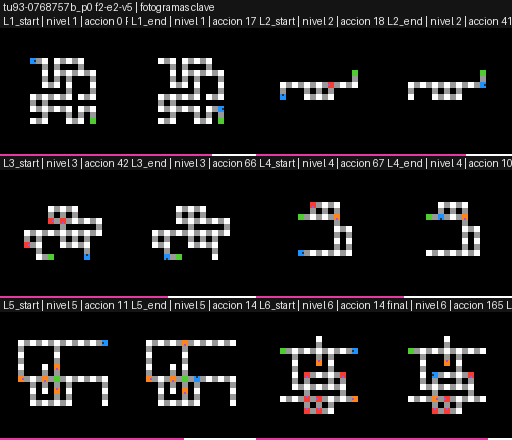
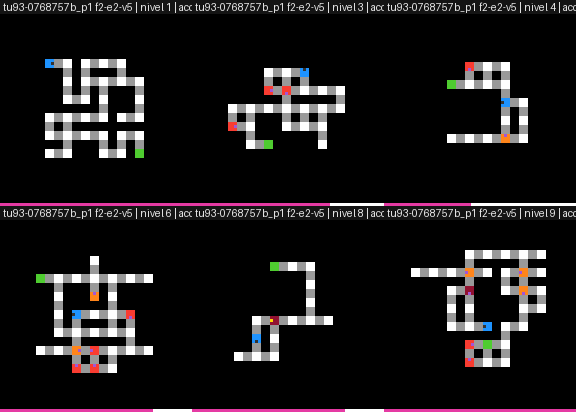
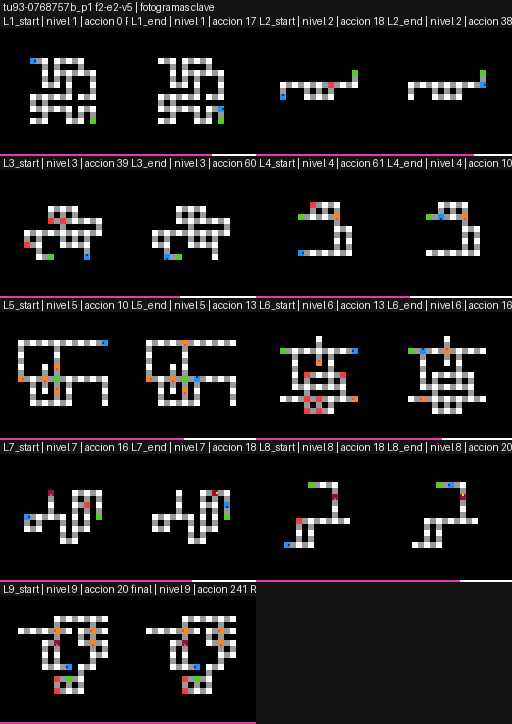
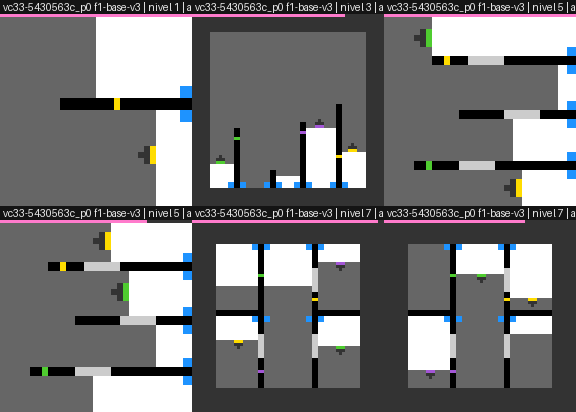
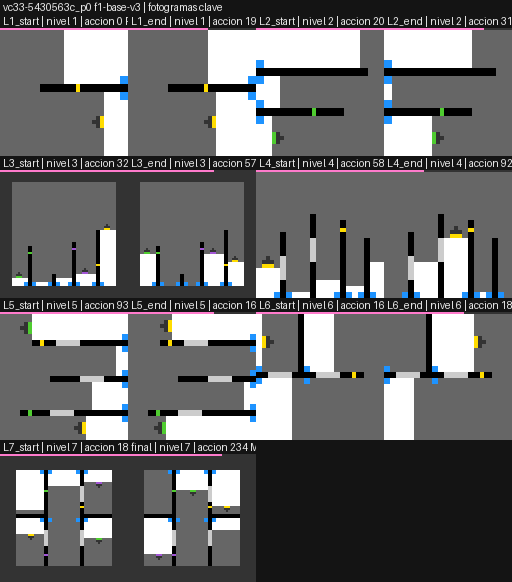
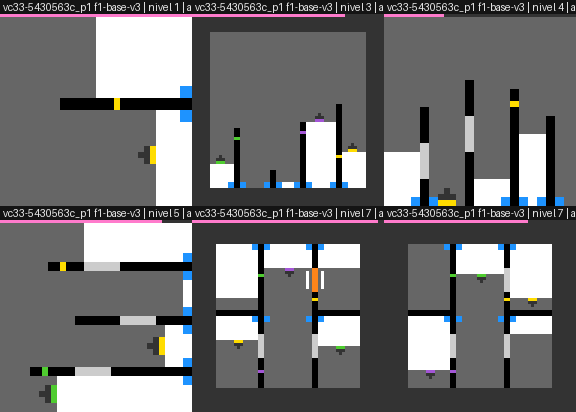
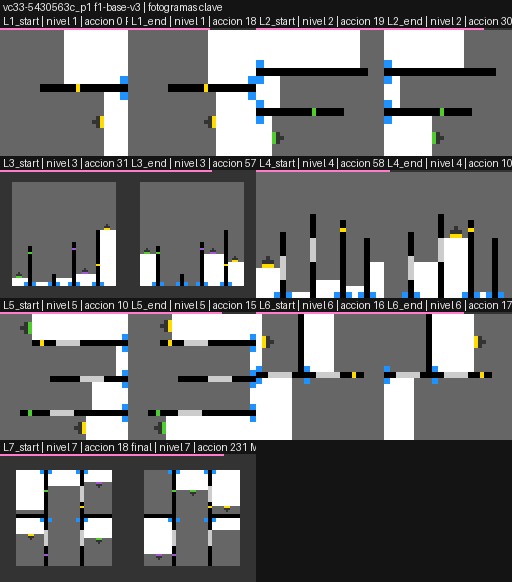
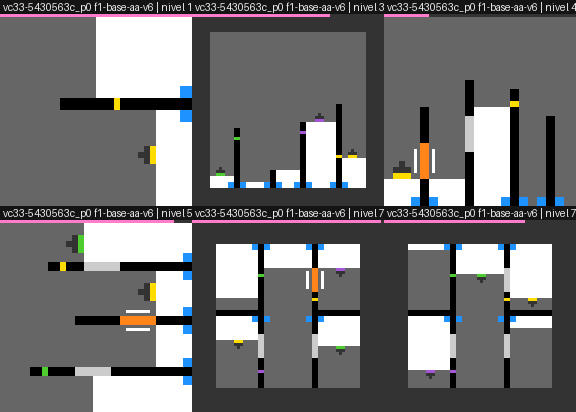
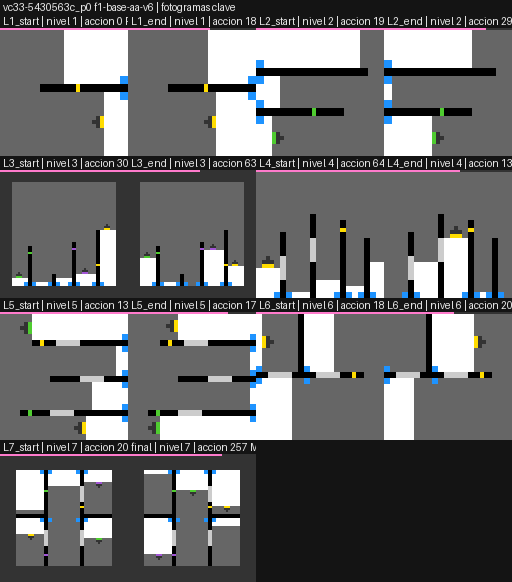
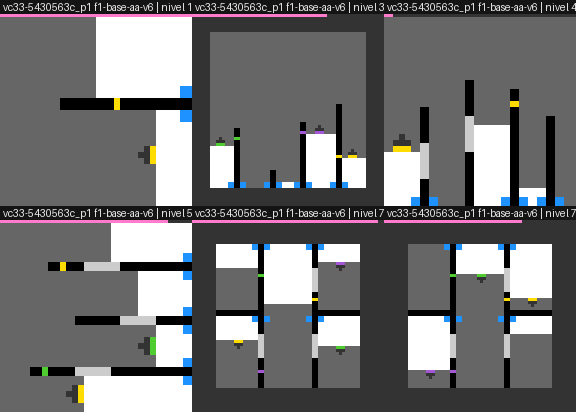
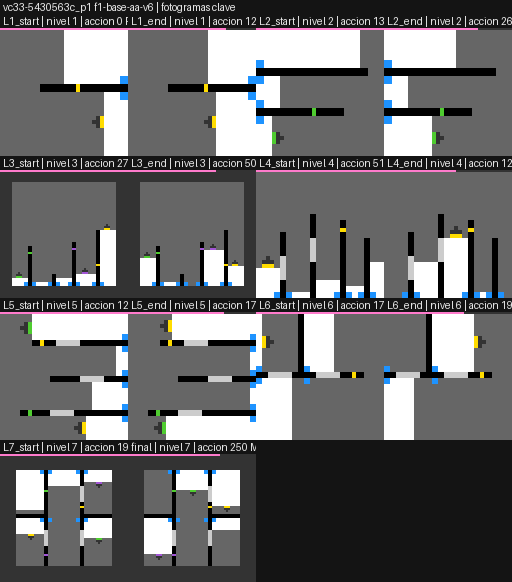
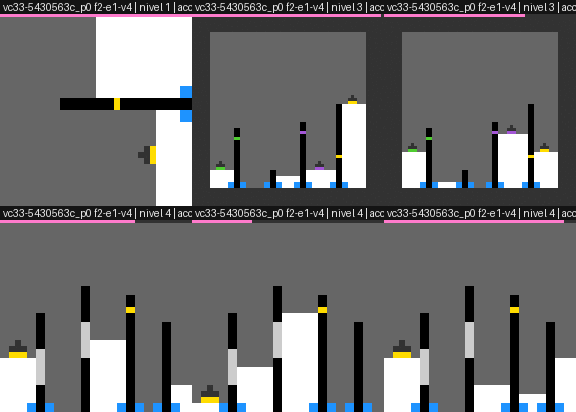
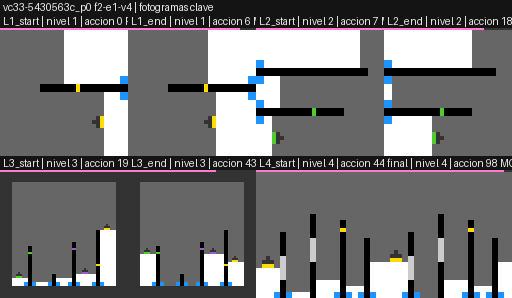
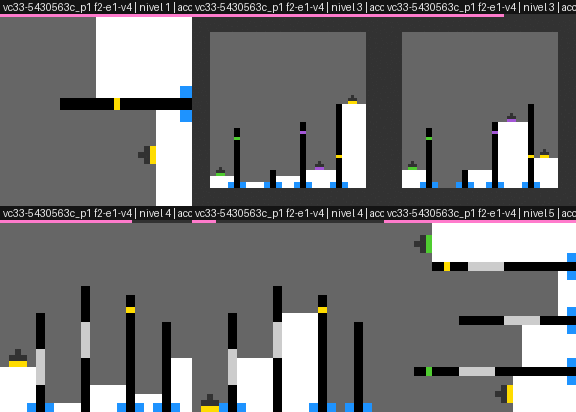
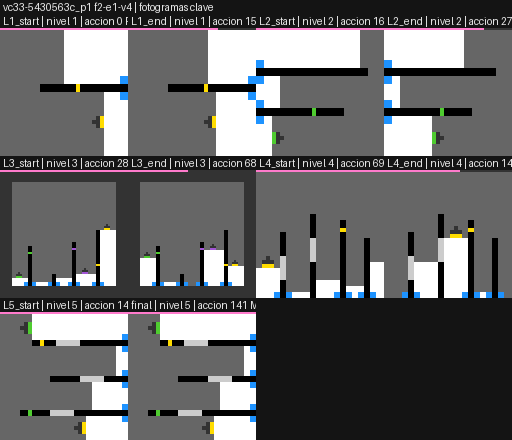
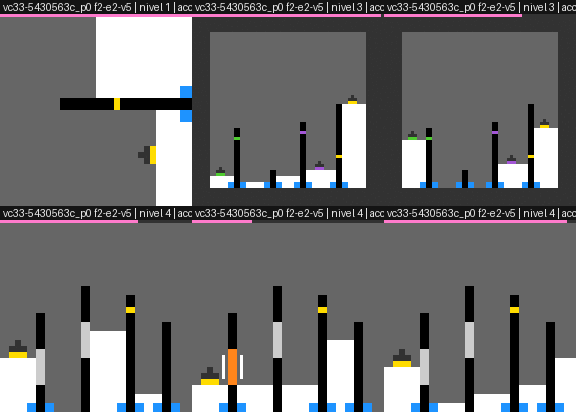
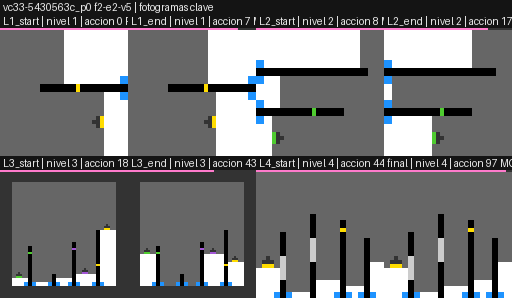
vc33 · 7 niveles · Base (F1): 100,00 / 100,00 · A/A (base repetida): 100,00 / 100,00 · E1: 21,43 / 31,47 · E2: 21,43 / 99,91
Pasada 0: completó los 7 niveles en 234 acciones (un humano usa 447). Pasada 1: completó los 7 niveles en 231 acciones (un humano usa 447). Puntuación (cap 1,15): 100,00 y 100,00.
…29,50) black bar right segment
3. (29,38) yellow gap — already no-op
4. (10,50) white top
5. (10,10) gray top
6. (50,30) gray bottom
7. (50,60) white bottom
8. (46,47) charcoal object — already no-op
9. (26,62) blue top (near edge) — same as button probably
10. (0,32)? pink bar — HUD
Let me test 1,2,4,5,6,7 = 6 clicks. Also test clicking the yellow object at (44,54)... did (46,50) earlier = no-op.
Let me run and see.
….
Honestly, let's just experiment. The most valuable experiment: click the upper blue a few times and watch. Let me do 3 clicks with diffs, and stop if level completes or game over.
Also I should consider: maybe the goal is simply to move the piston to the far right (or to fill the region). Let's watch for a win.
Let me be careful about the timer: currently pink = 52ish. Each action costs 1-2 pink. Let's do 3 clicks.
Base (F1)
A/A (base repetida)
E1
E2
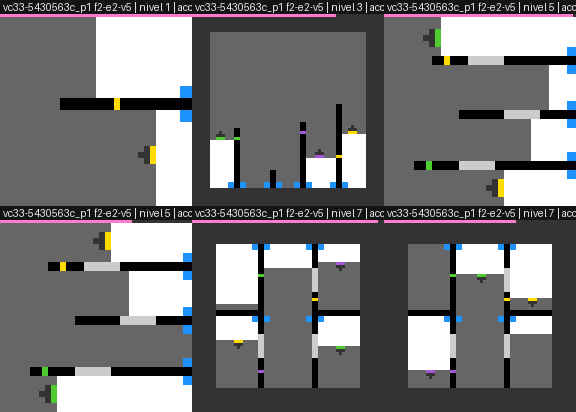
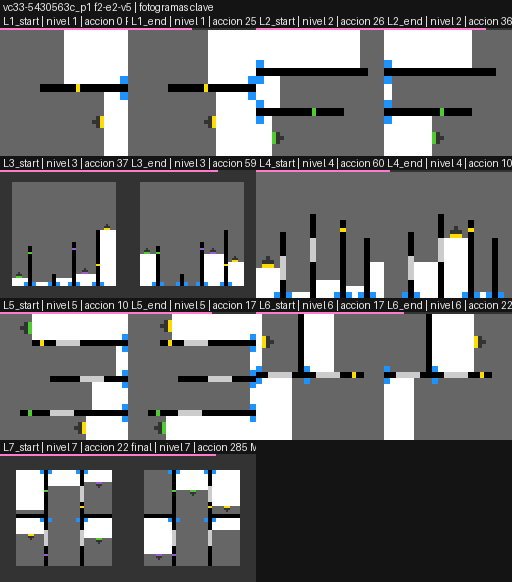
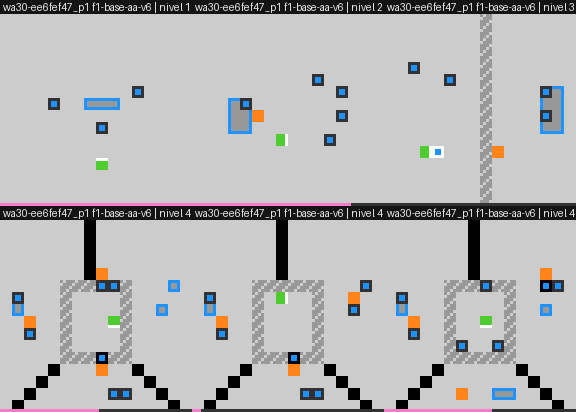
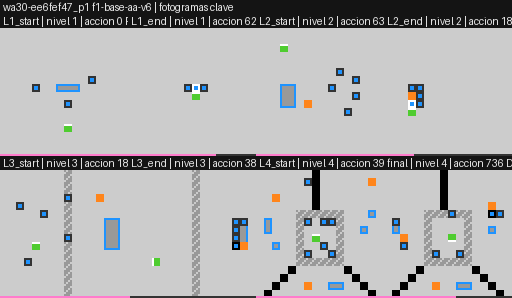
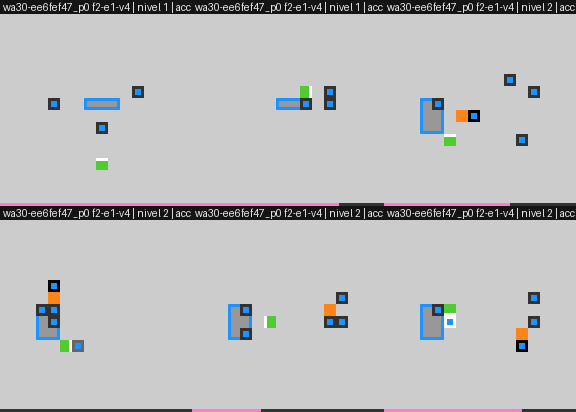
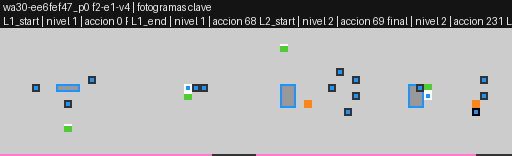
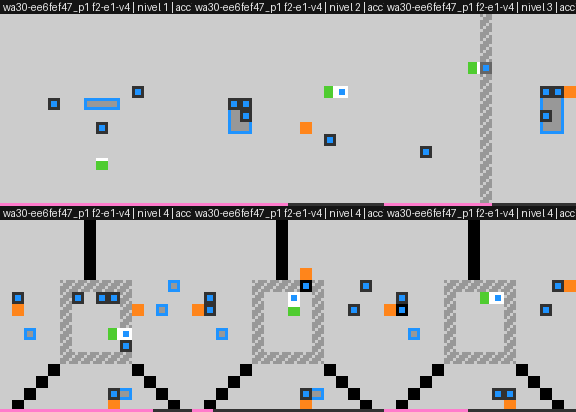
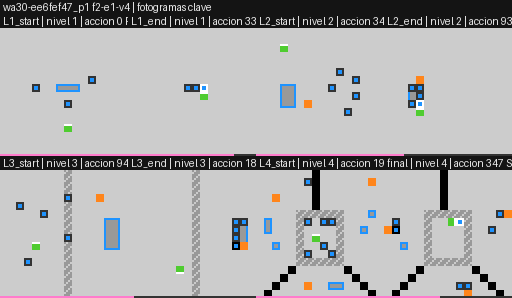
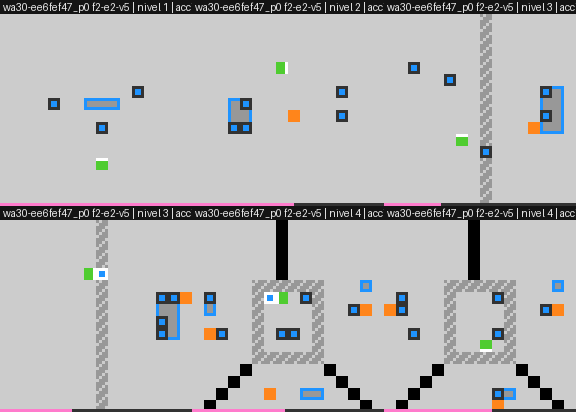
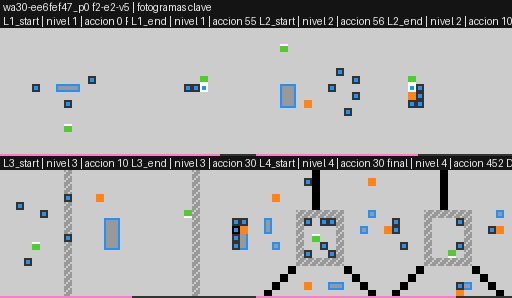
wa30 · 9 niveles · Base (F1): 2,22 / 12,77 · A/A (base repetida): 22,22 / 12,05 · E1: 2,22 / 13,33 · E2: 13,30 / 22,22
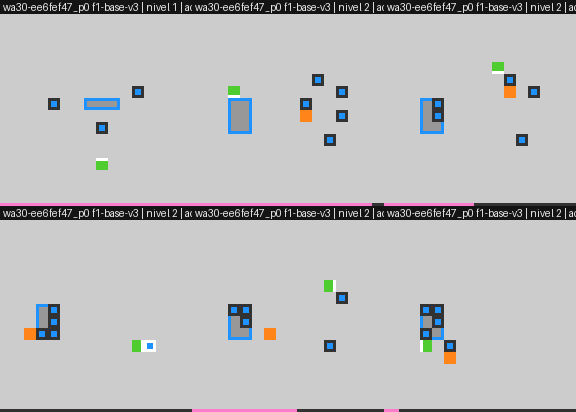
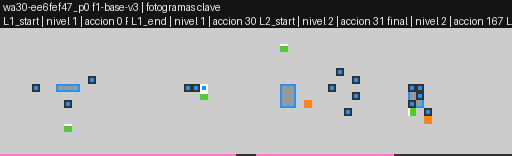
Pasada 0: 1 de 9 niveles, con 31 acciones (un humano usa 71); se quedó en el nivel 2 con 167 acciones en total. Pasada 1: 3 de 9 niveles, con 61, 124 y 191 acciones (un humano usa 71, 119 y 183); se quedó en el nivel 4 con 530 acciones en total. Puntuación (cap 1,15): 2,22 y 12,77. Las pasadas difieren mucho: en este juego el ruido de la base es grande.
…24-27. The player at rows 28-31. Then DOWN → player rows 32-35, box rows 28-31 cols 44-47. Then LEFT x2 → cols 40-43, 36-39 → box at rows 28-31 cols 36-39 = right slot. Then SPACE drops.
Careful: when moving LEFT with the box at rows 28-31 from cols 44-47 to 36-39, path passes cols 40-43 (free). Good.
Total: RIGHT x4, UP, SPACE, DOWN, LEFT x2, SPACE = 10 actions. Steps remaining ~59-? fine.
Let me batch and inspect.
…, better: press a no-op to avoid moving the player into a position that blocks things: e.g., UP is blocked? The player at rows 40-43 cols 12-15: UP → rows 36-39 cols 12-15 = BL (filled) → blocked → rotates in place (a near no-op). That keeps the player still. Let me use UP as a "wait" and watch the bot.
Hmm, but a blocked move might still cost budget. Fine.
Let me press UP and observe the bot's behavior over 2 turns.
…keeping the same side]
if both free & in-bounds: move (facing unchanged, ring at new position). else: no-op (return None).
Hmm, but what about a blocked move while holding — does the ring stay and the player not move (a full no-op)? I'll model it as a no-op (return None) and verify in reality if needed.
Let me now BFS to the goal with the corrected model, from the current state. Then execute with verification.
…ar 33, drain continues (~0.6/turn) → after 10 turns ~27. Then D4b = 4 → ~24. Then bots do the rest (need ~30 bot moves but in parallel with each other; after player finishes, turns are bot-only: drain 1-2/turn… ~15-20 turns → bar ~24 → survivable if parallelism is good).
Batch D4a (10 actions) — timeout risk: 10 actions ≈ 15-20 sec ✓ OK (12 timed out once; keep it to 9 or fewer). Split: first 5: UP,UP,UP,RIGHT,RIGHT.
Base (F1)
A/A (base repetida)
E1
E2
Lo que no afirmo
Ninguna pieza de ECHO ha mejorado todavía la base. Las puntuaciones offline son de 25 juegos públicos, no de la clasificación privada. La base y el modelo no son míos: son de Tufa Labs, Daniel Franzen y Qwen; lo mío es la medición y las piezas que se prueban encima.
Fuentes y evidencia
- Repetición de la base, base agrupada y relectura de E1 y E2
- Base F1: corrida, puntuación y envío
- E1: comparación pareada y uso de la pieza
- E2: comparación pareada y diagnóstico
- E1b: ensayo en seco con partidas grabadas
- Dónde pierde puntos la base
- Explorador CPU tras el LLM (offline)
- Datos de todas las partidas publicadas